Choosing among USB oscilloscopes is easier when you match the scope to your actual bench work. Some models are best for quick hobby diagnostics, while others offer stronger bandwidth, more channels, or extra tools like signal generation and logic analysis.
This roundup focuses on practical performance, software support, portability, and value so you can narrow the field fast and buy with confidence.
Best 10 USB Oscilloscopes Picks for 2026
Compact Lab-Ready USB Scope
PicoScope 2204A 2 Channel 10 MHz

- 2-channel USB-powered oscilloscope
- PicoScope 7 with cross-platform support
- Spectrum, waveform, and protocol tools
Best For: Portable bench users who want strong software features
Handheld 3-in-1 Tester
FNIRSI 2C53T Oscilloscope Multimeter

- Scope, multimeter, and DDS generator in one
- 50 MHz bandwidth with 250 MSa/s sampling
- Battery-powered handheld design with Type-C charging
Best For: Technicians and hobbyists needing an all-in-one handheld tester
PC-Based Starter Scope

- 2-channel USB-powered oscilloscope
- 20 MHz bandwidth with 48 MSa/s sampling
- FFT, math, X-Y, and 20 measurements
Best For: Budget buyers seeking a simple PC-based scope
Portable Signal Tool

- Handheld 10 MHz oscilloscope with battery
- DDS generator with 13 waveform types
- Waveform saving, exporting, and one-key AUTO
Best For: Portable troubleshooting and basic signal generation
Touchscreen Portable Pick
FNIRSI 1013D Plus 100MHz Oscilloscope

- 7-inch touchscreen with gesture controls
- Dual-channel 100MHz bandwidth and 1GSa/s sampling
- Stores screenshots and waveform data onboard
Best For: portable signal checking with a large touch display
All-in-One USB Lab Pick
EspoTek Labrador USB Oscilloscope

- Oscilloscope, generator, power supply, analyzer, and multimeter
- Works with Windows, Mac, Linux, Android, and Raspberry Pi
- Ultra-compact open-source design at 20 g
Best For: makers who want a tiny multi-function USB test tool
Fieldwork Portable Pick
HANMATEK HO11 Handheld Oscilloscope

- 10MHz bandwidth with 48MSa/s sampling
- USB rechargeable 1800mAh battery and 166g body
- 2.8-inch TFT display with auto/normal/single triggers
Best For: portable field troubleshooting and quick voltage checks
Premium Multi-Instrument Lab Bench
Analog Discovery 3 USB Oscilloscope

- 125 MS/s, 14-bit dual-channel scope
- Built-in AWG, logic analyzer, and power supplies
- Supports LabVIEW, MATLAB, and scripting
Best For: Engineers and advanced hobbyists needing an all-in-one USB test instrument
Portable High-Bandwidth PC Scope

- 100 MHz bandwidth with 1 GSa/s sampling
- USB Type-C can run from a 5V/2A power bank
- Supports SCPI, LabVIEW, and multiple platforms
Best For: Portable PC-based troubleshooting and training
Compact Budget Multi-Channel Scope
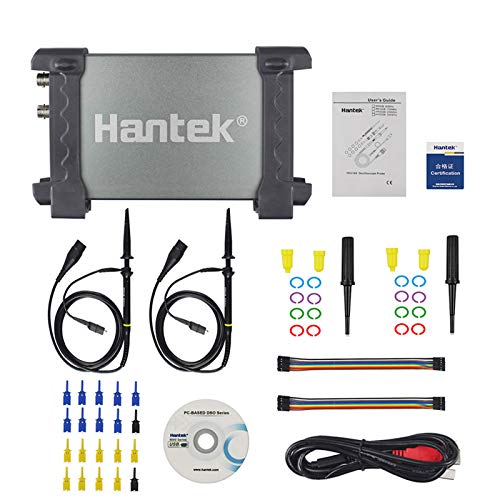
- 2-channel scope with 20 MHz bandwidth
- Adds 16-channel logic analyzer support
- Powered directly from USB2.0 for portability
Best For: Budget users needing a small PC scope for basic diagnostics
Compact Lab-Ready USB Scope – PicoScope 2204A 2 Channel 10 MHz
If you’re comparing usb oscilloscopes for a small bench or travel kit, the PicoScope 2204A stands out for software depth and portability. It connects and powers over USB, yet still gives you two channels, 10 MHz bandwidth, and analysis tools that go beyond basic waveform viewing.
Best For: Users who want a compact PC-based scope with strong software features and long-term support.
Pros:
- USB-connected and USB-powered, with a travel-friendly compact design
- Includes two probes and works with Windows, Linux, and Mac via PicoScope 7
- Offers spectrum analysis, function generation, arbitrary waveform generation, and serial decoding
- Supports advanced tools like mask testing, math, filtering, and digital triggering
Cons:
- 10 MHz bandwidth is more limited than higher-end bench scopes
- 8 kS capture memory is relatively small for deeper captures
- Not compatible with PicoScope 7 Automotive Software
Overall, this is a strong pick if you value polished software, compact size, and broad analysis capability over raw bandwidth. It is especially appealing for debugging small-scale designs where portability matters.
Handheld 3-in-1 Tester – FNIRSI 2C53T Oscilloscope Multimeter
For buyers shopping usb oscilloscopes with extra handheld utility, the FNIRSI 2C53T bundles a 2-channel scope, multimeter, and DDS signal generator in one battery-powered unit. It is aimed at quick field checks and electronic repair, with a color LCD, Type-C charging, and a compact form factor.
Best For: Technicians, hobbyists, and repair work that benefits from an all-in-one handheld tester.
Pros:
- Combines oscilloscope, 19999-count multimeter, and signal generator
- 2-channel scope with 50 MHz bandwidth and 250 MSa/s sampling
- Includes math operations, cursor measurement, persistence mode, and XY mode
- Built-in 3000 mAh battery with Type-C charging and portable design
Cons:
- 1 Kpts record depth is modest for more demanding capture work
- Small 2.8-inch screen may feel cramped for detailed analysis
- Signal generator tops out at 50 kHz output frequency
This model makes sense when versatility matters more than bench-style scope depth. It is best viewed as a practical handheld tool for measurement, basic waveform generation, and quick troubleshooting.
PC-Based Starter Scope – Hantek 6022BE 20 MHz USB
If you want a straightforward option among usb oscilloscopes, the Hantek 6022BE focuses on essential PC-based capture and analysis. It runs from a single USB connection, includes two probes, and adds the core measurement tools most people need for everyday electronics work.
Best For: Budget-minded users who want a simple two-channel USB scope for bench or field use.
Pros:
- Two analog channels with 20 MHz bandwidth and 48 MSa/s sampling
- USB powers the unit, so no external supply is required
- Includes 20 automatic measurements, FFT, math, X-Y display, and cursors
- Comes with probes, USB cable, software media, and documentation
Cons:
- Lower sample rate and bandwidth than higher-end USB scopes
- Requires a computer for operation, so it is not a standalone handheld unit
- Best suited to basic to moderate analysis rather than heavy-duty work
As a starter PC-based oscilloscope, it covers the fundamentals without adding much complexity. That makes it a sensible choice for users who want an affordable entry into computer-driven signal measurement.
Portable Signal Tool – FNIRSI DSO-510 10MHz Handheld
For shoppers looking at usb oscilloscopes in a compact handheld format, the FNIRSI DSO-510 keeps the feature set focused on quick signal checks. It offers 10 MHz bandwidth, 48 MS/s sampling, a DDS signal generator, and a battery-powered design that is easy to carry.
Best For: Portable troubleshooting and basic signal generation in a small handheld package.
Pros:
- 10 MHz bandwidth with 48 MS/s sampling rate
- Includes a DDS signal generator with 13 waveform types
- Supports waveform scaling, movement, saving, and exporting
- One-key AUTO mode helps simplify setup for periodic and non-periodic signals
Cons:
- 10 MHz bandwidth is best for lighter-duty measurement tasks
- Built-in 1000 mAh battery is smaller than some other portable options
- 2.8-inch display limits on-screen workspace
It is a practical choice if you want a compact tool for quick diagnostics rather than a full bench replacement. The combination of simple controls and signal output makes it useful for field checks and basic testing.
Touchscreen Portable Pick – FNIRSI 1013D Plus 100MHz Oscilloscope
If you’re comparing usb oscilloscopes for a portable bench-style setup, the FNIRSI 1013D Plus leans into a large touchscreen, dual-channel capture, and a simple interface. With 100MHz bandwidth per channel, 1GSa/s sampling, and built-in waveform storage, it suits users who want a feature-rich handheld scope for everyday signal checks.
Best For: Users who want a touch-driven portable oscilloscope with strong display and storage features.
Pros:
- 7-inch 800 × 480 touchscreen with capacitive touch and gesture control
- Dual-channel 100MHz bandwidth with 1GSa/s sampling and multiple trigger modes
- 1GB storage for up to 1000 screenshots and 1000 waveform data sets
- Includes FFT viewing, Lissajous display, and cursor-based measurement tools
Cons:
- Battery life is listed at about 4 hours, so long sessions may need planning
- At 2.31 pounds, it is portable but not ultra-light
- More of a handheld touchscreen scope than a compact USB-only analyzer
Overall, the FNIRSI 1013D Plus is a strong pick if display quality, on-device analysis, and portability matter more than minimal size. It has the kind of feature set that makes routine troubleshooting easier without needing a separate computer.
All-in-One USB Lab Pick – EspoTek Labrador USB Oscilloscope
For buyers looking at usb oscilloscopes as a compact lab tool, the EspoTek Labrador stands out because it combines multiple instruments in one open-source device. It works as a 2-channel oscilloscope, signal generator, power supply, logic analyzer, and multimeter, making it useful when you want one small unit for several basic test tasks.
Best For: Makers and tinkerers who want a tiny open-source multi-tool for PC or Raspberry Pi use.
Pros:
- Combines oscilloscope, waveform generator, power supply, logic analyzer, and multimeter functions
- Supports Windows, Mac, Linux, Android, and Raspberry Pi
- Very compact at 20 g and built around an open-source design
- Includes serial decoding in the logic analyzer mode
Cons:
- Oscilloscope sampling is limited to 750 ksps
- Power supply output is modest at 0.75W max
- Only 2 channels for scope and analyzer functions
The EspoTek Labrador is best when flexibility matters more than raw scope performance. If you want a lightweight USB-connected tool that can replace several basic bench devices, it offers a practical all-in-one approach.
Fieldwork Portable Pick – HANMATEK HO11 Handheld Oscilloscope
If you want usb oscilloscopes for field troubleshooting, the HANMATEK HO11 focuses on portability, clear viewing, and practical voltage coverage. It offers a 10MHz bandwidth, 48MSa/s sampling, and a rechargeable USB Type-C battery setup in a lightweight handheld body.
Best For: Field technicians and beginners who want a compact rechargeable handheld scope.
Pros:
- 10MHz bandwidth with 48MSa/s sampling for everyday diagnostic work
- Supports voltage measurement up to ±400V with X1 and X10 probe options
- Lightweight 166g design with USB rechargeable 1800mAh battery
- 2.8-inch full-color TFT display with simple menu navigation
Cons:
- 10MHz bandwidth is much lower than higher-end lab scopes
- Smaller 2.8-inch screen may feel tight for detailed analysis
- Best suited to basic and mid-level troubleshooting rather than advanced capture
The HO11 is a sensible choice if you value convenience and portability over top-end bandwidth. Its rechargeable handheld format and straightforward trigger modes make it a practical everyday tool for quick checks away from the bench.
Premium Multi-Instrument Lab Bench – Analog Discovery 3 USB Oscilloscope
If you want one of the most capable USB oscilloscopes for mixed-signal work, the Analog Discovery 3 stands out as a compact bench replacement. It combines a 125 MS/s, 14-bit oscilloscope with waveform generation, logic analysis, and variable power outputs, making it a strong fit for users who need more than basic capture.
Best For: Engineers, educators, and advanced hobbyists who want a compact all-in-one USB test instrument.
Pros:
- Two differential oscilloscope channels with 14-bit resolution and up to 125 MS/s per channel
- Includes two-channel arbitrary waveform generation, 16-channel logic analysis, and pattern generation
- Offers programmable variable power supplies plus extra software tools like spectrum, network, and impedance analysis
- Supports LabVIEW, MATLAB, and scripting in C, C++, Python, and other languages
Cons:
- Uses an auxiliary power source to reach the stated 800 mA per channel on the supplies
- Some analog performance figures depend on the BNC adapter setup
- Likely more instrument than a simple scope-only buyer needs
This is the most feature-rich option in the group, and its strength is flexibility across analog, digital, and power tasks. If you want a USB oscilloscope that can cover a full project workflow, it is the most complete package here.
Portable High-Bandwidth PC Scope – OWON VDS6102 USB Oscilloscope
The OWON VDS6102 is a practical pick if you want a portable USB oscilloscope with strong bandwidth and easy PC connectivity. With 100 MHz bandwidth, 1 GSa/s real-time sampling, and Type-C power/data support, it is built for users who need a lightweight scope that can move between workspaces.
Best For: Portable PC-based troubleshooting, training, and secondary analysis workflows.
Pros:
- Up to 100 MHz bandwidth and 1 GSa/s real-time sample rate
- Type-C connection can be powered by a 5V/2A power bank for portable use
- Supports SCPI, LabVIEW, and secondary development on Windows, Linux, Android, and iOS
- Includes multiple trigger modes such as edge, video, slope, and pulse
Cons:
- 8-bit ADC resolution is lower than higher-end mixed-signal instruments
- Best suited to PC-based use rather than standalone operation
- Feature set is scope-focused compared with multifunction alternatives
This model is a solid middle-ground choice for buyers who prioritize bandwidth, portability, and software integration. It makes the most sense when you want a USB oscilloscope that can travel easily and still fit into a computer-based test workflow.
Compact Budget Multi-Channel Scope – 6022BL USB Oscilloscope
The 6022BL is a compact USB oscilloscope aimed at users who want a simple portable PC scope with extra channel capacity for logic work. It pairs 2-channel oscilloscope functionality with 16 channels of logic analyzer input, making it useful for basic electronics checks and field maintenance.
Best For: Budget-conscious users who need a small PC oscilloscope for basic diagnostics and portable work.
Pros:
- 2-channel, 20 MHz USB oscilloscope with 48 MSa/s sampling
- Includes 16-channel logic analyzer functionality
- No extra power supply needed; it runs from the USB2.0 port
- Compact aluminum case designed for portability and heat resistance
Cons:
- Lower bandwidth and sampling than the higher-end USB oscilloscopes in this roundup
- Windows-only support is listed in the notes
- Primary feature set is more basic than multifunction alternatives
For straightforward measurement tasks, this model offers a practical mix of portability and channel count. It is best viewed as a lightweight, entry-level USB oscilloscope rather than a high-performance lab instrument.
How We Picked These USB Oscilloscopes
We prioritized models that make sense for real-world electronics testing: enough bandwidth for common repair and prototyping tasks, usable sampling rates, reliable PC or standalone operation, and feature sets that add value instead of complexity. We also looked for practical extras such as multimeter functions, signal generators, and logic analyzer support where they meaningfully expand the tool.
Quick Comparison: Which Type Fits Your Work?
Not all USB Oscilloscopes are built for the same job. Entry-level PC-based units are a good fit for simple waveform checks, low-frequency debugging, and education. Portable handheld models are better when you need to move around the bench or field. Higher-performance USB scopes with wider bandwidth and faster sampling are more suitable for embedded work, mixed-signal debugging, and more demanding signal analysis.
Key Buying Factors for USB Oscilloscopes
Bandwidth and Sampling Rate
Bandwidth determines how fast a signal the scope can measure accurately, while sampling rate affects how much detail you see. For general hobby and repair work, 10 MHz to 20 MHz may be enough. For faster digital signals, motor control, or more advanced troubleshooting, look higher. As a rule, sampling should be comfortably above the signal frequency you want to inspect.
Channels and Expandability
Two channels cover most basic tasks, like comparing input and output signals. If you work with serial buses, timing relationships, or multi-signal systems, more channels or logic analyzer support can be a major advantage.
Software and Connectivity
Since USB Oscilloscopes depend on a host device or companion software, the app experience matters. Look for stable drivers, clear controls, export tools, and compatibility with your operating system. Type-C connectivity, SCPI support, and cross-platform software can make daily use smoother.
Portability and Power
Some buyers want a compact bench tool; others need a rechargeable handheld unit for field service or mobile diagnostics. Decide whether you prefer PC-tethered convenience, standalone portability, or a hybrid design.
Who Should Buy Which USB Oscilloscopes?
Beginners and students usually do best with simple, affordable USB Oscilloscopes that are easy to set up and learn. Makers and hobbyists may want a model with extra functions like waveform generation or multimeter features. Repair technicians and advanced users should lean toward higher bandwidth, better sampling, and stronger software control. If you need more than one measurement mode in a single device, multifunction models can save desk space and money.
The best choice is the one that matches your signal range, workflow, and software needs, not just the highest specs on paper.