If you need to measure multiple signals at once, four-channel oscilloscopes are the sweet spot for electronics work, embedded debugging, and service tasks. They let you compare timing, track power rails, and capture complex interactions without constantly swapping probes.
Below, we focus on the best options for 2026 across value, bandwidth, display quality, portability, and resolution so you can match the scope to your workflow.
Best 10 Four Channel Oscilloscopes Picks for 2026
Lab-Friendly Four-Channel Scope
Siglent SDS1104X-E 100MHz 4-Ch Decoder
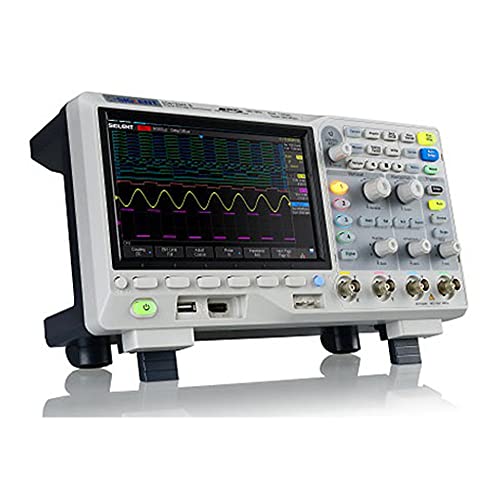
- 4 analog channels with 100 MHz bandwidth
- Built-in decode for Iic, Spi, Uart/Rs232, Can, and Lin
- Includes 4 passive probes and calibration certificate
Best For: Bench users who want a 4-channel scope with standard decoder support
Value Pick Four-Channel Scope
Rigol DS1054Z 50MHz 4-Ch 1GSa/s

- 4 analog channels with up to 1 GSa/s sampling
- Up to 24 Mpts memory depth for long captures
- Serial decode for RS232/UART, I2C, and SPI
Best For: Buyers who want a capable 4-channel oscilloscope with deep memory and strong value positioning
Higher-Bandwidth Four-Channel Scope
Siglent SDS1204X-E 200MHz 4-Ch

- 200 MHz bandwidth with 4 channels and 1 GSa/s sampling
- Large 7-inch display with 800 x 480 resolution
- Intelligent trigger set and 14 Mpts memory use
Best For: Engineers and hobbyists who want a 4-channel oscilloscope with higher bandwidth and advanced triggering
Portable Four-Channel Scope

- 4 channels with 70 MHz bandwidth and 12-bit resolution
- Up to 1,000,000 wfms/s with waveform search/navigation
- LAN, SCPI, USB, HDMI, and browser Web Control support
Best For: Users who want a portable 4-channel oscilloscope with 12-bit resolution and modern interface options
High-Resolution Mixed-Signal Pick
Siglent SDS814X HD 4CH 100MHz 12-Bit

- 12-bit resolution with 100 MHz bandwidth
- 2 GSa/s sampling and 50 Mpts memory
- Optional mixed-signal expansion to 16 digital channels
Best For: Detailed bench diagnostics and future mixed-signal expansion
Portable Workflow-Focused Pick
RIGOL DHO814 4CH 100MHz 12-Bit Portable

- Portable 4-channel scope with 100 MHz bandwidth
- Up to 1,000,000 wfms/s in UltraAcquire mode
- SCPI, LXI-C, HDMI, and serial decode support
Best For: Portable troubleshooting and fast workflow on the bench
Balanced Everyday Pick
UNI-T UPO1104 4CH 100MHz 2GSa/s

- 100 MHz bandwidth with 4 channels and 2 GSa/s
- 56 Mpts storage with decoding and navigation tools
- Includes probes, power cord, USB cable, and calibration report
Best For: Everyday measurement work and education
Editor’s Pick
Siglent SDS804X HD 70 MHz 12-bit 4CH Oscilloscope
- 12-bit ADCs with 70 μVrms noise floor
- 50 Mpts/ch memory depth and 2 GSa/s sample rate
- Search, Bode plot, Power Analysis, and 4 math traces
Best For: bench users who want higher resolution and advanced analysis
Portable Value
HANMATEK DOS1104 110 MHz 4CH Portable Oscilloscope

- 110 MHz bandwidth with 1 GS/s real-time sampling
- 4 channels, cursor tools, and 30 automatic measurements
- USB storage plus SCPI and LABVIEW support
Best For: portable users who want strong bandwidth and measurement tools
Deep Memory Pick
UNI-T UPO1054 50 MHz 4CH Deep-Memory Oscilloscope

- 56 Mpts memory depth for longer captures
- 500,000 wfm/s refresh rate for faster viewing
- 1 Mpts FFT plus cursor and navigation tools
Best For: deep-memory users who want fast capture and analysis
Lab-Friendly Four-Channel Scope – Siglent SDS1104X-E 100MHz 4-Ch Decoder
Siglent Technologies SDS1104X-E 100Mhz Digital Oscilloscope 4 Channels Standard Decoder, Grey
Check Price On AmazonIf you want a practical four channel oscilloscope for mixed-signal troubleshooting, the Siglent SDS1104X-E covers the basics well with 100 MHz bandwidth, 4 analog channels, and built-in serial decoding. It is a good fit when you need a bench scope with standard protocol support and a compact footprint.
Best For: Bench users who want a 4-channel scope with standard decoder support for common serial buses.
Pros:
- 4 analog channels with 100 MHz bandwidth for everyday debugging
- Standard decoder support for Iic, Spi, Uart/Rs232, Can, and Lin
- Includes 4 passive probes, USB cable, and calibration certificate
- Compact 12.2 x 5.12 x 5.91 inch form factor
Cons:
- MSO digital channels and USB AWG are option-only on the four-channel series
- Lower bandwidth than higher-spec models in this roundup
Overall, this is a straightforward four channel oscilloscope for users who value built-in decode features and a familiar bench setup. It makes the most sense for general electronics work rather than higher-bandwidth signal hunting.
Value Pick Four-Channel Scope – Rigol DS1054Z 50MHz 4-Ch 1GSa/s
The Rigol DS1054Z is a value-focused four channel oscilloscope with 50 MHz bandwidth, 4 analog channels, and up to 1 GSa/s single-channel sampling. Its deep memory and strong capture features make it a practical choice for everyday debugging, teaching labs, and embedded bring-up.
Best For: Buyers who want a capable 4-channel oscilloscope with deep memory and strong value positioning.
Pros:
- 4 analog channels with up to 1 GSa/s sample rate
- Up to 24 Mpts memory depth for long captures
- 30,000 wfms/s capture rate plus intensity graded display
- Includes serial trigger/decoding for RS232/UART, I2C, and SPI
Cons:
- 50 MHz bandwidth is modest compared with higher-bandwidth options
- Memory depth is reduced in 3/4-channel operation compared with single-channel use
As a four channel oscilloscope, this model balances features and cost well for general bench work. It stands out most when deep capture, documentation connectivity, and basic serial analysis matter more than raw bandwidth.
Higher-Bandwidth Four-Channel Scope – Siglent SDS1204X-E 200MHz 4-Ch
For users comparing four channel oscilloscopes, the Siglent SDS1204X-E brings more bandwidth to the table with 200 MHz, 4 channels, and 1 GSa/s sampling. Its large display, deep memory usage for measurements, and broad trigger set make it well suited to more demanding troubleshooting.
Best For: Engineers and hobbyists who want a 4-channel oscilloscope with higher bandwidth and advanced triggering.
Pros:
- 200 MHz bandwidth with 4 channels and 1 GSa/s sampling
- Large 7-inch TFT-LCD with 800 x 480 resolution
- Uses all 14 Mpts of memory for true measurement and math
- Intelligent trigger set includes edge, slope, pulse width, window, runt, interval, timeout, and pattern
Cons:
- Heavier than the portable option in this roundup
- Bulkier footprint than smaller bench models
This is a strong pick when a four channel oscilloscope needs extra bandwidth and a fuller trigger toolkit. It is especially appealing for users who want a larger screen and more measurement flexibility on the bench.
Portable Four-Channel Scope – RIGOL DHO804 70MHz 12-Bit 4CH
The RIGOL DHO804 is a portable four channel oscilloscope built around 70 MHz bandwidth, 12-bit vertical resolution, and 1.25 GSa/s sampling. It is especially appealing when you want a compact scope with fine vertical detail, fast waveform capture, and modern connectivity features.
Best For: Users who want a portable 4-channel oscilloscope with 12-bit resolution and modern interface options.
Pros:
- 4 analog channels with 70 MHz bandwidth and 12-bit resolution
- Up to 1,000,000 wfms/s capture rate with waveform search/navigation
- Standard serial trigger/decode for CAN, RS232/UART, I2C, SPI, and 4-bit parallel
- LAN, SCPI, USB Host/Device, HDMI, and browser Web Control support
Cons:
- Bandwidth is lower than the 200 MHz bench model in this roundup
- Best suited to compact setups rather than larger-screen bench workflows
Among four channel oscilloscopes, this one stands out for portability and high-resolution measurement detail. It is a sensible choice for switching power checks, embedded bring-up, and protocol troubleshooting where a smaller unit is easier to live with.
High-Resolution Mixed-Signal Pick – Siglent SDS814X HD 4CH 100MHz 12-Bit
If you need four channel oscilloscopes for detailed bench work, the Siglent SDS814X HD stands out for its 12-bit high-resolution front end, 100 MHz bandwidth, and 2 GSa/s sampling. It is built for users who want sharper small-signal visibility, a large 7-inch touch screen, and a deep 50 Mpts memory for longer captures.
Best For: Engineers and advanced hobbyists who want a 4-channel scope with high resolution and mixed-signal expansion options.
Pros:
- 12-bit ADC and 100 MHz bandwidth help reveal fine waveform detail.
- 2 GSa/s sampling and 50 Mpts memory support longer, more detailed captures.
- Waveform capture rate reaches 80,000 wfm/s in normal mode and 500,000 wfm/s in sequence mode.
- 7-inch touch display and mixed-signal support with optional 16 digital channels.
Cons:
- 16 digital channels require separate SDS800XHD-16LA and SLA1016 logic probe purchases.
- Heavier and larger than some portable alternatives.
This model is a strong fit when resolution and capture depth matter more than compact size. It is especially appealing for users who may later expand into mixed-signal debugging.
Portable Workflow-Focused Pick – RIGOL DHO814 4CH 100MHz 12-Bit Portable
Among four channel oscilloscopes, the RIGOL DHO814 is a practical pick if you want a portable 100 MHz instrument with 12-bit resolution and strong workflow tools. Its 1.25 GSa/s sampling, 25 Mpts memory depth, and 7-inch 1024×600 touch display are aimed at everyday troubleshooting and quick signal review.
Best For: Portable bench use, embedded debugging, and users who value fast waveform capture and remote control.
Pros:
- 100 MHz bandwidth with 4 analog channels and 12-bit vertical resolution.
- UltraAcquire mode reaches up to 1,000,000 wfms/s with intensity grading.
- Built-in search, navigation, SCPI, LXI-C browser control, and HDMI output support workflow flexibility.
- Serial trigger/decode covers CAN, RS232/UART, I2C, SPI, and 4-bit parallel.
Cons:
- 1.25 GSa/s sample rate is lower than some competing 100 MHz 4-channel models.
- Memory depth tops out at 25 Mpts, which may be limiting for some long captures.
This is a well-rounded option for users who want a lightweight scope with modern capture and control features. It is especially appealing when mobility and analysis speed matter as much as raw channel count.
Balanced Everyday Pick – UNI-T UPO1104 4CH 100MHz 2GSa/s
UNI-T UPO1104 Digital Oscilloscope - 100 MHz, 4 Channels, 2 GSa/s, 56 Mpts, 7 in Display
Check Price On AmazonIf you are comparing four channel oscilloscopes for general lab use, the UNI-T UPO1104 offers a straightforward mix of 100 MHz bandwidth, 2 GSa/s sampling, and 56 Mpts storage. It also includes a 7-inch display and bundled accessories, making it a practical option for users who want a ready-to-use setup.
Best For: Everyday measurement work, education, and users who want a simple 4-channel scope with useful analysis features.
Pros:
- 100 MHz bandwidth and 2 GSa/s sample rate suit broad bench use.
- 56 Mpts storage and millisecond-level decoding support longer signal review.
- Cursor, time, marker, and segment navigation tools help with analysis.
- Includes probes, power cord, USB cable, and calibration report.
Cons:
- No mixed-signal expansion or advanced remote-control features are highlighted in the notes.
- Its feature set is more focused on core measurement than high-end acquisition speed.
The UPO1104 is a solid middle-ground pick for users who want essential four-channel capability without a steep learning curve. It balances storage, decoding, and display clarity well for routine diagnostics.
Editor’s Pick – Siglent SDS804X HD 70 MHz 12-bit 4CH Oscilloscope
If you want one of the more capable four channel oscilloscopes in this group, the Siglent SDS804X HD stands out for its 12-bit conversion, 70 MHz bandwidth, and 2 GSa/s sample rate. It is built for users who want deeper analysis tools and a cleaner look at low-level signals, with a 70 μVrms noise floor and 50 Mpts/ch memory depth.
Best For: Users who need a capable 4-channel scope with strong resolution and advanced analysis functions.
Pros:
- 12-bit ADCs and a 70 μVrms noise floor support more detailed signal viewing.
- 50 Mpts/ch memory depth and up to 2 GSa/s sampling help capture more waveform detail.
- Includes analysis tools such as Search, Navigate, Counter, Bode plot, and Power Analysis.
- Four math traces and a formula editor add flexibility for testing and measurement work.
Cons:
- 70 MHz bandwidth may be limiting for higher-frequency applications.
- The 8.73 lb chassis is less portable than lighter handheld-style options.
For buyers comparing four channel oscilloscopes, this model is the most feature-rich option here, especially if analysis depth matters more than portability. The 7-inch display and broad toolset make it a strong bench choice for mixed measurement tasks.
Portable Value – HANMATEK DOS1104 110 MHz 4CH Portable Oscilloscope
The HANMATEK DOS1104 is a practical choice among four channel oscilloscopes if you want a higher bandwidth and a lighter, more portable body. It offers 110 MHz bandwidth, 1 GS/s real-time sampling, and a 7-inch TFT LCD, plus storage and measurement features that make it useful for day-to-day bench and field work.
Best For: Buyers who want a portable 4-channel oscilloscope with solid bandwidth and everyday measurement tools.
Pros:
- 110 MHz bandwidth and 1 GS/s real-time sampling cover a broad range of common tasks.
- 4-channel design with 2 ns/div to 1000 s/div time base range adds flexibility.
- Supports 30 automatic measurements, cursor measurement modes, and a built-in 6-digit hardware frequency meter.
- Includes USB storage, waveform save support, and SCPI/LABVIEW compatibility.
Cons:
- 20K sample record length is modest compared with deeper-memory options.
- The 800×480 display is smaller and lower-resolution than some competing scopes.
For shoppers comparing four channel oscilloscopes on portability and feature coverage, this model offers a lot for the size. It is a good fit when you want a capable 4-channel scope without moving into a heavier bench-focused unit.
Deep Memory Pick – UNI-T UPO1054 50 MHz 4CH Deep-Memory Oscilloscope
The UNI-T UPO1054 is a solid option for users who value memory depth and acquisition speed in four channel oscilloscopes. It pairs 50 MHz bandwidth with 2 GSa/s sampling, 56 Mpts memory depth, and a fast 500,000 wfm/s refresh rate, making it well suited to capturing and reviewing active signals.
Best For: Users who want deep memory and fast waveform capture in a 4-channel bench scope.
Pros:
- 56 Mpts memory depth supports longer captures and better post-analysis.
- 500,000 wfm/s refresh rate helps reveal waveform behavior more quickly.
- Includes 1 Mpts FFT points and spectrum-analysis functions for frequency-domain work.
- Cursor, navigation, marker, and segment tools improve waveform review.
Cons:
- 50 MHz bandwidth is lower than some other 4-channel options in this roundup.
- The scope weighs 9.28 lb, so it is more bench-oriented than portable.
If your priority is capture depth and responsive acquisition, this model is a strong contender among four channel oscilloscopes. It balances storage, refresh speed, and analysis features well for lab and troubleshooting use.
How We Picked the Best Four Channel Oscilloscopes
We prioritized real-world usefulness over spec-sheet noise. That means looking at bandwidth, sample rate, memory depth, waveform update rate, display readability, and how well each model suits bench or field use. For Four Channel Oscilloscopes, channel count alone is not enough; the best picks also need dependable triggering, useful decoding or math tools, and a control layout that speeds up daily work.
Quick Comparison: What Matters Most
If you mostly troubleshoot digital circuits, a responsive display and strong acquisition speed may matter more than extreme bandwidth. If you work on analog, mixed-signal, or power electronics, higher bandwidth and better vertical resolution become more valuable. Portable models are easier to move between lab and field, while bench scopes usually offer a more comfortable interface for extended sessions.
Key Buying Factors for Four Channel Oscilloscopes
Bandwidth and Sample Rate
Choose bandwidth based on the fastest signals you expect to measure. A 50 to 100 MHz scope is often enough for general electronics, while 200 MHz gives extra headroom for faster edge rates and cleaner detail. Sample rate should be high enough to preserve waveform shape across all active channels.
Resolution and Memory Depth
Many modern Four Channel Oscilloscopes now offer 12-bit resolution, which can improve visibility on small signal changes and ripple measurements. Deep memory helps keep higher sample rates available during longer captures, especially when investigating intermittent glitches or serial bus activity.
Display, Portability, and Workflow
A larger 7-inch screen can make a big difference when you are comparing four traces at once. If you travel between benches or need a field-ready setup, portable chassis designs are worth considering. Also look for fast acquisition, straightforward menus, and decoding support if you regularly work with common serial protocols.
Connectivity and Upgrade Value
Some models stand out for long-term value because they balance performance with a strong accessory ecosystem and software support. If you plan to keep the scope for years, consider probe quality, firmware maturity, and whether the interface feels fast enough for your pace.
Who Should Buy Which Four Channel Oscilloscopes?
Budget-conscious users who need a capable general-purpose instrument can focus on entry-level bench models. Makers and technicians who want a better balance of portability and performance should look at midrange 12-bit or higher-bandwidth options. Engineers handling mixed-signal work, power supply debugging, or more demanding waveform analysis will benefit most from higher-resolution or faster-acquisition Four Channel Oscilloscopes.
In short, match the scope to your signal speed, capture needs, and workspace. The best choice is the one that makes it easier to see what your circuit is really doing.