Choosing among function signal generators means balancing frequency range, waveform flexibility, output accuracy, channel count, and ease of use. The right model can simplify everything from classroom demonstrations to demanding electronics troubleshooting.
This roundup compares ten options across professional, midrange, and budget categories, with attention to controls, sampling performance, connectivity, and practical bench value.
Best 10 Function Signal Generators Picks for 2026
Best High-Resolution Pick
- Dual-channel output up to 40 MHz sine wave
- 16-bit vertical resolution with touchscreen control
- Modulation, sweep, burst, USB, and LAN support
Best For: Advanced bench testing and waveform control
Best Connected 80 MHz Option
Koolertron DDS Signal Generator

- Dual-channel output with up to 80 MHz sine wave
- Mobile app and PC control with waveform import/export
- 275 MSa/s sampling and 14-bit vertical resolution
Best For: Connected labs and custom waveform work
Best All-Around Lab Choice

- Dual-channel generation up to 25 MHz
- 160 built-in waveforms plus arbitrary output
- USB and LAN connectivity for PC integration
Best For: Education, repair, and general electronics testing
Best Compact Portable Pick

- Lightweight dual-channel DDS generator
- 15 MHz sine output with 200 MSa/s sampling
- Stores 99 states and 60 custom waveforms
Best For: Portable testing, teaching, and beginner-friendly use
Versatile Bench Pick

- Dual-channel DDS generator with combining
- 30 MHz output and 200MSa/s sampling
- Multiple modulation modes and waveform storage
Best For: Hobby benches, small labs, audio testing, and ham radio work
High-Frequency Feature Pick
Seesii JDS6600 60MHz Generator

- Dual-channel output with 60 MHz sine-wave range
- Stores instrument states and custom waveforms
- Built-in sweep and frequency measurement functions
Best For: Labs, production testing, teaching, and custom-signal work
Compact Module Pick

- Compact 8.1-ounce DDS signal source
- 0.01 Hz–500 kHz sine-wave range
- Adjustable amplitude, DC bias, and filtering
Best For: Portable testing, oscilloscope calibration, and audio circuits
Precision Lab Pick
Koolertron 15MHz DDS Signal Generator

- Dual-channel DDS with independent settings
- 200MSa/s sampling and 14-bit vertical resolution
- Sweeps, measurements, storage, and custom waveforms
Best For: Labs, classrooms, and electronic engineering benches
Connected Workbench Choice
YERTAI ET3320C Signal Function Generator

- 20MHz dual-channel DDS output
- USB communication and modulation support
- 100MHz frequency counter with 32 waveform memories
Best For: Lightweight benches needing connectivity and measurement tools
High-Frequency Output Pick

- 60MHz double-channel DDS output
- 250MSa/s listed sampling rate
- Includes common waveforms and connection cables
Best For: Bench testing where a higher frequency range is important
Best High-Resolution Pick – Siglent SDG2042X
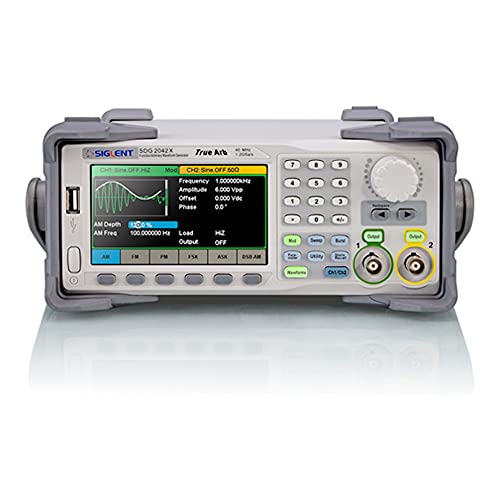
Siglent Technologies SDG2042X Arbitrary Waveform Function-Generators, 40 MHz, Grey
Check Price On AmazonThe Siglent SDG2042X is a strong option among function signal generators when you need dual-channel operation, 40 MHz sine-wave output, and a clear touchscreen interface. Its 16-bit vertical resolution, modulation tools, and USB/LAN connectivity suit bench testing and more advanced waveform work.
Best For: Engineers and technicians who want a dual-channel generator with high vertical resolution, modulation, sweep, burst, and remote-control connectivity.
Pros:
- Dual-channel design with up to 40 MHz sine-wave output
- 16-bit vertical resolution and touchscreen display
- Supports modulation, sweep, burst, TrueArb, and Easy Pulse functions
- Includes a built-in frequency counter plus USB and LAN interfaces
Cons:
- GPIB connectivity requires an optional adapter
- Its feature set may be more than needed for basic signal testing
Choose the SDG2042X if signal fidelity, flexible waveform control, and connectivity matter more than keeping the instrument limited to basic functions.
Best Connected 80 MHz Option – Koolertron DDS Signal Generator
The Koolertron DDS is one of the more versatile function signal generators for users who want dual-channel output, an 80 MHz sine-wave ceiling, and phone or PC control. It also combines arbitrary waveform creation, measurement functions, sweep modes, and onboard storage.
Best For: Labs, production work, teaching, and engineering setups that benefit from mobile control, PC waveform editing, and extensive measurement features.
Pros:
- Dual-channel DDS output with sine-wave frequency up to 80 MHz
- 275 MSa/s sampling rate and 14-bit vertical resolution
- Mobile app, PC software, and communication protocol support
- Includes sweep, frequency measurement, pulse measurements, counting, and 100 saved states
Cons:
- Remote-control features require downloading the app or using PC software
- Its broad feature set may take time to learn
This is a compelling choice when connectivity and waveform customization are priorities, particularly for users who want to draw, import, export, and reuse arbitrary waveforms.
Best All-Around Lab Choice – Rigol DG1022Z
The Rigol DG1022Z is a practical all-around pick among function signal generators, offering dual-channel output to 25 MHz, 14-bit resolution, and a large selection of built-in waveforms. Its modulation, sweep, burst, harmonic, and PC-connectivity features cover common education, repair, design, and testing tasks.
Best For: Electronics labs, education, embedded design, repair work, and general signal simulation where flexible built-in functions are useful.
Pros:
- Dual-channel generation with frequency output up to 25 MHz
- 200 MSa/s sampling rate and 14-bit vertical resolution
- Includes 160 built-in waveforms and arbitrary waveform capability
- Supports AM, FM, PM, FSK, ASK, PWM, sweep, burst, and harmonic functions
Cons:
- Its 25 MHz range is lower than the higher-frequency models in this roundup
- Some advanced functions may be unnecessary for simple testing
The DG1022Z makes sense for buyers who want a recognized, broadly capable bench instrument with strong waveform variety and USB/LAN integration.
Best Compact Portable Pick – SEESII JDS6615
The SEESII JDS6615 is a compact choice among function signal generators for users who need dual-channel DDS output, basic measurement tools, and portable operation. It supports sine-wave output up to 15 MHz, user-defined waveforms, separate channel settings, and storage for reusable setups.
Best For: Newcomers, field technicians, teaching environments, and compact benches that need waveform generation and frequency measurement in a lightweight unit.
Pros:
- Compact 2.2-pound design with an intuitive control panel
- Dual-channel output with independently adjustable parameters and duty cycles
- 200 MSa/s sampling rate, 60 user-waveform positions, and 99 saved states
- Includes sweep, frequency, period, pulse-width, and counting functions
Cons:
- Sine-wave output is limited to 15 MHz
- It offers less frequency headroom than the other listed models
The JDS6615 is a sensible fit when portability and ease of use matter more than maximum frequency range, while its software adds useful custom-waveform flexibility.
Versatile Bench Pick – UNI-T UTG932E
The UNI-T UTG932E is a practical choice among function signal generators for hobby benches, classrooms, and small labs. Its dual-channel design, 30 MHz output range, modulation options, and arbitrary waveform support give it flexibility for circuit, audio, and receiver testing.
Best For: Hobbyists, students, small labs, ham radio alignment, and pro audio measurements.
Pros:
- Dual channels with Ch1-Ch2 combining capability
- Supports sine, square, pulse, ramp, noise, DC, and arbitrary waveforms
- Includes AM, FM, PM, FSK, line, and log modulation
- 200MSa/s sampling, 14-bit vertical resolution, and a built-in frequency counter
Cons:
- Maximum output frequency is 30 MHz
- May offer more functions than needed for simple beginner projects
With scanning, non-volatile arbitrary waveform storage, and included BNC accessories, the UTG932E is a well-rounded generator for users who want broad functionality without moving to a larger lab instrument.
High-Frequency Feature Pick – Seesii JDS6600 60MHz Generator
The Seesii JDS6600 stands out among function signal generators for users who need a 60 MHz sine-wave output, dual independent channels, and measurement features. Its waveform customization and parameter memory also make it useful for repeatable testing and teaching.
Best For: Electronic engineering, laboratories, production lines, teaching, and scientific research.
Pros:
- Dual-channel output with independently adjustable parameters and duty cycles
- Up to 60 MHz sine-wave frequency and 200MSa/s sampling
- Stores 99 instrument states and 60 user-defined waveforms
- Provides frequency, period, pulse-width, and counting measurements
Cons:
- The product weighs about 1 kg, making it less portable than compact modules
- Custom waveform creation uses the included software package, adding a computer-based step
For buyers prioritizing higher frequency coverage and reusable custom signals, the Seesii offers a strong feature set in a compact instrument, with sweep and counter functions extending its usefulness beyond basic waveform generation.
Compact Module Pick – FG-200 DDS Function Generator
The FG-200 DDS is a compact option among function signal generators for basic bench testing, oscilloscope work, and audio circuit troubleshooting. It generates sine, square, and sawtooth waveforms, while adjustable amplitude, DC bias, filtering, and saved settings add practical control.
Best For: Oscilloscope calibration, amplifier testing, probe adjustment, and portable electronics projects.
Pros:
- Very compact and lightweight at 8.1 ounces
- Sine-wave range extends from 0.01 Hz to 500 kHz
- Provides adjustable amplitude, up to ±10 V DC bias, and switchable filters
- Settings can be saved for repeat use
Cons:
- Other waveform outputs are specified to 100 kHz
- Requires a 4–9 V DC supply or a 3.7 V lithium battery
- It is a module-style instrument rather than a full dual-channel bench generator
The FG-200 makes sense when size and straightforward waveform control matter more than advanced modulation or high-frequency coverage. Pair it with an oscilloscope for circuit debugging, response testing, or calibration tasks.
Precision Lab Pick – Koolertron 15MHz DDS Signal Generator
For buyers comparing function signal generators for lab work, teaching, or production testing, the Koolertron offers dual-channel DDS output with a 15MHz maximum sine-wave frequency. Its 200MSa/s sampling rate, stable active-crystal reference, and broad waveform selection make it a versatile bench instrument.
Best For: Electronic engineering, laboratory testing, teaching, and scientific research requiring dual-channel control and measurement functions.
Pros:
- Dual channels can be configured independently, with TTL output support.
- Supports sine, square, triangle, sawtooth, pulse, white noise, and user-defined waveforms.
- Includes linear and logarithmic sweeps, frequency and period measurement, pulse-width measurement, and counting.
- Stores up to 99 instrument-state setups and 60 user-defined waveforms.
Cons:
- Its 15MHz sine-wave ceiling is lower than some higher-frequency alternatives.
- The unit is relatively substantial for a compact bench instrument, weighing 2.05 pounds.
Choose this model when waveform flexibility, saved configurations, and built-in measurement capabilities matter more than maximum frequency. The independent dual-channel setup is particularly useful for comparative or multi-signal experiments.
Connected Workbench Choice – YERTAI ET3320C Signal Function Generator
The YERTAI ET3320C is a practical option for shoppers seeking function signal generators with USB communication and a clear graphical interface. It combines dual-channel output, a 20MHz frequency range, arbitrary-waveform support, and integrated counting features in a roughly 600g package.
Best For: Users who want a lightweight dual-channel generator with USB connectivity, modulation functions, and built-in frequency counting.
Pros:
- 2.4-inch 320×240 TFT LCD provides a graphic operating interface.
- Offers five basic waveforms plus 32 arbitrary waveforms and storage for 50 customized waveforms.
- Includes a 100MHz high-precision frequency counter and 32-bit counter.
- Supports internal and external ASK, FSK, and PSK modulation, along with USB communication.
Cons:
- Arbitrary-waveform editing software must be obtained from the manufacturer.
- Its 20MHz frequency range may not suit applications needing higher-frequency output.
This YERTAI model stands out for convenient operation and connectivity rather than the highest output range. It is a sensible fit for benches where waveform storage, modulation, and counter functions are useful additions.
High-Frequency Output Pick – FY6900 60MHz DDS Generator
For applications that prioritize a wider frequency range, the FY6900 provides 60MHz double-channel DDS output and a listed 250MSa/s sampling rate. It supports common analog and pulse waveforms, plus a frequency-meter function, making it a strong candidate among function signal generators for general bench use.
Best For: Users seeking dual-channel output with a higher 60MHz frequency rating for commercial, residential, or general electronic testing.
Pros:
- 60MHz frequency rating exceeds the range of the other listed models.
- Double-channel DDS design supports two signal outputs.
- Supports sine, square, triangle, pulse, sawtooth, and staircase waveforms.
- Package includes USB cable, power cord, BNC-BNC cable, and BNC-clip cable.
Cons:
- The supplied notes do not specify display details, waveform-memory capacity, or modulation functions.
- It is AC-powered, so it is less suited to setups requiring battery operation.
The FY6900 is the straightforward choice when the listed 60MHz frequency range is the deciding factor. Its included cables and broad basic-waveform selection also make it ready for common signal-output tasks without emphasizing advanced arbitrary-waveform features.
How We Picked These Function Signal Generators
We selected models that cover a broad range of common bench requirements, from compact low-frequency signal sources to dual-channel arbitrary waveform generators with higher sampling rates and computer connectivity. The comparison emphasizes published frequency limits, channel configuration, waveform support, frequency-counter features, display usability, and overall suitability for electronics testing.
Because specifications and included accessories can vary by seller or revision, verify the current listing before purchase. Pay particular attention to maximum frequency, amplitude limits, output impedance, included cables, and software support.
Quick Comparison
| Best For | What to Prioritize | Typical Options in This Roundup |
|---|---|---|
| Professional laboratory work | Accuracy, stability, arbitrary waveform depth, remote control | Siglent, Rigol |
| Two-signal testing | Independent dual channels and synchronized controls | Koolertron, SEESII, YERTAI, FY6900 |
| General electronics work | Usable frequency range, counter functions, clear display | UNI-T, Koolertron, SEESII |
| Low-cost or embedded projects | Simple controls, low-frequency resolution, compact design | FG-200 modules and entry-level DDS models |
Key Buying Factors for Function Signal Generators
Frequency Range and Resolution
Choose a generator whose maximum frequency comfortably exceeds your highest planned test frequency. A margin helps preserve waveform quality and leaves room for future projects. For slow sensors, control circuits, and audio work, fine low-frequency resolution may matter more than a high top-end rating.
Waveforms and Arbitrary Waveform Capability
Most models provide sine, square, and sawtooth outputs, but arbitrary waveform support is important when reproducing sensor signals, communication patterns, or nonstandard test shapes. Check waveform memory, editing controls, and whether software is required.
Channels, Synchronization, and Modulation
Dual-channel units are useful for comparing signals, creating phase relationships, or driving a circuit and reference input simultaneously. Look for independent amplitude and frequency control, phase adjustment, synchronization, sweep, burst, and modulation functions if your testing requires them.
Sampling Rate, Accuracy, and Output Performance
A higher sampling rate can improve the reproduction of complex waveforms, while clock stability affects frequency accuracy over time. Also check amplitude range, DC offset, output impedance, distortion specifications, and whether both channels maintain the advertised performance at higher frequencies.
Controls, Display, and Connectivity
A clear front-panel interface is valuable for quick adjustments. USB or other computer connectivity helps with waveform transfer, automation, and repeatable testing. For occasional field or classroom use, prioritize straightforward controls and a readable display over advanced software features.
Who Should Buy Which Function Signal Generators?
Choose a professional Siglent or Rigol-style instrument if you need dependable measurements, deeper waveform control, and a polished lab workflow. A dual-channel Koolertron, SEESII, YERTAI, or FY6900 model is a practical fit for hobbyists, repair benches, and projects requiring two related outputs. UNI-T is worth considering when you want a recognizable general-purpose instrument with balanced functionality.
For basic experiments, microcontroller projects, audio-frequency testing, or a low-cost backup source, an FG-200 or entry-level DDS generator can be sufficient. Before ordering, match the instrument’s output range and waveform features to your oscilloscope, load, and test procedures rather than choosing solely by the highest advertised frequency.