The best programmable benchtop power supplies make it easier to deliver repeatable voltage and current during design, repair, testing, and education. This roundup compares 10 models ranging from compact single-channel units to high-output multi-channel laboratory supplies.
Use the buying guide below to match output capacity, programming options, control interfaces, and precision with the way you actually work.
Best 10 Programmable Benchtop Power Supplies Picks for 2026
Multi-Channel Lab Pick
Siglent 3-Channel Programmable Supply

- Three independently controlled channels
- 0–32 VDC output range
- 115/220 VAC input support
Best For: Multi-channel benchtop testing
Feature-Rich Value Pick
WANPTEK 0–30V 10A Bench Supply

- 0–30 V and 0–10 A output
- USB and Type-C charging ports
- Multiple protection functions
Best For: Repair benches and DIY electronics
Programmable Lab Control Pick
UNI-T UDP3305S 4-Channel Supply

- Four-channel 328 W design
- 1 mV/1 mA resolution
- Remote control and cycle testing
Best For: Automated laboratory and industrial testing
Compact Workspace Pick
Jesverty SPS-3010V 32V 10A Supply

- 0–32 V and 0–10 A output
- Compact benchtop enclosure
- USB-A and USB-C 20 W charging
Best For: Space-limited DIY and repair benches
Best Overall
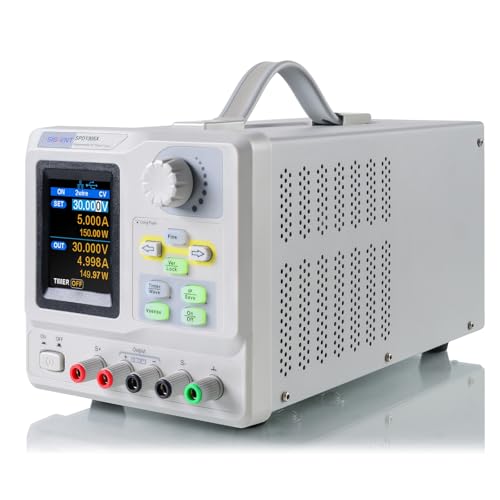
- 0–30 V, 0–5 A, and 150 W output
- Color TFT-LCD with detailed readings
- USB and LAN connectivity
Best For: General-purpose bench testing and prototyping
Best for Presets

- 0–30 V and 0–5 A linear output
- Four memory recall buttons
- USB and RS232 remote control
Best For: Repeatable lab setups and remote operation
Best High-Power Compact Pick

- 0–60 V, 0–10 A, and 300 W output
- Compact 3.3-pound design
- Memory, timed output, and PC control
Best For: Higher-power testing on space-limited benches
Precision USB Bench Supply
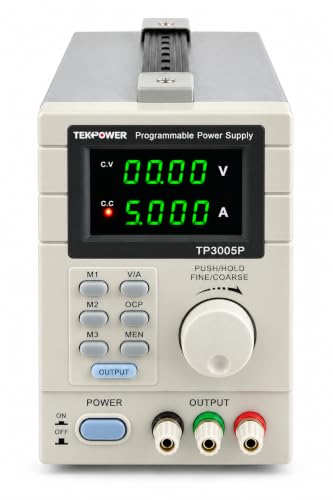
- 0–30V, 0–5A single output
- Low-noise linear regulation
- USB control with memory presets
Best For: Precision electronics testing and Windows-based bench automation
High-Power Programmable Supply
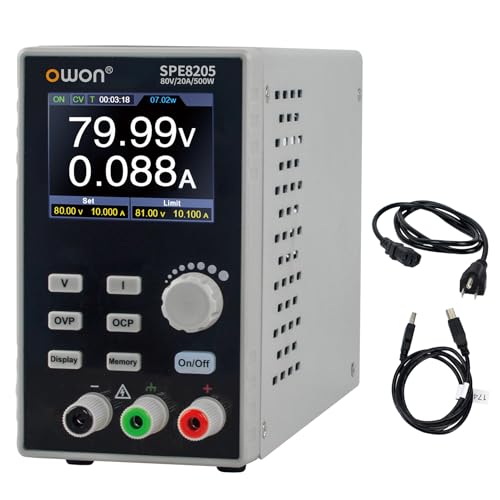
- 0–80V, 0–20A, up to 500W
- Waveform and timing output tools
- 2.8-inch display with extensive protection
Best For: High-power lab testing and programmable test sequences
USB-C Repair Bench Supply
32V 10A Programmable USB-C PSU

- 0–32V, 0–10A, 320W output
- USB-C PC control and dual display
- 1mV/1mA adjustment with OCP and lock
Best For: Phone repair, maker projects, and moderate-power battery testing
Multi-Channel Lab Pick – Siglent 3-Channel Programmable Supply
Siglent Technologies Benchtop Programmable DC Power Supply 3 Independently Controlled Channels
Check Price On AmazonFor users comparing programmable benchtop power supplies, this Siglent model stands out for its three independently controlled channels. It accepts 115 VAC or 220 VAC input and provides adjustable output from 0 to 32 VDC and 0 to 3.2 A.
Best For: Benchtop testing that benefits from three independently controlled outputs.
Pros:
- Three independently controlled channels
- 0–32 VDC adjustable output range
- Supports 115 VAC and 220 VAC input at 50 or 60 Hz
Cons:
- Heavier and larger than the compact supplies in this roundup
- Maximum output current is 3.2 A
Choose this Siglent when independent multi-channel control matters more than a small footprint or higher single-channel current capacity.
Feature-Rich Value Pick – WANPTEK 0–30V 10A Bench Supply
This WANPTEK is a practical option among programmable benchtop power supplies for repair benches and electronics projects. Its 0–30 V, 0–10 A output is paired with coarse and fine encoder controls, USB and Type-C charging, and automatic 110/220 V ±10% input detection.
Best For: Electronics repair, DIY work, and users who want high current plus convenient charging ports.
Pros:
- Adjustable 0–30 V and 0–10 A output
- Coarse and fine encoder knobs improve adjustment efficiency
- Includes 5 V/3.6 A USB and Type-C charging output
- Offers short-circuit, overheat, voltage, and power protection
Cons:
- Single-output design
- Cooling uses an intelligent temperature-controlled fan
Its combination of 10 A output, protection features, and charging ports makes it a versatile general-purpose bench supply, particularly for repair and development work.
Programmable Lab Control Pick – UNI-T UDP3305S 4-Channel Supply
The UNI-T UDP3305S is a strong choice for advanced programmable benchtop power supplies, with four channels, 1 mV/1 mA resolution, and up to 328 W of power. Its list and delay functions support up to 2,048 data sets and 99,999 cycles for automated testing.
Best For: Laboratory and industrial testing requiring multiple outputs, sequencing, and remote control.
Pros:
- Four channels with dedicated output ranges
- 1 mV/1 mA resolution and high-definition 4.3-inch display
- Supports series and parallel connection of CH1 and CH2
- RS232, Ethernet, Digital I/O, and USB interfaces
Cons:
- More substantial and specialized than basic bench supplies
- CH4 is fixed at 5 V/2 A
With extensive interfaces and cycle-testing capacity, this UNI-T is best suited to structured lab workflows rather than occasional low-complexity projects.
Compact Workspace Pick – Jesverty SPS-3010V 32V 10A Supply
For space-conscious buyers, this Jesverty model is one of the more compact programmable benchtop power supplies. It delivers 0–32 V and up to 10 A, with coarse and fine encoder adjustment, an output on/off button, and USB-A and USB-C 20 W charging ports.
Best For: DIY electronics, maintenance, educational work, and crowded benches that need a compact 10 A supply.
Pros:
- 0–32 V and 0–10 A adjustable output
- Compact 7.09 x 3.35 x 6.1-inch footprint
- Separate output switch simplifies adjustments with a load connected
- Includes USB-A and USB-C 20 W quick-charge ports
Cons:
- Supplied test leads are not recommended for long-term high-current use
- Single-output design
This Jesverty balances useful controls and 10 A capability with a small enclosure, making it a practical everyday supply when bench space is limited.
Best Overall – Siglent SPD1305X
Siglent Technologies SPD1305X Programmable DC Power Supply 1 Channel,30 V / 5 A,150W
Check Price On AmazonThe Siglent SPD1305X is a capable choice for users comparing programmable benchtop power supplies for general electronics work. Its single output provides 0–30 V and 0–5 A, with up to 150 W of power, while the color display provides detailed voltage and current readings.
Best For: General-purpose bench testing, prototyping, and users who want USB and LAN connectivity.
Pros:
- Adjustable 0–30 V and 0–5 A output with 150 W maximum power
- 2.8-inch true-color TFT-LCD with 5-digit voltage and 4-digit current display
- USB Device and LAN connectivity
- Three-year warranty listed in the supplied specifications
Cons:
- Single-channel design limits simultaneous multi-output work
- Heavier and larger than the compact OWON option
Choose the SPD1305X if clear readings, standard 30 V/5 A capability, and network connectivity matter more than portability.
Best for Presets – KORAD KA3005P
The KORAD KA3005P is a practical pick among programmable benchtop power supplies for labs, businesses, and home workbenches. It combines a 0–30 V, 0–5 A output with fine adjustment, memory recall, and USB/RS232 remote control.
Best For: Users who value repeatable setups, remote control, and straightforward front-panel adjustment.
Pros:
- 0.001 V and 0.001 A displayed resolution
- Four memory recall buttons for frequently used settings
- USB and RS232 ports with included remote-control software
- Thermal, overload, short-circuit, and grounding protection
Cons:
- Only a single output channel is specified
- At 9 pounds, it is less portable than the compact OWON model
The KA3005P makes sense when you repeatedly use the same test conditions and want both manual controls and computer-based operation.
Best High-Power Compact Pick – OWON SPE6103
The OWON SPE6103 stands out among programmable benchtop power supplies when you need more voltage, current, and wattage in a small enclosure. Its single channel reaches 0–60 V and 0–10 A, with 300 W maximum output and PC software support.
Best For: Space-constrained benches and projects requiring higher output capacity than a 30 V/5 A supply.
Pros:
- 0–60 V, 0–10 A, and 300 W rated output
- Compact 3.2 × 8.9 × 5.6-inch form factor weighing 3.3 pounds
- Four memory shortcuts and up to 10 groups of timed output editing
- Includes USB communication, PC software support, and a 5 V/1 A USB charging output
Cons:
- Single-channel output
- Its maximum output is higher than needed for simpler low-power projects
Pick the SPE6103 if compact size and 300 W capacity are priorities, especially for automated or repeated output sequences.
Precision USB Bench Supply – Tekpower TP3005P
Tekpower TP3005P Programmable Linear Type Variable Regulated DC Power Supply, 0-30V at 0-5A
Check Price On AmazonFor users comparing programmable benchtop power supplies, the Tekpower TP3005P offers a practical 0–30V, 0–5A single-output design with coarse and fine adjustment. Its low-noise linear output, dual LED displays, memory presets, and included Windows PC software make it a capable choice for repeatable bench work.
Best For: Electronics testing, repair benches, and users who want computer control with a linear power supply.
Pros:
- Adjustable 0–30V and 0–5A output with 10mA/1mV resolution.
- Low noise and low ripple suit precision testing.
- Built-in memory presets and included USB software support repeatable setups.
- Includes overcurrent protection, thermal fan control, and overload fuse protection.
Cons:
- Windows PC-only software limits compatibility.
- Single-output design is less flexible for multi-rail testing.
- At 10.9 pounds, it is less portable than compact switching supplies.
The TP3005P is a sensible pick when clean linear power and fine adjustment matter more than portability or multiple outputs. Its USB interface adds useful automation, provided your computer runs Windows.
High-Power Programmable Supply – OWON SPE8205 80V/20A
The OWON SPE8205 stands out among programmable benchtop power supplies with an 0–80V, 0–20A range and up to 500W of output. A 2.8-inch TFT display, programmable timing and waveform functions, memory shortcuts, and PC communication give it broad utility for demanding lab and test setups.
Best For: Higher-power electronics development, automated testing, battery work, and users needing wide voltage and current ranges.
Pros:
- Wide 0–80V and 0–20A range with up to 500W output.
- Display shows set and actual voltage, current, power, runtime, and channel status.
- Supports four memory groups plus editable waveform and timing output for up to ten groups.
- Includes current-limit, thermal, overload, short-circuit, and overpower protection.
Cons:
- The supplied warranty description is only one month.
- Its higher-power feature set may be unnecessary for simple low-power projects.
- The listed input range is limited to 90–120V AC.
Choose the SPE8205 when output headroom and programmable test sequences are priorities. Its detailed display and extensive protection features are especially useful for lab workflows, though buyers should verify input compatibility and warranty terms.
USB-C Repair Bench Supply – 32V 10A Programmable USB-C PSU
This 32V, 10A model is one of the more modern programmable benchtop power supplies for repair technicians and makers. It combines dual set-versus-real-output displays, USB-C PC control, 1mV/1mA encoder adjustment, lock controls, and a one-key overcurrent setting in a compact 320W bench format.
Best For: Phone repair, DIY electronics, battery projects, R&D work, and users who prefer direct USB-C computer control.
Pros:
- Provides 0–32V and 0–10A output with 320W capacity.
- Dual display shows set values alongside real-time output.
- USB-C supports PC adjustment and control without RS232 adapters.
- Offers 1mV/1mA encoder adjustment, lock mode, and one-key OCP.
Cons:
- It has less voltage and current headroom than the 80V/20A OWON model.
- Fan cooling may be noticeable during operation.
- The supplied model name is truncated in the listed details.
This supply is a strong fit for compact repair and development benches where convenient computer control and clear output monitoring matter. Its CC/CV operation and battery-oriented use cases add flexibility, while the 32V/10A ceiling keeps it focused on moderate-power work.
How We Picked These Programmable Benchtop Power Supplies
We selected models that offer meaningful programmability rather than basic manual adjustment alone. The lineup includes linear and switching designs, single- and multi-channel supplies, and output capacities from approximately 150W to 500W. We also considered voltage and current range, display and adjustment controls, resolution, output enable features, USB connectivity, and suitability for bench testing.
Because applications differ, no single supply is ideal for every user. A compact 30V, 5A model may be preferable for electronics repair, while a multi-channel or higher-power unit makes more sense for embedded systems, motors, amplifiers, and production test work.
Quick Comparison: What to Look for
- Typical single-channel range: 0–30V and 0–5A is sufficient for many hobby, repair, and classroom projects.
- Higher-voltage options: 0–60V and 0–80V models provide more headroom for power electronics and specialized equipment.
- Multiple channels: Three or four independently controlled outputs can power several rails or a circuit and its peripherals simultaneously.
- Power capacity: Check the wattage limit as well as maximum voltage and current; the usable combination may be lower than multiplying both headline values.
- Control options: Encoders, presets, remote interfaces, USB, and PC control can improve repeatability and speed.
Key Buying Factors for Programmable Benchtop Power Supplies
Output Range and Channel Configuration
Choose voltage and current limits with a safety margin above your project’s needs. Independent channels are valuable when testing boards with separate logic, analog, or motor rails. For simple repairs, one well-regulated channel may be easier and less expensive.
Linear Versus Switching Regulation
Linear supplies are often favored for low-noise analog work, audio circuits, and sensitive measurements, but they can be heavier and less efficient. Switching supplies are generally lighter, cooler-running, and capable of higher output power. Review ripple and noise specifications when powering precision circuits.
Programming, Measurement, and Protection
Look for clear voltage and current readouts, fine adjustment resolution, stored settings, timed sequences, and computer control if repeatable test routines matter. Overvoltage, overcurrent, short-circuit, and thermal protection help prevent damage to both the supply and the connected device.
Connections and Everyday Usability
Front-panel terminals, USB-A or USB-C ports, output enable controls, and a readable display can make a major difference at the bench. Confirm whether included ports are intended for charging, control, or auxiliary power, since those functions are not interchangeable.
Who Should Buy Which Programmable Benchtop Power Supplies?
Hobbyists and repair technicians: A 0–30V, 0–5A or 0–10A single-channel supply offers a practical balance of range, size, and cost.
Students and general-purpose labs: Choose a model with straightforward encoder controls, good display resolution, protection features, and enough power for common development boards and small circuits.
Engineers testing complex systems: Multi-channel programmable units are the better choice when several independently adjustable rails or repeatable test sequences are required.
Power electronics and demanding loads: Consider 60V or 80V models with 300W to 500W capacity, while verifying thermal performance, duty-cycle limits, and the supply’s actual output curve.