Finding dependable lab-style accuracy on a modest budget is possible, but specifications can vary widely among affordable balances. Capacity, readability, calibration, shielding, and repeatability all matter when small measurement errors can affect your results.
We compared 10 precision balances under $300 to help you match the right scale to your workload, workspace, and required level of accuracy.
Best 10 Precision Balances Under 300 Picks for 2026
Best Shielded Precision Balance
300 g x 0.001 g Laboratory Balance

- Four-sided draft shield helps stabilize readings
- 300 g capacity with 0.001 g readability
- RS-232, backlit LCD, and leveling features
Best For: Chemistry labs, students, hobbyists, and jewelry or powder weighing
Best Dual-Display Precision Balance
JOANLAB FA2003S 200 g x 0.001 g

- Front and rear displays improve viewing
- 0.001 g readability with 200 g capacity
- Counting, percentage, check-weighing, and RS-232
Best For: Labs, pharmacies, jewelry shops, and shared workspaces
Best Mechanical Precision Balance
500 g x 0.02 g Single-Lever Scale

- Battery-free single-lever operation
- 500 g capacity with 0.02 g precision
- Includes weights, tweezers, and compact platform
Best For: Classrooms, teaching aids, and portable mechanics experiments
Best Compact Analytical Balance

- 0.001 g readability for small samples
- Windshield helps limit environmental effects
- 19 units, counting, and RS-232 data exchange
Best For: Jewelry and small-quantity laboratory or pharmacy weighing
500g Windshield Precision Balance
0.001g Analytical Scale with Windshield

- 500g capacity with 0.001g accuracy
- Tare, counting, and multiple unit settings
- Plug-in design with adjustable leveling foot
Best For: Higher-capacity laboratory and jewelry weighing
Laboratory 1mg Precision Balance
U.S. Solid 300g Analytical Scale

- 10mg–300g range with 0.001g accuracy
- Windshield supports stable readings
- Simple CAL-button calibration process
Best For: Laboratory and jewelry bench weighing
Dual-Screen Commercial Precision Balance
- Dual front and rear LCD displays
- Checkweighing, counting, and under-hook modes
- Fast 1.5-second stabilization
Best For: Multi-user laboratory and commercial weighing workflows
Best Compact Lab Balance
U.S. Solid 200g 1mg Analytical Scale
- 200 g capacity with 0.001 g resolution
- Backlit LCD and multiple weighing units
- AC/DC power, tare, and part counting
Best For: Coins, jewelry, and compact lab weighing
Best Dual-Display 200g Balance
- 200 g capacity and 0.001 g readability
- Front-and-rear dual LCD displays
- 1.5-second stabilization and checkweighing
Best For: Small-sample work needing dual-view operation
Best Higher-Capacity 1mg Balance
- 300 g capacity with 0.001 g readability
- Dual LCD screens for two-sided viewing
- Checkweighing, counting, and under-hook options
Best For: Detailed weighing requiring up to 300 g capacity
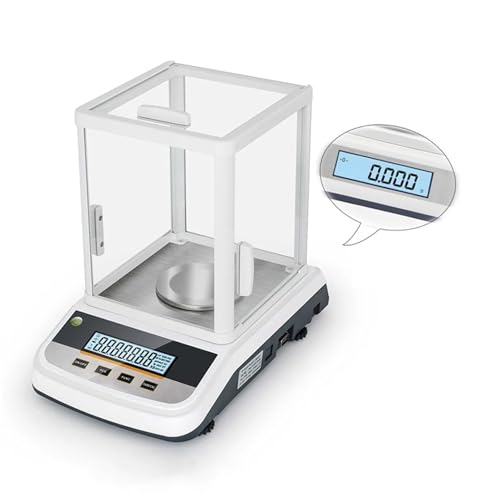
Best Shielded Precision Balance – 300 g x 0.001 g Laboratory Balance
For shoppers comparing precision balances under 300, this Tree laboratory balance combines a 300 g capacity with 0.001 g readability. Its four-sided draft shield, leveling bubble, and adjustable feet help support stable measurements in sensitive weighing tasks.
Best For: Chemistry labs, students, hobbyists, and weighing powders, herbs, jewelry, or precious metals.
Pros:
- Four-sided glass draft shield with sliding doors helps reduce airflow and environmental disturbances.
- Offers 0.001 g readability across a 300 g maximum capacity.
- Includes backlit LCD, RS-232 connectivity, unit conversions, tare functions, and overload protection.
- Built-in leveling bubble, adjustable feet, and a two-year manufacturer warranty add practical value.
Cons:
- At about 7 pounds, it is less convenient to move frequently than a compact portable scale.
- The plastic construction may be less rugged than an all-metal laboratory balance.
This is a strong all-around choice when you want high resolution, draft protection, and computer or printer connectivity without stepping up to a larger-capacity analytical balance.
Best Dual-Display Precision Balance – JOANLAB FA2003S 200 g x 0.001 g
The JOANLAB FA2003S is a practical option among precision balances under 300, offering 200 g capacity and a 0.001 g minimum readout. Its dual-display layout is especially useful when the operator and another person need to view measurements from opposite sides.
Best For: Laboratories, pharmacies, jewelry shops, and users who need counting, percentage weighing, or check-weighing functions.
Pros:
- Dual displays make readings visible from front and rear positions.
- Provides 0.001 g readability with a 200 g maximum capacity.
- Supports grams, milligrams, carats, and ounces, plus counting, percentage, and check weighing.
- RS-232 connectivity and automatic screen-off settings support data handling and energy savings.
Cons:
- Its 200 g capacity is lower than some competing laboratory balances.
- The supplied notes specify a one-year warranty, shorter than some alternatives.
Choose this model if viewing convenience and flexible weighing modes matter as much as fine resolution. The dual-screen design gives it a useful advantage in shared workspaces.
Best Mechanical Precision Balance – 500 g x 0.02 g Single-Lever Scale
Among precision balances under 300, this mechanical model stands out for its battery-free operation and straightforward single-lever design. It measures up to 500 g in 0.02 g increments, making it suited to teaching, demonstrations, and basic weighing where electronic power is unavailable.
Best For: Classrooms, portable lab work, and physical mechanics experiments that benefit from a hands-on balance.
Pros:
- Mechanical operation requires no batteries or electrical outlet.
- 500 g capacity with 0.02 g measurement precision.
- Steel beam construction and reinforced components are designed for durability.
- Includes standard weights and tweezers, with a compact 12 cm platform.
Cons:
- Its 0.02 g precision is lower than the 0.001 g resolution offered by electronic analytical balances.
- Manual readings and physical weights may take more time than digital operation.
- The notes do not specify electronic connectivity or a backlit display.
This is the better fit for users who value simplicity, portability, and demonstration-friendly mechanics over ultra-fine electronic resolution or data export.
Best Compact Analytical Balance – 100 g x 0.001 g Lab Scale
This compact analytical scale is a focused choice among precision balances under 300, delivering 0.001 g readability for loads up to 100 g. A windshield, counting function, 19-unit conversion system, and RS-232 interface make it useful for detailed jewelry and laboratory measurements.
Best For: Jewelry weighing and small-quantity laboratory or pharmacy tasks where fine readability is more important than capacity.
Pros:
- Provides 0.001 g reading accuracy in a compact form.
- Windshield helps reduce the effect of airflow and other external influences.
- Supports 19 unit conversions, counting, and RS-232 data exchange.
- Tactile-feedback buttons provide straightforward operation.
Cons:
- Its 100 g maximum capacity is the lowest among the electronic models listed here.
- The scale is plug-in type and must be connected to power during use.
- It requires a stable, dry, clean surface away from temperature fluctuations, sunlight, and strong airflow.
Pick this balance when compact size and fine resolution are the priorities. Its lower capacity makes it less versatile for heavier samples, but the windshield and data features suit small, careful measurements.
500g Windshield Precision Balance – 0.001g Analytical Scale with Windshield
For shoppers comparing precision balances under 300, this 500g analytical balance offers 0.001g readability for laboratory, jewelry, and small-part weighing. It includes a windshield, tare and counting functions, multiple unit conversions, and an adjustable leveling foot. Note that it is a plug-in model and should be calibrated before use.
Best For: Buyers who need a higher 500g capacity with fine 0.001g measurements for laboratory or jewelry tasks.
Pros:
- Measures up to 500g with 0.001g accuracy and a stated ±0.003g tolerance.
- Windshield helps reduce airflow interference during weighing.
- Includes tare weighing, counting, unit conversion, and an adjustable leveling foot.
- LED display is designed for easy reading, including in darker environments.
Cons:
- Requires a power connection to operate.
- Needs careful placement away from drafts, temperature changes, sunlight, and magnetic interference.
This is a practical option when capacity matters as much as fine resolution. Its feature set is broad, but accurate results depend on stable setup and calibration.
Laboratory 1mg Precision Balance – U.S. Solid 300g Analytical Scale
U.S. Solid 300x0.001g 1mg Digital Analytical Balance Precision Scale for Laboratories
Check Price On AmazonAmong precision balances under 300, this U.S. Solid model is designed for laboratory and jewelry work with a 300g range and 0.001g accuracy. Its quick-response construction, windshield, tare function, and straightforward calibration process make it a focused choice for repeatable bench weighing.
Best For: Laboratory or jewelry users who want a 300g analytical balance with simple calibration and tare operation.
Pros:
- Measures from 10mg to 300g with 0.001g accuracy.
- Windshield helps protect readings from airflow.
- Quick response and stable operation are emphasized in the supplied specifications.
- Dedicated CAL button and included calibration weight simplify calibration.
Cons:
- Maximum capacity is lower than some 500g alternatives.
- The supplied notes do not list counting or under-hook weighing functions.
This balance keeps the feature set centered on accurate bench measurements and easy calibration. It is a sensible fit when a 300g limit is sufficient and stable readings are the priority.
Dual-Screen Commercial Precision Balance – TF1003S 1mg Analytical Scale
For precision balances under 300, this TF1003S model combines a high-precision sensor with dual front and rear LCD screens. The supplied notes identify a 100g, 1mg configuration and highlight checkweighing, item counting, under-hook weighing, and fast 1.5-second stabilization.
Best For: Users who value dual-sided visibility and multiple weighing modes for laboratory, commercial, or jewelry tasks.
Pros:
- Dual LCD screens provide front and rear viewing.
- Supports checkweighing, item counting, and under-hook weighing.
- Stabilizes in approximately 1.5 seconds.
- Offers gram, ounce, and carat measurement options.
Cons:
- The supplied configuration is listed as 100g with 1mg resolution.
- The product title references several capacities, so buyers should confirm the selected variant before ordering.
This model stands out for workflow-friendly features rather than capacity alone. Its dual display and weighing modes are useful where multiple people need to view results or where counting and checkweighing are part of the process.
Best Compact Lab Balance – U.S. Solid 200g 1mg Analytical Scale
U.S. Solid 200x0.001g 1mg Digital Analytical Balance Precision Scale for Laboratories
Check Price On AmazonFor shoppers comparing precision balances under 300, the U.S. Solid USS-DBS3-2 offers a 200 g capacity with 0.001 g (1 mg) readability. Its backlit LCD, manual calibration, tare, counting, and AC/DC power options make it a practical choice for detailed weighing tasks.
Best For: Coins, jewelry, and compact laboratory weighing where 200 g capacity is sufficient.
Pros:
- 0.001 g resolution with stated 0.002 g accuracy
- Supports gram, ounce, karat, and pound units
- Includes tare and part-counting functions
- Can run on AC or DC power
Cons:
- Maximum capacity is limited to 200 g
- Calibration is manual rather than automatic
This balance is a focused option for small, high-resolution measurements. Choose it when its 200 g limit and manual calibration fit your workflow.
Best Dual-Display 200g Balance – TF2003S 1mg Precision Scale
Among precision balances under 300, the TF2003S combines a 200 g capacity and 0.001 g readability with features aimed at flexible commercial or laboratory work. Its front-and-rear LCD screens, 1.5-second stabilization, and checkweighing and counting modes support efficient operation.
Best For: Users who need a 200 g, 1 mg balance with dual-view displays and flexible weighing modes.
Pros:
- High-precision sensor with 0.001 g readability
- Dual LCD screens improve front and rear visibility
- Stabilizes in approximately 1.5 seconds
- Offers checkweighing, counting, and under-hook weighing
Cons:
- Capacity is limited to 200 g
- Supplied details do not specify accuracy beyond the 0.001 g readability
The TF2003S is a feature-rich pick if quick stabilization and visibility from either side matter more than a larger capacity. Its 200 g limit suits smaller samples and items.
Best Higher-Capacity 1mg Balance – TF3003S 300g Precision Scale
For precision balances under 300, the TF3003S stands out with a 300 g capacity while retaining 0.001 g readability. The dual LCD design, rapid 1.5-second stabilization, and checkweighing, counting, and under-hook options make it adaptable for detailed weighing tasks.
Best For: Users who need more capacity than a 200 g balance while retaining 1 mg readability.
Pros:
- 300 g capacity with 0.001 g readability
- Dual LCD screens provide visibility from both sides
- Stabilizes in approximately 1.5 seconds
- Supports grams, ounces, and carats
Cons:
- Supplied details do not state a specific accuracy figure
- Its larger capacity may be unnecessary for very small weighing tasks
The TF3003S is the practical choice of these options when a 300 g maximum is useful. It preserves fine 1 mg readability while adding flexible display and weighing features.
How We Picked the Best Precision Balances Under 300
We focused on the specifications that most directly affect everyday weighing: readability, maximum capacity, calibration method, draft protection, display design, and intended use. The selection includes digital analytical balances, enclosed laboratory-style scales, jewelry-capable models, and a mechanical option for users who prefer operation without electronics.
Because advertised accuracy does not guarantee identical real-world performance, we also considered practical factors such as weighing-platform capacity, protection from air movement, ease of leveling, and whether calibration weights or procedures are clearly supported.
Quick Comparison
| Feature | What to look for | Why it matters |
|---|---|---|
| Readability | 0.001 g, 0.01 g, or 0.02 g | Determines the smallest displayed increment. |
| Capacity | 100 g to 500 g | Sets the maximum sample weight, including containers. |
| Draft shield | Four-sided or enclosed windshield | Reduces air-current interference around light samples. |
| Calibration | Internal, external, or mechanical weights | Helps maintain accuracy after movement or temperature changes. |
| Display | Single or dual-screen digital display | Improves visibility from different working positions. |
Key Buying Factors for Precision Balances Under 300
Readability and Usable Accuracy
A balance displaying 0.001 g offers finer resolution than one displaying 0.01 g, but resolution is only one part of performance. Look for information about repeatability, linearity, stabilization time, and calibration. For routine educational, formulation, hobby, or jewelry work, a 1 mg display may be sufficient; demanding analytical applications require more careful validation.
Capacity and Sample Size
Choose enough capacity for the sample plus its vessel. A 200 g balance should not routinely operate near its limit, especially when using larger containers. A 300 g or 500 g model provides more flexibility but may have different sensitivity, footprint, or stabilization behavior.
Draft Protection and Workspace Conditions
Air movement, vibration, static electricity, temperature changes, and an uneven surface can affect small measurements. A draft shield is especially useful for 0.001 g balances. Place the unit on a stable, level bench away from vents, doors, and vibrating equipment.
Calibration and Daily Operation
External calibration can be straightforward when suitable certified weights are available. Internal calibration is more convenient but may not be included at this price. Check the supplied accessories, power requirements, tare function, unit modes, and operating instructions before purchasing.
Who Should Buy Which Precision Balances Under 300?
Choose a 0.001 g digital model with a windshield if you need the finest displayed resolution for small samples, jewelry, educational experiments, or formulation work. A 200 g balance suits lighter loads and compact workspaces, while a 300 g or 500 g model is better when containers or larger samples are common.
A four-sided shielded balance is the strongest general-purpose choice for indoor laboratory-style work. Buyers who prioritize simplicity, durability, or demonstrations without batteries may prefer the mechanical balance, accepting its coarser readability. For regulated testing, certified research, or results requiring traceability, verify calibration documentation and performance independently rather than relying on the advertised resolution alone.