The best linear benchtop power supplies provide clean, adjustable DC power for prototyping, troubleshooting, repair work, and laboratory testing. The right model depends on more than voltage and current ratings: channel count, display resolution, programming features, protection, and output noise all matter.
Our roundup includes compact single-output supplies, higher-power multi-channel instruments, and programmable laboratory models so you can match your equipment to your workload and budget.
Best 10 Linear Benchtop Power Supplies Picks for 2026
Reliable 5A Workhorse

- 0–30V, 0–5A adjustable output
- Constant-voltage and constant-current modes
- Back-lit display with automatic fan control
Best For: General bench testing and hobby electronics
Flexible Multi-Rail Choice
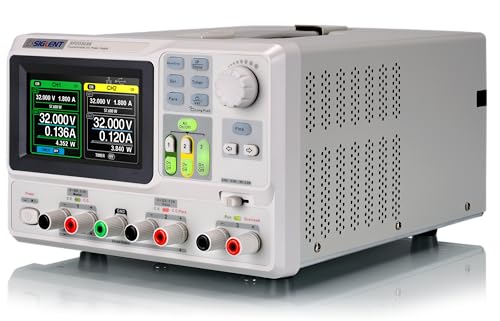
- Three isolated controlled outputs
- Series, parallel, and independent modes
- 220W output with trending graphs
Best For: Multi-rail development and testing
Precision Memory-Controlled Pick

- 0–30V, 0–5A regulated output
- 0.001V and 0.001A display resolution
- Memory recall and extensive protection
Best For: Repeatable precision testing and lab benches
Low-Noise Accuracy Option

- 0–30V and 0–5A single output
- ≤2mVrms ripple and noise
- Four-digit display with automatic CV/CC switching
Best For: Sensitive electronics and clean-power testing
Compact High-Current Pick
Jesverty SPS-3010 30V/10A Supply

- 0-30V and up to 10A output
- Four-digit V/A/W display
- Compact 2.5-pound design
Best For: Portable, general-purpose bench projects needing high current
Multi-Channel Laboratory Choice
UNI-T UTP3305-II Triple-Output Supply
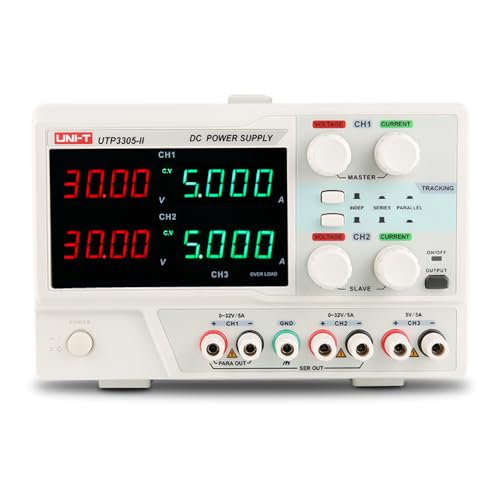
- Two 0-32V/0-5A adjustable channels
- Fixed 5V output included
- Series, parallel, and tracking modes
Best For: Laboratory work requiring multiple coordinated power rails
Programmable Professional Pick

- Three fully isolated channels
- Programmable linear DC output
- 210W total power capacity
Best For: Professional development and automated multi-channel testing
Versatile Starter Pick
X-Tronic PX-70 30V/5A Linear Bench Supply

- 0–30V, 0–5A output with 1mA current resolution
- Includes three lead sets and bench accessories
- Memory presets, protection modes, and adjustable USB output
Best For: Beginners, repair benches, schools, and complete-kit buyers
Compact Professional Choice
Rigol DP711 30V/5A Programmable Supply
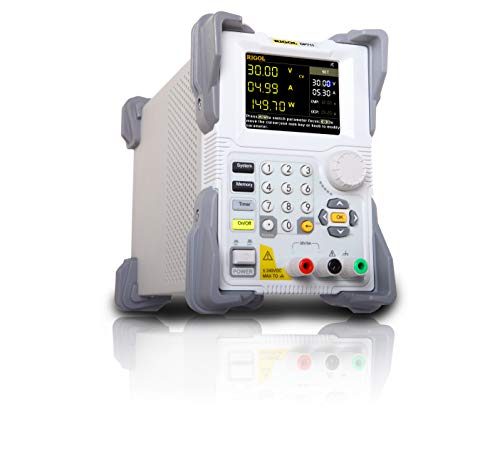
- Single 30V/5A output rated up to 150W
- Low ripple and strong line/load regulation specifications
- RS232, external trigger, display, and key-lock functions
Best For: Laboratory and engineering benches needing one controlled output
Multi-Channel Testing Pick
UNI-T UDP3305S-E 4-Channel Supply

- Four channels with up to 328W total power
- 10mV/1mA resolution and series/parallel main channels
- USB, RS232, LAN, digital I/O, and test sequencing
Best For: Automated testing, multi-rail development, and aging tests
Reliable 5A Workhorse – Tekpower TP3005T
Tekpower TP3005T Variable Linear DC Power Supply, 0-30V @ 0-5A with Alligator Test Leads
Check Price On AmazonThe Tekpower TP3005T is a straightforward choice among linear benchtop power supplies when you need adjustable 0–30V output and up to 5A for general electronics work. Its metal body, clear back-lit display, and automatic fan control make it practical for a bench setup.
Best For: Hobbyists and repair work requiring a conventional single-output supply with useful voltage and current capacity.
Pros:
- Adjustable 0–30V and 0–5A output range.
- Supports constant-voltage and constant-current operation.
- Back-lit LED display provides 0.1V and 0.01A resolution.
- Thermo-sensor-controlled cooling fan and metal enclosure.
Cons:
- At 12 pounds, it is less portable than lighter benchtop options.
- Its listed display resolution is less granular than some four-digit competitors.
Choose the TP3005T if you value a familiar, durable design and a full 5A output more than advanced memory or multi-output features. The included alligator test leads and one-year warranty add convenience.
Flexible Multi-Rail Choice – Siglent SPD3303X-E
The Siglent SPD3303X-E stands out among linear benchtop power supplies for projects needing multiple isolated outputs. It combines two adjustable 32V/3.2A channels with a fixed selectable 2.5V, 3.3V, or 5V channel, plus series and parallel operating modes.
Best For: Development benches and test setups that need several independently controlled rails or higher combined flexibility.
Pros:
- Three independent, controlled, and isolated outputs.
- Offers independent, series, and parallel output modes.
- Includes timing output functionality and trending graphs.
- Three-year warranty and 220W total power rating.
Cons:
- Its 17.6-pound weight and large dimensions require substantial bench space.
- The fixed auxiliary channel is limited to 2.5V, 3.3V, or 5V at up to 3.2A.
This is the strongest fit for users who will actually use multiple rails, series/parallel operation, or graphing features. If you only need one simple adjustable output, its size and extra capability may be unnecessary.
Precision Memory-Controlled Pick – KORAD KA3005D
The KORAD KA3005D is a precision-focused option among linear benchtop power supplies, providing 0–30V and up to 5A with a four-digit back-lit display. Fine/coarse controls, memory recall, and selectable 110/220V input make it convenient for repeatable bench work.
Best For: Labs, businesses, and hobbyists who want precise readings, repeatable settings, and built-in protection features.
Pros:
- Four-digit display with 0.001V and 0.001A resolution.
- Four memory recall buttons speed up repeat setups.
- Includes overload, short-circuit, thermal, and grounding protection.
- Lock and load on/off buttons help prevent operating mistakes.
Cons:
- Its 150W rating is lower than some higher-capacity supplies.
- The metal-and-plastic enclosure may feel less rugged than an all-metal design.
The KA3005D is a compelling choice when adjustment precision and repeatability matter. Its quiet variable fan and safety controls further suit regular lab or home-bench use, while the included test leads help you get started.
Low-Noise Accuracy Option – UNI-T UTP3315TFL-II
The UNI-T UTP3315TFL-II targets sensitive electronics work with a 0–30V range, 0–5A output, and specified ripple and noise of no more than 2mVrms. Its four-digit display, automatic CV/CC switching, and 110V/220V ±5% input support precise everyday bench use.
Best For: Sensitive circuits and users prioritizing low ripple, load regulation, and international input compatibility.
Pros:
- 0–30V output range with up to 5A current.
- Specified ripple and noise of ≤2mVrms.
- Four-digit display with 10mV/1mA precision.
- Automatic CV/CC switching and current-limiting protection.
Cons:
- The supplied details list a rack form factor, which may be less convenient for a compact desktop bench.
- It provides one channel rather than multiple independently controlled outputs.
Consider the UTP3315TFL-II when clean, stable power is more important than multi-channel flexibility. Its universal input range and included international power cord also make it practical for varied work environments.
Compact High-Current Pick – Jesverty SPS-3010 30V/10A Supply
For shoppers comparing linear benchtop power supplies, the Jesverty SPS-3010 is a compact, lightweight option with adjustable 0-30V output and up to 10A. Its four-digit display shows voltage, current, and wattage in real time, while automatic constant-voltage and constant-current operation helps accommodate changing loads.
Best For: Space-conscious benches, general electronics work, and projects needing up to 300W of adjustable output.
Pros:
- Displays V, A, and W with resolutions down to 0.01V, 0.001A, and 0.1W.
- Supports automatic CV and CC mode switching.
- Compact 7.1 x 3.35 x 6.1-inch body weighing about 2.5 pounds.
- Includes short-circuit, overload, grounding, and temperature-regulated fan protections.
Cons:
- Supplied test leads are described as giveaway leads and may not suit sustained high-current use.
- It has one adjustable output rather than multiple channels.
The SPS-3010 stands out when portability and high current matter more than multi-channel laboratory control. Consider upgrading the leads for demanding, long-duration 10A applications.
Multi-Channel Laboratory Choice – UNI-T UTP3305-II Triple-Output Supply
Among linear benchtop power supplies, the UNI-T UTP3305-II is designed for work that benefits from multiple outputs and controlled laboratory performance. It combines two adjustable 0-32V/0-5A channels with a fixed 5V output, plus independent, series, and parallel operating modes.
Best For: Laboratory setups, multi-rail circuits, and users who need adjustable channels with tracking and low-ripple output.
Pros:
- Provides two adjustable channels and one fixed 5V channel.
- Supports independent operation as well as series and parallel tracking.
- Offers four-digit displays with 10mV/1mA resolution.
- Includes overvoltage/current protection and temperature-controlled cooling.
Cons:
- At 15 pounds, it is less portable than compact single-output supplies.
- Each adjustable channel is rated for up to 5A, not 10A.
The UTP3305-II is a practical fit for bench users who need several coordinated outputs rather than maximum current from one channel. Its five-year limited warranty is an additional consideration for longer-term laboratory use.
Programmable Professional Pick – Rigol DP932A 3-Channel Supply
The Rigol DP932A is a professional-oriented choice among linear benchtop power supplies, offering three fully isolated channels and 210W of total power. Its programmable design suits users who want computer-compatible control and separate isolated outputs for more involved testing or development work.
Best For: Professional electronics development, automated test setups, and circuits requiring three isolated programmable channels.
Pros:
- Provides three fully isolated channels.
- Programmable operation supports controlled power-supply workflows.
- Offers 210W of total output power.
Cons:
- The supplied notes do not specify individual channel voltage or current ratings.
- Its 9.15kg weight makes it better suited to a fixed bench than frequent transport.
- The notes do not provide detailed ripple, display, or protection specifications.
The DP932A is most compelling when channel isolation and programmability are priorities. Before buying, verify the detailed channel ratings and interface requirements for your particular test system.
Versatile Starter Pick – X-Tronic PX-70 30V/5A Linear Bench Supply
The X-Tronic PX-70 is a practical choice among linear benchtop power supplies for repair benches, classrooms, and general electronics work. Its 0–30V, 0–5A output, memory presets, adjustable USB output, and included leads make it a well-equipped complete kit.
Best For: Beginners, computer repair services, schools, and users who want included accessories and straightforward controls.
Pros:
- 0–30V and 0–5A adjustable output with 1mA current resolution.
- Includes three sets of leads, a work mat, power cord, and instructions.
- Offers output on/off, lock/unlock controls, three memory presets, and multiple protection modes.
- Includes adjustable USB output and low-noise, low-ripple operation.
Cons:
- Designed for 110/120V, 60Hz operation; the notes state that 220V is unavailable.
- Its feature-rich interface may be more than needed for simple voltage-output tasks.
Choose the PX-70 when a broad feature set and bundled accessories matter as much as basic output capability. Its protection functions and fine adjustments also make it approachable for less experienced users.
Compact Professional Choice – Rigol DP711 30V/5A Programmable Supply
The Rigol DP711 is a focused single-channel option for users comparing linear benchtop power supplies for laboratory or development work. It provides up to 30V and 5A, with low ripple and noise, strong regulation specifications, protection features, and RS232 communication.
Best For: Labs, engineering benches, and users who need a programmable single-output supply with remote communication.
Pros:
- Single 30V/5A output with power up to 150W.
- Low ripple and noise specifications of less than 500µVrms/3mVpp and less than 2mArms.
- Supports overvoltage, overcurrent, and overtemperature protection.
- Includes RS232, external trigger support, TFT-LCD display, and front-panel key locking.
Cons:
- Only one output channel is provided.
- The package is relatively focused, including a power cord, fuses, certificates, and the supply rather than multiple test-lead sets.
The DP711 is a sensible fit when measurement stability, protection, and connectivity are more important than multiple channels or a large accessory bundle. Its single-output design keeps the workflow straightforward.
Multi-Channel Testing Pick – UNI-T UDP3305S-E 4-Channel Supply
The UNI-T UDP3305S-E stands out among linear benchtop power supplies when a test setup needs several outputs and automated sequencing. It combines four channels, up to 328W, series/parallel operation for the main channels, extensive interfaces, and list and delay functions for repeatable testing.
Best For: Multi-rail development, production testing, aging tests, and users who need programmable sequences or remote control.
Pros:
- Four channels: two 0–30V/0–5A channels, a 0–6V/0–3A channel, and a 5V/2A channel.
- Provides 328W maximum power with 10mV/1mA resolution.
- Supports USB, RS232, LAN, and digital I/O connections.
- List and delay functions support up to 2,048 data sets and up to 99,999 cycles.
Cons:
- Its 12.5kg weight and desktop form factor require more bench space than a compact single-channel unit.
- The listed setting-accuracy specifications are less tight than the regulation figures emphasized for the Rigol DP711.
- Its advanced sequencing features may be unnecessary for basic manual powering tasks.
The UDP3305S-E is the strongest match for complex setups that benefit from multiple rails and repeatable test routines. Choose it when channel count, automation, and connectivity justify the larger, more capable instrument.
How We Picked These Linear Benchtop Power Supplies
We focused on models suited to electronics work, including regulated linear supplies and laboratory-grade instruments with dependable adjustment and monitoring. The selection covers single- and multi-channel designs, basic front-panel controls, programmable interfaces, and output ratings ranging from compact 30V/5A units to higher-power systems.
We also considered practical factors such as display readability, voltage and current resolution, output controls, protection features, channel flexibility, and suitability for repeated bench use. Some listings use switching architectures despite a similar bench-supply format, so check the specifications carefully if low ripple and linear regulation are essential.
Quick Comparison
| Best For | What to Prioritize |
|---|---|
| Basic repair and hobby projects | Simple controls, 0–30V range, 3–5A output, and clear digital displays |
| Analog and sensitive circuit testing | Linear regulation, low ripple and noise, fine adjustment, and stable current limiting |
| Multi-rail prototypes | Three or four isolated channels, tracking or series/parallel operation, and adequate total power |
| Automated testing | Programmability, remote sensing, computer interfaces, memory functions, and logging support |
Key Buying Factors for Linear Benchtop Power Supplies
Voltage, Current, and Total Power
Choose a supply with headroom above your project’s maximum requirement. A 30V/5A unit handles many general-purpose tasks, while 10A models suit heavier loads. For multi-channel supplies, verify both each channel’s limit and the combined wattage.
Noise, Ripple, and Regulation
Linear Benchtop Power Supplies are often preferred for analog, audio, sensor, and measurement circuits because they can deliver cleaner power than many switching designs. Review published ripple, noise, load regulation, and line regulation figures rather than relying only on the word “linear.”
Channels and Output Configuration
Multiple isolated channels can power separate circuit rails or provide positive and negative supplies. Tracking, series, and parallel modes add flexibility, but confirm how those modes affect maximum voltage, current, and isolation.
Controls, Resolution, and Protection
Fine voltage and current resolution makes repeatable testing easier. Look for output enable controls, lock functions, over-voltage and over-current protection, thermal protection, and memory presets. Remote sensing is especially useful when leads are long or load changes are substantial.
Programming and Connectivity
If the supply will be part of an automated test system, check supported interfaces, command compatibility, software availability, and whether readings can be logged. A programmable model costs more but can save time in repeated production or validation tests.
Who Should Buy Which Linear Benchtop Power Supplies?
Choose a basic single-channel model for occasional repairs, education, Arduino or microcontroller projects, and general bench work. Choose a higher-current unit for motors, relays, power circuits, and loads that exceed typical 5A requirements. Choose a multi-channel linear supply when your prototypes need several independent rails or positive and negative voltages. Choose a programmable model for automated testing, repeatable experiments, data capture, or laboratory workflows.
Before ordering, confirm the exact listing’s architecture, output limits, connector arrangement, included cables, warranty, and input-voltage requirements. Those details can vary between closely named versions and are more important than headline specifications alone.