Choosing the right bench supply can make circuit testing more repeatable, safer, and easier to troubleshoot. The products in this roundup range from compact adjustable DC supplies for electronics work to automotive circuit probes for 12- and 24-volt systems.
Use the guide below to match voltage and current capacity, protection features, display accuracy, and testing style to your projects before you buy.
Best 10 Benchtop Power Supplies for Circuit Testing Picks for 2026
Compact Precision Pick

- 0–30V and up to 10A output
- Four-digit V/A/W display
- Compact body with multiple protections
Best For: Space-conscious electronics testing and repair
Automotive Circuit Diagnostic Pick
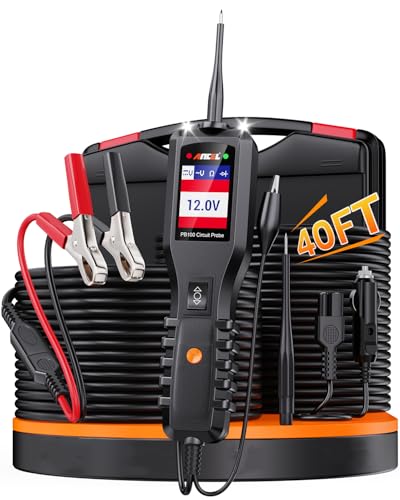
- Tests 12–24V vehicle circuits
- Activates and checks components
- Includes up to 40 feet of cable reach
Best For: Automotive wiring and component troubleshooting
Battery-Test Convenience Pick

- 0–30V and up to 10A output
- Intelligent charging with full-charge stop
- 18W USB port and OCP protection
Best For: Bench repair, battery charging, and DIY testing
Professional Automotive Probe Pick

- Supports 6–30V vehicle systems
- Tests and activates components
- Includes AC/DC, resistance, and continuity modes
Best For: Detailed automotive electrical diagnostics
Best Quiet Adjustable Supply
UNI-T UTP1306 32V/6A Bench Supply

- 0–32V, 0–6A adjustable single output
- Four-digit LCD with three memory presets
- OVP, OCP, and OTP protection
Best For: Development, lab, repair, and repeatable circuit testing
Best Automotive Circuit Probe

- Tests 6–30V vehicle electrical systems
- Performs continuity, resistance, and polarity checks
- Includes component activation and short-circuit tracing
Best For: Automotive diagnostics and vehicle circuit repair
Best High-Voltage Compact Supply

- 0–120V adjustable output at up to 3A
- Coarse/fine encoder adjustment controls
- 20W USB-A and USB-C charging ports
Best For: Compact high-voltage electronics projects and bench testing
Automotive Circuit Diagnostic Tool

- Tests voltage, resistance, diode, continuity, and polarity
- Traces wires and locates shorts, opens, and leaks
- Includes component activation and overload protection
Best For: Vehicle electrical diagnosis and 12V/24V circuit troubleshooting
Compact 150W Bench Supply

- Adjustable 0–30V DC and 0–5A output
- Four-digit display with encoder adjustment and output switch
- Compact design with an 18W USB-A charging port
Best For: General electronics repair, laboratory work, and DIY bench testing
Compact Precision Pick – Jesverty SPS-3010
For benchtop power supplies for circuit testing, the Jesverty SPS-3010 offers adjustable 0–30V output and up to 10A, with real-time voltage, amperage, and wattage readings on a four-digit LED display. Its compact 2.5-pound design suits crowded workbenches.
Best For: Space-conscious electronics testing, repair work, and projects needing adjustable voltage and current.
Pros:
- Displays V, A, and W with resolution up to 0.01V, 0.001A, and 0.1W.
- Automatically switches between constant-voltage and constant-current modes.
- Includes short-circuit, overload, grounding, and temperature-regulated fan protection.
- Provides a 5V/2A USB port and coarse/fine adjustment controls.
Cons:
- The included test leads are described as giveaway accessories and may not suit extended high-current use.
- The LED display uses a red color that may be less flexible than a larger bench display.
The SPS-3010 is a practical choice when compact size and clear output monitoring matter. Plan to use higher-capacity test leads for sustained 10A applications.
Automotive Circuit Diagnostic Pick – ANCEL PB100
Although it is not a conventional benchtop power supply, the ANCEL PB100 is a useful companion for circuit testing in 12–24V vehicles. It combines voltage, polarity, continuity, grounding, short-circuit detection, and component activation in one automotive probe.
Best For: Vehicle wiring diagnosis, trailer circuits, component checks, and locating opens or shorts.
Pros:
- Supports DC voltage, AC voltage, resistance, and diode testing.
- Can activate components such as lights, fans, injectors, and power windows.
- Includes a 20-foot cable plus a 20-foot extension for up to 40 feet of reach.
- Uses LED polarity indicators, sound alerts, and an automatic circuit breaker.
Cons:
- Designed for 12–24V automotive systems rather than general laboratory bench-power applications.
- Its probe format is less suitable for powering a circuit continuously at a controlled bench voltage.
The PB100 makes sense for automotive troubleshooting where speed, reach, and active component testing are more important than adjustable bench output. Choose a dedicated DC supply for laboratory-style circuit development.
Battery-Test Convenience Pick – Kungber SPS3010B
The Kungber SPS3010B is a compact option among benchtop power supplies for circuit testing, delivering adjustable 0–30V and up to 10A. Its intelligent charging mode, 18W USB port, and encoder control add convenience for repair benches and battery-related projects.
Best For: Bench testing, battery charging, electronics repair, and DIY work requiring compact adjustable DC power.
Pros:
- Offers up to 300W of output with a 30V, 10A range.
- Intelligent charging mode can stop charging when a battery is full.
- OCP detection provides an alarm and stops output during overcurrent or short-circuit conditions.
- Includes grounding, leakage, thermal, voltage-overload, power-overload, and short-circuit protection.
Cons:
- The plastic enclosure may feel less substantial than a metal laboratory supply.
- Its charging features may be unnecessary if you only need basic circuit powering.
With its compact footprint and charging-focused safeguards, the SPS3010B is well suited to general repair benches. Its 18W USB output is a useful extra for charging compatible devices.
Professional Automotive Probe Pick – Autel PowerScan PS100
The Autel PowerScan PS100 is another automotive circuit tester rather than a variable bench supply, but it is valuable for vehicle electrical diagnosis. It supports 6–30V systems and combines polarity, voltage, continuity, resistance, signal, grounding, and component-activation functions.
Best For: Automotive technicians and DIY users diagnosing trailer wiring, bad grounds, open circuits, and vehicle components.
Pros:
- Provides DC and AC voltage, resistance, diode, and continuity testing.
- Can activate lights, motors, wipers, fans, relays, and other components without jumper wires.
- Offers voltage-drop information, polarity LEDs, short/open tracking, and signal testing.
- Includes 20-foot and 20-foot extension cables plus circuit-breaker overload protection.
Cons:
- It is intended for vehicle electrical systems, not adjustable laboratory power delivery.
- The feature set may be more than necessary for simple voltage or continuity checks.
The PS100 is a strong choice when automotive diagnosis requires active testing and circuit tracing, especially around trailers or in low-light conditions. For powering experimental circuits at a set voltage, pair this type of probe with a dedicated bench supply.
Best Quiet Adjustable Supply – UNI-T UTP1306 32V/6A Bench Supply
The UNI-T UTP1306 is a practical choice among benchtop power supplies for circuit testing when you need adjustable voltage and current, readable measurements, and a relatively quiet setup. Its 0–32V, 0–6A output, four-digit display, and stored settings suit development, debugging, inspection, and general electronics work.
Best For: Electronics development, classroom labs, repair benches, and circuit testing that benefits from stored voltage and current presets.
Pros:
- Adjustable 0–32V and 0–6A single output.
- Four-digit EBTN LCD display with viewing from multiple angles.
- One-key recall for three stored voltage/current settings.
- Independent output switch and OVP, OCP, and OTP protection.
Cons:
- Single-output design may limit multi-rail testing.
- The supplied unit is relatively larger than compact desktop alternatives.
Choose this model if quiet operation, straightforward controls, and repeatable presets matter more than having multiple outputs or advanced programming features.
Best Automotive Circuit Probe – Autel PowerScan 12–24V Tester
The Autel PowerScan is a vehicle-focused circuit probe rather than a conventional benchtop power supply. For automotive circuit testing, it can test 6–30V systems, check voltage and polarity, measure resistance, assess continuity, activate components, and help locate short circuits.
Best For: Automotive technicians and DIY vehicle repairers testing 12–24V electrical systems in or around a vehicle.
Pros:
- Supports voltage, polarity, continuity, resistance, and signal-circuit tests.
- Can activate components such as motors, lights, injectors, and fans.
- Long 20-foot cable plus an additional 20-foot cable.
- Overload protection and polarity indicators provide practical testing feedback.
Cons:
- It is not a variable benchtop DC power supply for general electronics work.
- Its stated application is limited to 6–30V vehicle electrical systems.
This is a specialized diagnostic tool for automotive troubleshooting, especially when component activation and circuit tracing are more useful than regulated bench output.
Best High-Voltage Compact Supply – Jesverty SPS-12003V 120V/3A
The Jesverty SPS-12003V stands out among benchtop power supplies for circuit testing when a compact unit needs unusually high adjustable voltage. It provides 0–120V and up to 3A, coarse and fine encoder adjustment, an output switch, and USB-A/USB-C charging ports for bench projects.
Best For: Compact electronics work, laboratory and educational projects, maintenance, battery charging, and applications requiring adjustable output up to 120V.
Pros:
- Wide 0–120V adjustable output with up to 3A current.
- Coarse/fine encoder controls provide 0.01V and 0.001A setting resolution.
- Output ON/OFF button allows adjustments without removing the load.
- USB-A and USB-C ports support 20W quick charging.
Cons:
- Supplied test leads are described as giveaways and may not suit sustained high-current use.
- It has a single output and a plastic enclosure.
- Its maximum current is lower than the UNI-T model in this roundup.
This model is a strong fit when voltage range and bench space are priorities, while users working at sustained high current should plan to use appropriately rated test leads.
Automotive Circuit Diagnostic Tool – V200 Pro Circuit Tester
If you are comparing benchtop power supplies for circuit testing, note that this V200 Pro serves a different role: it is a vehicle-focused circuit probe for diagnosing 6–42V DC systems. It combines voltage, resistance, diode, continuity, polarity, wire-tracing, and component-activation functions in one tool.
Best For: Automotive technicians and DIYers troubleshooting 12V and 24V vehicle wiring, relays, fuses, sensors, lights, motors, and short circuits.
Pros:
- Supports multiple circuit tests, including AC/DC voltage, resistance, diode, continuity, polarity, and ground testing.
- Can trace wires and locate open connections, broken wires, leaks, and breaker points without damaging insulation.
- Generates activation signals for components such as lights, motors, wipers, fans, relays, and fuel injectors.
- Includes short-circuit overload protection and a 20-foot cord plus 20-foot extension cord.
Cons:
- Designed for automotive electrical systems rather than regulated benchtop laboratory output.
- Requires connection to a vehicle cigarette lighter or battery; it does not use an external battery.
The V200 Pro is best viewed as a mobile diagnostic probe, not a conventional adjustable DC bench supply. Its long cable and component-activation features make it particularly useful when testing circuits throughout a vehicle.
Compact 150W Bench Supply – Wanptek MN305 0–30V/5A
The Wanptek MN305 is a compact option among benchtop power supplies for circuit testing, offering adjustable 0–30V DC output and up to 5A. Its encoder adjustment, output switch, four-digit display, and automatic constant-voltage/constant-current operation suit electronics repair, laboratory work, and DIY projects.
Best For: Users who need a small, 150W adjustable supply for general electronics testing, repair, and bench projects.
Pros:
- Provides adjustable output up to 30V and 5A, with a maximum power rating of 150W.
- Four-digit LED display and encoder knob support precise value setting and monitoring.
- Automatically operates in constant-voltage or constant-current mode based on settings and load.
- Compact 16 × 10 × 8 cm form factor and integrated 18W USB-A charging port save bench space.
Cons:
- Its 30V, 5A range is less versatile than supplies offering higher voltage or current.
- The supplied output leads are limited to the included pair, so additional leads may be useful for specialized setups.
With its small footprint and straightforward controls, the MN305 is a practical everyday supply for low- to medium-power circuit testing. Automatic 110V/220V input selection adds flexibility for different electrical environments.
High-Voltage Bench Supply – Jesverty SPS-6005 0–60V/5A
For benchtop power supplies for circuit testing that need a wider voltage range, the Jesverty SPS-6005 delivers adjustable 0–60V and 0–5A output, with up to 300W of power. Its four-digit readout shows voltage, current, and wattage in real time, while automatic CV/CC operation adapts to load changes.
Best For: Electronics users testing projects that require more than 30V, along with adjustable current limiting and real-time power monitoring.
Pros:
- Offers a broad 0–60V output range, up to 5A and 300W.
- Displays V, A, and W readings with resolution up to 0.01V, 0.001A, and 0.1W.
- Automatically switches between constant-voltage and constant-current modes as the load changes.
- Includes short-circuit and overload protection, a grounding terminal, and a temperature-regulated fan.
Cons:
- The included test leads are described as giveaway accessories and may not suit sustained high-current use.
- Its plastic enclosure and approximately 2.5-pound weight may feel less substantial than larger professional supplies.
- The unit uses coarse and fine adjustment, which may require more setup time for exact target values.
The SPS-6005 is the stronger choice when a project needs 60V capability or 300W maximum output. Its power calculation display and protection features provide useful feedback and safeguards for varied bench-testing tasks.
How We Picked the Best Benchtop Power Supplies for Circuit Testing
We selected these Benchtop Power Supplies for Circuit Testing by comparing their stated voltage and current ranges, adjustment controls, display readability, protection features, connectivity, and intended use. The list includes conventional laboratory-style supplies as well as automotive circuit probes, since both can be useful for controlled electrical diagnosis but serve different purposes.
Adjustable supplies were favored for electronics benches because they let you set a known voltage and current limit before powering a circuit. Automotive probes were included for technicians who need fast voltage checks, continuity testing, short-circuit diagnosis, or power injection on vehicle wiring.
Quick Comparison
- Best for general electronics: A 0–30V supply with adjustable current limiting is a practical starting point for microcontrollers, modules, and small circuit boards.
- Best for higher-voltage experiments: A 0–60V or 0–120V model provides more headroom, but requires greater care and appropriate test leads.
- Best for automotive work: A 12–24V power circuit probe is easier to use inside vehicles than a full bench supply.
- Best for bench convenience: Models with USB or USB-C outputs can charge accessories, but those ports should not replace a properly regulated test output.
Key Buying Factors for Benchtop Power Supplies for Circuit Testing
Voltage and Current Range
Choose a supply that covers your normal projects without operating constantly at its maximum rating. For common low-voltage electronics, 0–30V is often sufficient. Higher-voltage models are useful for specialized circuits, while a 5A or 10A rating provides more flexibility for motors, lamps, and heavier loads.
Current Limiting and Protection
Adjustable current limiting is one of the most important safety features. It can reduce damage from wiring mistakes and help reveal abnormal current draw. Look for overvoltage, overcurrent, and over-temperature protection, and confirm whether the unit resumes output automatically after a fault.
Controls and Measurement
A clear four-digit display makes small voltage or current changes easier to monitor. Coarse and fine adjustment, an output-enable button, and stable knobs or encoders improve repeatability. Remember that the displayed value may differ from the voltage measured at the circuit because of lead resistance and load behavior.
Use Case and Accessories
For a fixed workbench, consider cooling noise, footprint, terminal quality, and included leads. For vehicle diagnostics, prioritize probe ergonomics, polarity protection, cable reach, and compatibility with 12V and 24V systems. Never use an automotive probe as a substitute for an isolated laboratory supply when powering sensitive electronics.
Who Should Buy Which Benchtop Power Supplies for Circuit Testing?
Beginners and hobbyists should generally choose a straightforward 0–30V adjustable supply with current limiting, a readable display, and an output switch. Advanced electronics users may prefer higher voltage or current capacity, finer adjustment, and stronger protection features. Automotive technicians should choose a dedicated 12–24V circuit probe for quick in-vehicle diagnosis, while a bench supply is better for testing removed components or simulating a controlled power source. Before connecting any product, verify polarity, voltage requirements, grounding, and the circuit’s expected current draw.