Choosing among programmable electronic loads means balancing voltage and current limits, power dissipation, transient speed, operating modes, and control connectivity. The right unit can make power-supply validation, battery testing, and component evaluation more repeatable.
This roundup compares 10 bench and tester-style models across several capability levels, from compact 120W loads to higher-current 400W options. Use the guide below to match each design to your test requirements and budget.
Best 10 Programmable Electronic Loads Picks for 2026
Best for Fast Dynamic Testing

- 150 V/30 A, up to 200 W
- 25 kHz CC dynamic mode
- 100-step programmable list
Best For: High-speed transient and repeatable bench testing
Best for Automated Battery Testing

- 150 V/30 A, up to 300 W
- USB, RS232, RS485, and SCPI
- PC-managed charge/discharge testing
Best For: Automated R&D and production test systems
Best for Interface-Rich Power Testing

- 150 V/40 A, up to 200 W
- 15 kHz dynamic mode
- LAN, USB, RS232, and SCPI
Best For: Connected lab and production testing
Best for Higher-Voltage DUTs

- 300 V/20 A, up to 300 W
- Four operating modes
- SCPI and battery-test support
Best For: Higher-voltage supply and converter testing
High-Speed Bench Load

- 150 V, 60 A, and 350 W capacity
- 30 kHz dynamic testing
- USB, LAN, and RS232 connectivity
Best For: High-power lab testing and fast transient evaluation
Wide-Voltage Test Platform

- 600 V, 30 A, and 300 W range
- USB, RS232, and RS485 with SCPI
- Battery charge/discharge testing
Best For: Automated testing and high-voltage bench work
Versatile Bench Testing
ET5406A+ 200W Programmable Load

- 0–120V, 0–20A, and 200W single-channel range
- CC/CV/CR/CP, battery, dynamic, list, and scan modes
- USB control with multiple built-in protections
Best For: Charger, power-supply, adapter, and battery testing
High-Resolution Lab Work
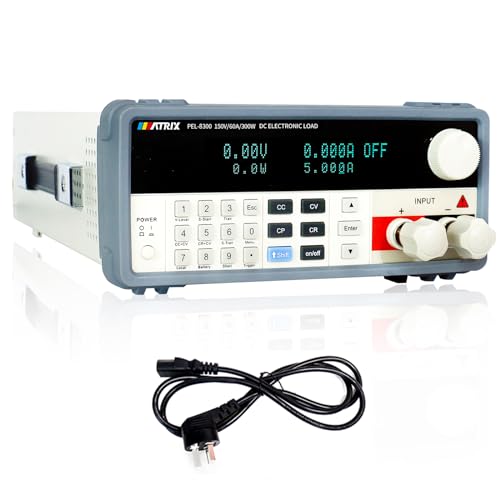
- 150V, 60A, and 300W single-channel capacity
- 0.1mV/0.1mA resolution and stated 0.03% basic accuracy
- Calibration certificate, VFD display, and trigger I/O
Best For: Precision-oriented lab and engineering testing
Expanded Test Coverage
ET5410A+ 400W Programmable Load

- 0–150V, 0–40A, and 400W load capacity
- 12 modes covering battery, LED, dynamic, scan, and list testing
- 2.8-inch TFT display, USB, key lock, and fan control
Best For: Higher-power charger, supply, battery, and LED testing
Best for Fast Dynamic Testing – Siglent SDL1020X-E
Siglent Technologies SDL1020X-E Programmable DC Electronic Load,1 Channel,150 V/30 A, 200 W
Check Price On AmazonThe Siglent SDL1020X-E is one of the more capable programmable electronic loads for testing power supplies, batteries, and other DC sources. Its 150 V, 30 A, and 200 W ratings are paired with fast dynamic operation and a 100-step list function for repeatable test sequences.
Best For: Engineers who need high-speed transient testing and programmable test routines from a single-channel bench load.
Pros:
- Supports CC, CV, CR, CP, and dynamic operating modes.
- CC dynamic testing reaches 25 kHz, with adjustable current rise time.
- List function supports up to 100 editable steps.
Cons:
- Maximum power is 200 W, lower than some similarly rated alternatives.
- Its listed dimensions and 15-pound weight make it less portable.
The SDL1020X-E stands out when dynamic response and repeatable sequencing matter more than compact size. It is a strong choice for lab users working within its 200 W limit.
Best for Automated Battery Testing – OWON OEL1530
The OWON OEL1530 is a versatile 300 W programmable electronic load with USB, RS232, and RS485 connectivity. It combines four operating modes, 5 kHz dynamic testing, SCPI support, and PC-managed battery charge/discharge testing for development and production workflows.
Best For: R&D and production users building automated power-supply or battery test systems.
Pros:
- Provides 0–150 V, 0–30 A operation with a 300 W maximum.
- Supports USB, RS232, RS485, and SCPI control.
- Includes battery charge/discharge testing and multiple protection features.
Cons:
- Dynamic testing is limited to 5 kHz.
- The 2.8-inch display is smaller than some competing bench-load screens.
With its broad communications options and battery-test workflow, the OEL1530 is particularly practical for automated setups. Its 300 W rating also gives it useful headroom for general bench testing.
Best for Interface-Rich Power Testing – Rigol DL3021
The Rigol DL3021 is a 200 W programmable electronic load designed for battery, power-supply, and transient-response testing. It supports 150 V and 40 A operation, four load modes, 15 kHz dynamic testing, and remote control through LAN, USB, and RS232.
Best For: Lab and production users who value fast dynamic testing, multiple interfaces, and a large visual display.
Pros:
- Supports CC, CV, CR, and CP operating modes.
- 15 kHz dynamic mode includes adjustable rise speed up to 5 A/µs.
- Offers LAN, USB, and RS232 control with SCPI support.
Cons:
- Maximum power is 200 W.
- At 7.34 kg, it is relatively heavy for a bench instrument.
The DL3021 is a well-rounded option when connectivity and clear parameter visibility are priorities. Its high current rating is useful for battery and supply testing, provided the 200 W limit fits the application.
Best for Higher-Voltage DUTs – OWON OEL3020
The OWON OEL3020 extends programmable electronic load testing to sources as high as 300 V while retaining a 300 W maximum power rating. It provides CC, CV, CR, and CP modes, 5 kHz dynamic testing, SCPI connectivity, and PC-controlled battery test functions.
Best For: Users testing higher-voltage power supplies, converters, and battery systems within a 20 A and 300 W envelope.
Pros:
- Supports up to 300 V, 20 A, and 300 W.
- Includes USB, RS232, RS485, and SCPI control.
- Offers dynamic testing, battery cycling, and multiple protection functions.
Cons:
- Maximum current is 20 A, lower than the OEL1530’s 30 A rating.
- Dynamic frequency is limited to 5 kHz.
The OEL3020 is the better fit of these OWON models when voltage range is the deciding factor. Its 300 V capability adds flexibility for higher-voltage DUTs, while the 300 W rating supports general bench and automated testing.
High-Speed Bench Load – Rigol DL3031A
The Rigol DL3031A is a capable choice for programmable electronic loads when you need substantial DC power handling and fast dynamic testing. Its single-channel design supports up to 150 V, 60 A, and 350 W, with selectable CC, CV, CR, and CP modes for power-supply, battery, and component evaluation.
Best For: Engineers who need high current capacity, detailed readback resolution, and dynamic testing up to 30 kHz.
Pros:
- Supports up to 150 V, 60 A, and 350 W.
- Dynamic operation reaches 30 kHz with adjustable current rise speed.
- Includes RS232, USB, and LAN interfaces plus battery, OCP, and OPP testing.
- Provides 0.1 mV and 0.1 mA readback resolution.
Cons:
- Its 7.34 kg weight makes it less convenient for portable work.
- It is a single-channel load.
- May provide more capacity and features than basic bench testing requires.
With its high power rating, protection features, multiple interfaces, and fast transient capability, the DL3031A is a strong fit for demanding lab and automated-test setups.
Wide-Voltage Test Platform – OWON OEL6030
The OWON OEL6030 is a flexible option among programmable electronic loads, combining a 600 V maximum voltage rating with 30 A current and 300 W power handling. It adds USB, RS232, and RS485 connectivity with SCPI support, making it practical for both manual bench work and automated testing.
Best For: R&D and production environments that need wide-voltage testing, computer control, and battery charge/discharge analysis.
Pros:
- Handles up to 600 V, 30 A, and 300 W.
- Supports CC, CV, CR, and CP operating modes.
- Offers 5 kHz dynamic testing with adjustable current rise rate.
- Includes battery testing, SCPI control, and OCP, OVP, OPP, OTP, and reverse-polarity protection.
Cons:
- Its 300 W maximum power is lower than the Rigol DL3031A’s rating.
- Dynamic testing is limited to 5 kHz.
- The 2.8-inch display is smaller than some larger bench instruments.
The OEL6030 stands out for its 600 V range and broad connectivity, while its compact 2.5 kg form factor makes it easier to move between bench and field applications.
Compact Desktop Tester – DH-801 120W Electronic Load
The DH-801 offers a straightforward, desktop approach to programmable electronic loads for batteries, power supplies, and other DC sources. It supports 0–150 V, 0–20 A, and up to 120 W, with CC, CV, CR, CP, and short-circuit testing modes selected from its front panel.
Best For: Home labs, electronics technicians, and users who want essential DC load modes with watt-hour and amp-hour measurement.
Pros:
- Provides CC, CV, CR, CP, and short-circuit testing.
- Supports up to 150 V and 20 A within a 120 W power limit.
- Measures watt-hours and amp-hours for battery and supply testing.
- Uses front-panel buttons, adjustment knobs, and a clear LED display.
Cons:
- Its 120 W maximum is lower than the other listed models.
- No computer communication interface is specified in the supplied notes.
- The notes do not specify dynamic testing capability.
For basic bench testing, the DH-801 keeps operation accessible while still covering the most useful constant-mode tests and battery capacity measurements.
Versatile Bench Testing – ET5406A+ 200W Programmable Load
The ET5406A+ is a practical choice for programmable electronic loads when you need one instrument for charger, power-supply, adapter, and battery testing. Its 0–120V, 0–20A, and 200W range is paired with CC, CV, CR, and CP modes, plus dynamic, list, scan, battery, and short-circuit tests.
Best For: Bench users testing chargers, DC power supplies, batteries, and other DC output devices.
Pros:
- Supports up to 200W, 120V, and 20A in a single channel.
- Offers 1mV/10mV voltage and 1mA/10mA current resolution.
- Includes battery capacity testing, dynamic testing, and USB PC control.
- Built-in over-voltage, over-current, over-power, over-temperature, and reverse-polarity protections.
Cons:
- Its 200W rating and 20A maximum may not suit higher-power applications.
- It is a single-channel tester.
Choose this model if you want broad test coverage and remote USB operation in a relatively compact bench instrument. The multiple modes make it more flexible than a basic fixed-load tester, especially for battery discharge and transient-response work.
High-Resolution Lab Work – MATRIX PEL8300 300W Load
The MATRIX PEL8300 is a strong option among programmable electronic loads for users who prioritize high resolution and documented accuracy. This single-channel unit handles up to 150V, 60A, and 300W, with static CC, CV, CR, and CP modes plus dynamic and short-circuit functions.
Best For: Lab and engineering work involving DC supplies, batteries, amplifiers, transformers, and other powered equipment.
Pros:
- Provides a 150V, 60A, 300W operating specification.
- Offers 0.1mV and 0.1mA resolution with stated 0.03% basic accuracy.
- Includes a calibration certificate and external trigger input/output.
- Uses a bright VFD screen and includes over-voltage, over-current, over-power, over-temperature, and reverse-polarity protection.
Cons:
- It is a corded, single-channel instrument.
- Its 10.8-pound weight and larger dimensions may limit portability.
The PEL8300 stands out when fine measurement resolution and a higher current ceiling matter more than compact size. The included calibration certificate and trigger connections also make it appealing for more structured testing setups.
Expanded Test Coverage – ET5410A+ 400W Programmable Load
The ET5410A+ is designed for demanding programmable electronic loads applications, offering a 400W, 0–150V, 0–40A range. It combines high-resolution measurements with 12 test modes, including battery, LED, dynamic, scan, list, and short-circuit testing, making it useful for power-supply and battery evaluation.
Best For: Users who need higher power and broader automated test functions for chargers, supplies, batteries, and LEDs.
Pros:
- Provides up to 400W, 150V, and 40A of programmable load capacity.
- Supports 1mV/10mV voltage and 1mA/10mA current resolution.
- Includes 12 common modes, including battery, LED, dynamic, scan, list, and short-circuit tests.
- Features a 2.8-inch TFT LCD, key lock, USB interface, and intelligent fan control.
Cons:
- The supplied details do not specify the exact operating limits for each individual test mode.
- It is a corded unit intended for powered bench use.
Compared with lower-power options, the ET5410A+ gives you more headroom for higher-current and higher-wattage testing while retaining broad test functionality. Its display, key lock, USB connection, and protection features support repeatable day-to-day bench work.
How We Picked These Programmable Electronic Loads
We selected models across common bench-testing needs, comparing maximum voltage, current, and power ratings; supported constant-current (CC), constant-voltage (CV), constant-resistance (CR), and constant-power (CP) modes; dynamic-load performance; measurement resolution; and computer connectivity. USB and RS-232 support can simplify automated test setups, while battery-capacity functions are useful for repeatable discharge testing.
Ratings are maximum limits, not operating targets. A load should be chosen with comfortable headroom, particularly when testing sources that may produce sustained heat or brief transients.
Quick Comparison
- For general 150V bench work: Siglent SDL1020X-E, OWON OEL1530, and Rigol DL3021 cover common 200W to 300W applications.
- For higher voltage: OWON OEL3020 reaches 300V, while the OEL6030 is designed for applications up to 600V.
- For higher current or faster dynamics: Rigol DL3031A, MATRIX PEL8300, and ET5410A+ offer stronger current or power capabilities.
- For compact, lower-power testing: the 120W programmable load and ET5406A+ suit smaller supplies, modules, and battery packs.
Key Buying Factors for Programmable Electronic Loads
Voltage, Current, and Power Envelope
Check all three limits together. A 300W load may accept high voltage only at a reduced current, and maximum current may be thermally limited. Compare the intended test point with the manufacturer’s derating information when available.
Modes and Transient Performance
CC is useful for battery discharge and supply regulation tests; CV can simulate regulated loads; CR suits resistance-style testing; and CP maintains a target power level. Faster dynamic response and higher bandwidth matter when evaluating transient behavior, control loops, or rapidly changing loads.
Readback, Protection, and Control
Look for suitable voltage and current resolution, over-voltage, over-current, over-power, and over-temperature protection, plus clear front-panel controls. USB or RS-232 is valuable for data logging and automated test sequences. Confirm software compatibility before building a computer-controlled setup.
Thermal Management
Electronic loads convert test power into heat. Adequate airflow, fan noise tolerance, duty cycle, and safe spacing are important for continuous testing. Do not assume the maximum rating is suitable for uninterrupted operation without checking thermal specifications.
Who Should Buy Which Programmable Electronic Loads?
Choose a 120W or ET5406A+ model for light-duty development, small adapters, compact power supplies, and basic battery-capacity checks. Choose the Siglent, OWON OEL1530, or Rigol DL3021 for versatile everyday lab work around the 150V, 200W-to-300W range.
Choose the OEL3020 or OEL6030 when voltage headroom is the priority, but verify insulation, cabling, and safety requirements before testing high-voltage sources. Choose the Rigol DL3031A or MATRIX PEL8300 for demanding higher-current applications and finer readback. Choose the ET5410A+ when a 400W rating and battery-oriented testing are more important than compact size.