Choosing an electronic load under $500 means balancing power capacity, control modes, measurement accuracy, and connectivity. The right model can simplify battery capacity tests, power-supply validation, and USB or DC source troubleshooting without the cost of a high-end analyzer.
This roundup covers compact USB testers, adjustable constant-current loads, and programmable bench instruments from 35W to 400W. Use the buying guide below to narrow the options by test type, voltage and current requirements, and workflow.
Best 10 Electronic Loads Under 500 Picks for 2026
Compact USB Load Tester
Adjustable 25W Discharge Module
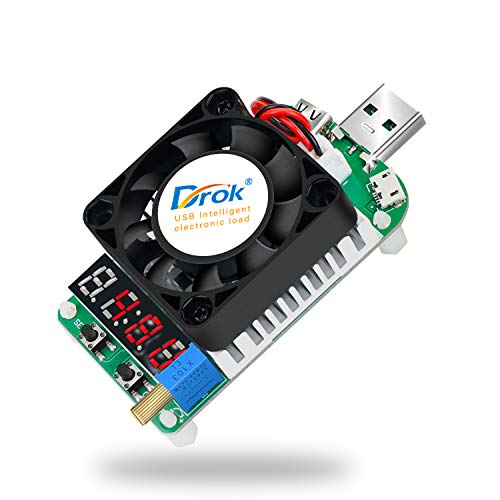
- 0.25A–4A adjustable constant-current loading
- LED readout for voltage, current, and power
- Temperature-controlled fan with protection features
Best For: USB charger, cable, and low-power discharge testing
Programmable Bench Load
Rigol DL3021 200W Electronic Load

- CC, CV, CR, and CP operating modes
- 15kHz dynamic testing capability
- LAN, USB, RS232, and SCPI control
Best For: Automated lab testing, battery evaluation, and power-supply development
High-Power Programmable Load

- 400W, 150V, and 40A operating capability
- Six load modes plus dynamic and battery tests
- TFT display with USB remote control
Best For: High-power testing of supplies, chargers, batteries, and LED drivers
Best Overall

- Handles up to 20A and 150W
- 1.77-inch display shows key test data
- Adjustable protections and active cooling
Best For: Battery aging tests and compact bench monitoring
Best Budget Module
Adjustable 35W Constant Current Load

- Fine 0.01A current adjustment
- Automates capacity and discharge-time tracking
- Multiple protections plus reverse-polarity protection
Best For: Low-power battery and power-supply testing
Best Programmable Option

- 300V, 20A, and 300W maximum ratings
- USB, RS232, RS485, and SCPI control
- Four modes and dynamic testing up to 5kHz
Best For: Automated lab testing and battery characterization
Precision Pick
Ransanx EL15 150W Programmable DC Load

- 150W, 60V, and 12A capacity
- CC, CV, and CP modes
- 1mV/1mA resolution with LCD monitoring
Best For: Compact battery and power-supply testing
Dual-Channel Choice
ET5420A+ 400W Programmable Load

- Two 200W channels, 400W total
- 0–150V and up to 40A total
- USB and RS485 connectivity
Best For: Multi-channel battery, LED, and charger testing
Feature-Rich Value
ET5410A+ 400W Electronic Load Tester
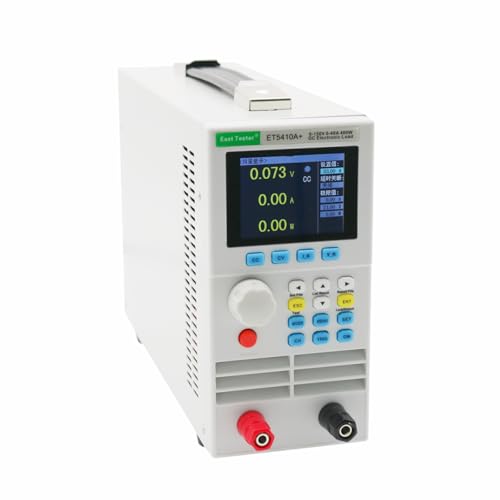
- 400W, 150V, and 40A range
- Six core programmable load modes
- Battery, LED, dynamic, and scanning tests
Best For: Broad power-supply and battery test coverage
Compact USB Load Tester – Adjustable 25W Discharge Module
For buyers comparing electronic loads under 500, this compact USB and Type-C module is designed for charger, cable, and low-power discharge testing. It provides adjustable constant-current loading from 0.25A to 4A, with voltage, current, and power shown on its four-digit LED display.
Best For: Testing USB chargers, Micro USB and Type-C cables, and other DC sources within its 25W, 25V, and 4A limits.
Pros:
- Adjustable constant-current load from 0.25A to 4A
- Displays voltage, current, and power readings
- Includes temperature-controlled cooling fan and multiple protections
- Supports automatic or manual recovery after protection events
Cons:
- Its 25W maximum limits it to lower-power testing
- No reverse-connection protection; incorrect polarity can permanently damage the module
- Must remain within its stated voltage, current, and power ranges
This is a practical, budget-friendly choice for USB-focused work, provided you carefully observe polarity and operating limits.
Programmable Bench Load – Rigol DL3021 200W Electronic Load
Among electronic loads under 500, the Rigol DL3021 is a more capable bench instrument for repeatable battery, power-supply, and transient-response testing. It supports constant-current, constant-voltage, constant-resistance, and constant-power modes, along with programmable interfaces for automated setups.
Best For: R&D engineers, IoT development, and lab users who need programmable 200W DC loading and dynamic testing up to 15kHz.
Pros:
- Supports CC, CV, CR, and CP operating modes
- 15kHz dynamic mode with adjustable current rise speed
- LAN, USB, and RS232 control with SCPI support
- 4.3-inch TFT display and built-in OVP, OCP, and OTP protection
Cons:
- Higher-capability bench equipment may be more than casual users need
- Limited to 200W, 40A, and 150V operating specifications
- Its listed weight is 7.34kg, so it is not a portable tester
The DL3021 is a strong fit when automation, dynamic behavior, and repeatable measurements matter more than compact size.
Color-Display DC Load – 150W Battery Capacity Tester
This adjustable DC load is a versatile option for electronic loads under 500, especially when battery discharge and capacity monitoring are priorities. It handles up to 150W and 20A, while its 2.4-inch TFT screen reports electrical values, capacity, internal resistance, and test status.
Best For: Battery capacity testing and adjustable DC-source evaluation with constant-current, voltage, power, or resistance loading.
Pros:
- Offers 150W maximum power and 20A maximum load current
- Four modes: constant current, voltage, power, and resistance
- Displays voltage, current, power, capacity, internal resistance, and time
- Allows configurable stop voltage, discharge time, and overrun protections
Cons:
- Requires a 12V DC power supply according to the listed specifications
- Maximum ratings are below those of higher-power programmable loads
- External NTC temperature monitoring is required for the temperature-sensing feature
Its combination of battery-oriented measurements and four loading modes makes it a flexible choice for hobby benches and moderate-power discharge work.
High-Power Programmable Load – ET5410A+ 400W DC Tester
For users comparing electronic loads under 500, the ET5410A+ provides the highest stated load capacity in this group at 400W, with a 0–150V input range and up to 40A. Its multiple operating modes, dynamic testing, battery tests, and USB control make it suited to demanding DC evaluation.
Best For: Testing power supplies, chargers, batteries, LED drivers, and other DC equipment that requires programmable loading up to 400W.
Pros:
- Supports up to 400W, 150V, and 40A
- Six modes include CC, CV, CR, CP, CC+CV, and CR+CV
- Includes dynamic, scan, list, short-circuit, and battery tests
- 2.8-inch TFT display, USB control, and extensive protection features
Cons:
- It is a relatively substantial bench unit at the listed dimensions
- Fan-assisted cooling and ventilation may produce operating noise
- Its advanced functions may be unnecessary for simple low-power USB testing
The ET5410A+ is the most capable option here for higher-power programmable testing, particularly when battery and dynamic test functions are important.
Best Overall – 20A 150W Electronic Load
For shoppers comparing electronic loads under 500, this 150W model offers a practical balance of capacity, monitoring, and protection. Its 20A maximum load current and compact color display make it suitable for battery aging tests and general bench testing.
Best For: Battery aging tests and users who want straightforward on-device measurements.
Pros:
- Supports up to 20A and 150W for demanding test tasks.
- Displays voltage, current, power, and cumulative running time.
- Offers adjustable overvoltage, overcurrent, and overpower protection.
- Active cooling uses temperature-controlled fan operation.
Cons:
- Includes no components beyond the listed unit.
- Its 1.77-inch display is smaller than the display on the OWON model.
This is a well-rounded choice when adjustable safety limits and a compact interface matter more than computer connectivity or advanced dynamic testing.
Best Budget Module – Adjustable 35W Constant Current Load
Among electronic loads under 500, this adjustable 35W module is a focused option for low-power battery testing and power-supply evaluation. It accepts DC5.0–30.0V input and provides fine current adjustment with automated capacity and time tracking.
Best For: Low-power discharge testing, unattended aging tests, and users who need fine current control.
Pros:
- Adjusts current in increments as fine as 0.01A.
- Automatically records discharge capacity and run time.
- Supports maximum capacity and discharge-time limits for unattended tests.
- Includes OVP, OCP, OPP, OTP, undervoltage, and reverse-polarity protection.
Cons:
- Limited to 35W and 5A, so it is not intended for higher-power loads.
- Its stated operating voltage range is DC5.0–30.0V.
This module makes the most sense for controlled, lower-power experiments where automated cutoff settings and precise adjustment are more valuable than maximum wattage.
Best Programmable Option – OWON OEL3020 300W DC Load
For buyers searching electronic loads under 500 with more advanced lab functionality, the OWON OEL3020 combines 300V, 20A, and 300W operation with USB, RS232, and RS485 connectivity. It also supports four operating modes and high-speed dynamic testing up to 5kHz.
Best For: R&D benches, automated test systems, and detailed power-supply or battery characterization.
Pros:
- Provides CV, CC, CR, and CP operating modes.
- Supports USB, RS232, RS485, and SCPI control for automation.
- Offers dynamic testing up to 5kHz with adjustable slew rate.
- Includes battery charge/discharge testing and multiple protection features.
Cons:
- At 2.5kg, it is less portable than the smaller modules.
- Its broader feature set may be more than needed for basic load testing.
This is the strongest fit for users who need programmable control, transient testing, or PC-managed battery analysis rather than a simple standalone electronic load.
Precision Pick – Ransanx EL15 150W Programmable DC Load
For shoppers comparing electronic loads under 500, the Ransanx EL15 is a compact 150W option for precise bench testing. It supports up to 60V and 12A, with 1mV/1mA resolution and programmable CC, CV, and CP modes for batteries, power supplies, and components.
Best For: Battery capacity testing, power-supply characterization, and compact workbench setups.
Pros:
- 150W/60V/12A capacity with 1mV/1mA resolution
- CC, CV, and CP programmable operating modes
- 1.9-inch LCD with real-time parameter monitoring
- Aluminum housing, dual fans, banana sockets, and XT30 plugs
Cons:
- Lower power and current capacity than the 400W models in this roundup
- Smaller display than the other listed testers
The EL15 emphasizes portability and measurement precision rather than maximum output. Its compact enclosure and flexible connection options make it a practical choice when 150W is sufficient.
Dual-Channel Choice – ET5420A+ 400W Programmable Load
Among electronic loads under 500, the ET5420A+ stands out for users who need two independent channels. Each channel provides 200W and 20A, while the unit supports up to 150V and 40A total, with USB and RS485 connectivity for testing equipment and data workflows.
Best For: Simultaneous or parallel testing of batteries, chargers, LEDs, and power supplies.
Pros:
- Dual independent 200W channels with 400W total capacity
- Six operating modes, including CC, CV, CR, CP, CC+CV, and CR+CR
- Built-in battery, capacity, resistance, and LED test functions
- 2.8-inch TFT display, USB/RS485 communication, and multiple protections
Cons:
- AC powered rather than battery powered
- White, bench-oriented design may be less convenient for field use
This is the most versatile option for multi-channel work in the supplied list. Its safety protections, intelligent fan control, and communications interfaces add useful flexibility for repeated lab testing.
Feature-Rich Value – ET5410A+ 400W Electronic Load Tester
For electronic loads under 500, the ET5410A+ offers broad testing coverage in a single 400W unit. It handles 0–150V and 0–40A, with six basic modes plus battery, LED, dynamic, scanning, list, and internal-resistance tests.
Best For: Users who want one programmable tester for power supplies, chargers, batteries, LEDs, and USB-connected test setups.
Pros:
- 400W, 150V, and 40A operating range
- CC, CV, CR, CP, CC+CV, and CR+CR modes
- 2.8-inch TFT screen with battery, LED, dynamic, scanning, and list tests
- USB port and device protection functions
Cons:
- At 2.8 kg, it is less portable than the EL15
- Supplied details do not list included components
The ET5410A+ is a strong general-purpose choice when test variety matters more than a lightweight enclosure. Its wide voltage and current range covers substantially more demanding applications than the 150W model.
How We Picked the Best Electronic Loads Under 500
We compared these electronic loads by maximum power, voltage and current range, operating modes, display and control options, dynamic performance, interfaces, and intended use. Models with constant-current control are useful for straightforward discharge and regulation tests, while programmable units with constant-voltage, constant-resistance, or constant-power modes offer more flexibility.
We also considered practical details such as USB or RS232 connectivity, dual-channel operation, battery-capacity measurement features, display readability, and whether a unit is better suited to portable troubleshooting or continuous bench work. Always verify the seller’s specifications, included leads, cooling requirements, and current limits before ordering.
Quick Comparison
| Type | Best suited to | Typical strengths |
|---|---|---|
| USB load tester | Chargers, USB ports, and power banks | Compact size, simple connection, adjustable current |
| 35W–150W adjustable load | Small batteries and low-power supplies | Affordable testing, visible readings, basic discharge work |
| 150W–300W programmable load | Power-supply development and battery testing | Multiple modes, logging or remote control, broader ranges |
| 400W programmable load | Higher-power bench validation | More headroom, higher current capability, advanced testing |
| Dual-channel load | Comparative or multi-output testing | Two-channel operation and better test-bench efficiency |
Key Buying Factors for Electronic Loads Under 500
Power, Voltage, and Current Headroom
Choose a load with more capacity than your normal test target. A 150W unit may suit small adapters and batteries, while 300W or 400W models are safer choices for demanding supplies. Check the maximum voltage and current independently; a unit may not deliver both maximum values simultaneously.
Operating Modes and Dynamic Behavior
Constant current is essential for many discharge tests, but constant voltage, resistance, and power modes can make a programmable load far more versatile. If you need to reproduce changing real-world demand, check dynamic-load frequency and response specifications rather than relying only on the headline wattage.
Measurement and Connectivity
Look for voltage, current, power, and capacity readouts that are easy to interpret. USB or RS232 support is valuable for automated testing, data capture, and repeatable lab procedures. For occasional manual checks, a clear front-panel display may matter more than remote-control features.
Cooling, Protection, and Setup
Electronic loads convert electrical energy into heat, so fan noise, ventilation, thermal protection, and duty-cycle limits matter. Confirm that the included terminals and cables can handle the intended current, and use appropriate external wiring for high-power testing.
Who Should Buy Which Electronic Loads Under 500?
Choose the DROK USB tester for chargers, USB-C sources, and compact power-bank checks. A 35W or 150W adjustable model is a practical choice for hobbyists testing small batteries and low-power adapters. Move to a programmable 150W–300W instrument if you need multiple load modes, repeatable procedures, or computer connectivity.
For higher-power supplies and demanding battery work, a 400W model offers useful headroom. The dual-channel ET5420A+ is the better fit when two outputs must be tested or compared at once, while compact programmable options are more suitable for limited benches. If your work involves safety-critical validation, production testing, or precision characterization, prioritize verified accuracy, calibration support, protections, and software compatibility over the lowest price.