Choosing the right microscope for bacteria viewing comes down to more than just magnification. You need usable optics, stable focus, good lighting, and enough image clarity to actually see small specimens well.
Below, we’ve rounded up 10 strong options for beginners, students, and more advanced users looking for practical microscopes for viewing bacteria at home, in class, or in a lab setting.
Best 10 Microscopes for Viewing Bacteria Picks for 2026
High-Power Pick
100X-2000X Compound Microscope

- 100X–2000X magnification for biological observation
- Includes slides and smartphone adapter
- Dual LED lighting with coarse/fine focus
Best For: students and hobbyists studying prepared biological specimens
Portable Explorer
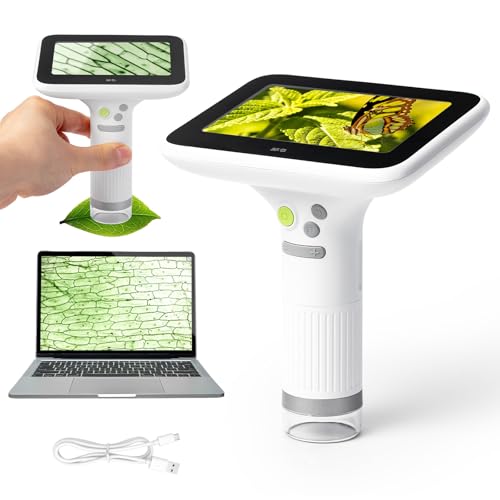
- 4.3-inch LCD screen for easy viewing
- 100x–1000x zoom with photo/video capture
- Portable, rechargeable, and computer compatible
Best For: kids and families doing beginner nature observation
Binocular Biology Pick

- 40X–2500X biological magnification range
- Binocular head with wide-angle eyepieces
- Dual LED lighting and mechanical stage
Best For: beginners and students wanting a lab-style biological microscope
Hands-Free Detail Pick
USB-C Digital Microscope 10X-200X

- 10X–200X range for close inspection
- 8 LEDs with adjustable brightness
- Rotating metal stand for stable viewing
Best For: hobbyists and repair users needing hands-free detail inspection
Professional Binocular Pick

- 40X-2000X magnification range
- Dual LED lighting for different samples
- Binocular head with coarse/fine focus
Best For: Adults and students wanting a comfortable compound microscope for detailed slide viewing
Laboratory-Grade Upgrade
40X-5000X Trinocular Microscope

- Trinocular head with USB camera
- Claimed 40X-5000X magnification
- Large lab-style accessory bundle
Best For: Users who want camera capture and a more advanced lab-oriented microscope
Kid-Friendly Starter
40X-2000X Monocular Microscope Kit

- 40X-2000X magnification for beginners
- Dual LED lights and 5-color filters
- Includes slides, coverslips, and phone holder
Best For: Kids, beginners, and families wanting an easy starter microscope kit
Portable Kids Pocket Microscope
Handheld 1000X 4K STEM Microscope

- 1000X digital magnification with 2MP camera
- Built-in 2.4-inch IPS screen; no computer needed
- 8 LEDs, manual focus, and photo/video storage
Best For: Kids and beginners exploring tiny objects on the go
Student Biological Microscope

- 40X-2000X compound microscope with 4X/10X/40X objectives
- Dual LED lighting for transparent and opaque specimens
- Includes phone adapter and starter slide kit
Best For: Students and home labs studying biological slides
Heavy-Duty Student Compound Microscope

- 100X-2000X range with WF25X eyepiece
- Top and bottom lights for multiple specimen types
- Includes slides, phone adapter, and beginner tools
Best For: Older students and adults wanting a sturdy biology kit
High-Power Pick – 100X-2000X Compound Microscope
If you want microscopes for viewing bacteria, this compound microscope is built for high-magnification biological observation. Its 100X–2000X range, dual LED illumination, and 40X achromatic objective make it a stronger fit for prepared slides and fine specimen work than a basic handheld scope.
Best For: Students, homeschoolers, and adults who want a feature-rich compound microscope for biological study and slide viewing.
Pros:
- 100X–2000X magnification supports detailed biological observation.
- Includes prepared slides and a smartphone adapter for easy sharing.
- Coaxial coarse/fine focus and 45° inclined head improve comfort and control.
- Dual LED lighting helps with clearer viewing in home or classroom use.
Cons:
- Not an electron microscope, so it won’t match lab-grade extreme detail.
- Compound design is less portable than handheld digital models.
Overall, this is the most purpose-built option here for anyone focused on biological specimens rather than surfaces or outdoor finds. It balances higher magnification with a kit-style setup that makes it easier to start observing right away.
Portable Explorer – 4.3" LCD Handheld Microscope
This handheld digital microscope is better suited for casual exploration than for microscopes for viewing bacteria, but it can still be useful for simple close-up learning. The 4.3-inch LCD screen, rechargeable battery, and photo/video capture make it an easy choice for kids who want a portable way to inspect everyday textures and outdoor finds.
Best For: Kids and families looking for a simple portable digital microscope for nature observation and beginner science projects.
Pros:
- Large 4.3-inch screen makes viewing easy without eye strain.
- 100x–1000x zoom supports a wide range of casual close-up viewing.
- Can capture photos and videos for science journals or sharing.
- Works with Windows and Mac for plug-and-play computer viewing.
Cons:
- Handheld digital design is not as suitable as a compound microscope for bacteria viewing.
- Maximum magnification is more limited than dedicated biological microscopes.
For quick inspection, field trips, and kid-friendly discovery, this model is easy to use and easy to carry. If your main goal is bacteria observation, a compound microscope will be the better tool, but this one shines as an entry-level digital explorer.
Binocular Biology Pick – 40X-2500X Compound Microscope
For microscopes for viewing bacteria, this compound binocular model is one of the more relevant choices in the lineup because it’s built for biological observation and high magnification. The wide-angle eyepieces, dual LED lighting, and two-layer mechanical stage make it a practical option for learners who want a more traditional lab-style setup.
Best For: Beginners, students, and hobbyists who want a binocular compound microscope for biology and lab-style specimen work.
Pros:
- 40X–2500X range supports detailed biological viewing.
- Binocular head with wide-angle eyepieces improves comfort for longer sessions.
- Top and bottom LED lights help with different specimen types.
- Mechanical stage and dual focus knobs improve control during observation.
Cons:
- Listed maximum magnification detail varies in the provided specs and bullets.
- Corded setup is less portable than battery-powered microscopes.
This is a strong pick if you want a more conventional biology microscope with a stable viewing setup. It looks especially useful for learners who plan to spend time studying slides and need better comfort during repeated sessions.
Hands-Free Detail Pick – USB-C Digital Microscope 10X-200X
This USB-C digital microscope is better for coins, circuits, skin, and other surface detail than for microscopes for viewing bacteria. Its manual focus, 8 LEDs, and rotating metal stand make it easy to inspect small objects steadily on a phone, tablet-compatible setup, or computer.
Best For: Hobbyists, electronics users, and collectors who want a hands-free digital microscope for close inspection work.
Pros:
- 10X–200X range is useful for coins, circuits, jewelry, and skin.
- 8 LEDs with 3 brightness levels help reduce glare and shadows.
- Rotating metal stand provides stable hands-free viewing.
- Works with iPhone 15+, Android, and PCs via USB-C.
Cons:
- Designed for inspection work, not ideal for biological slide viewing.
- Lower magnification ceiling than dedicated compound microscopes.
As a digital inspection tool, this model is strong on convenience and stability. It makes more sense for surface detail and hobby work than for bacteria study, but the stand and lighting are excellent for close-up tasks.
Professional Binocular Pick – 40X-2000X Compound Microscope
If you’re comparing microscopes for viewing bacteria, this PalliPartners compound binocular microscope gives you a strong 40X-2000X range plus achromatic optics for clearer slide work. Its dual LED lighting and mechanical stage make it easier to find and hold fine details, while the binocular head helps during longer sessions.
Best For: Adults, students, and hobbyists who want a binocular compound microscope for detailed slide observation and comfortable extended use.
Pros:
- 40X-2000X magnification covers a wide range of biological viewing needs.
- Dual LED illumination supports both opaque and transparent specimens.
- Coaxial coarse/fine focus and a mechanical stage improve control.
- Binocular head with 45-degree incline reduces neck strain.
Cons:
- Not a specialized bacteria-only system; slide quality still matters for tiny specimens.
- Phone compatibility is included, but results depend on your mobile setup.
Overall, this is a practical all-around compound microscope for users who want strong magnification, easy focusing, and comfortable viewing. It looks especially suitable for biology learning and general lab-style slide work.
Laboratory-Grade Upgrade – 40X-5000X Trinocular Microscope
For buyers focused on microscopes for viewing bacteria, this trinocular model stands out for its high claimed 40X-5000X range, infinity optical system, and real 195 achromatic objective lens. The included HD USB camera and electronic eyepiece also make it easier to observe, document, and share what you see during lab-style work.
Best For: Users who want a more advanced trinocular microscope with camera support, broad magnification options, and a lab-oriented accessory bundle.
Pros:
- Claimed 40X-5000X magnification offers a very wide observation range.
- Trinocular design includes a high-pixel electronic eyepiece and HD USB camera.
- Real 195 achromatic objective lens and infinity optical system are built for clearer imaging.
- Large accessory pack includes slides, coverslips, tools, and storage items.
Cons:
- More complex than a basic student microscope.
- Higher-end feature set may be more than casual users need.
This is the most feature-packed option in the group, especially if you value camera capture and a lab-style setup. It is the strongest fit for users who want more observation flexibility and a fuller microscope kit.
Kid-Friendly Starter – 40X-2000X Monocular Microscope Kit
If you want microscopes for viewing bacteria in a beginner-friendly format, this Fitense kit offers 40X-2000X magnification, dual LED lighting, and a monocular design that’s easy to approach. The included slides, coverslips, phone holder, and color filters make it a convenient all-in-one setup for home or school use.
Best For: Kids, beginners, and families who want a simple microscope kit with extras for immediate exploring and sharing.
Pros:
- 40X-2000X magnification provides a useful range for introductory slide viewing.
- Top and bottom LED lights help with both solid and transparent specimens.
- 5-color filter wheel adds contrast options for easier viewing.
- Includes slides, coverslips, a phone holder, and a storage bag.
Cons:
- Monocular design is less comfortable for long sessions than binocular models.
- AAA batteries are not included.
This kit is the most beginner-friendly choice here because it packages the basics into one ready-to-use set. It’s a sensible pick for families or students who want straightforward microscope learning without extra complexity.
Portable Kids Pocket Microscope – Handheld 1000X 4K STEM Microscope
If you want microscopes for viewing bacteria in a beginner-friendly format, this handheld digital microscope is best understood as an entry-level learning tool rather than a lab-grade biology instrument. Its 1000X digital magnification, 2MP camera, manual focus, and built-in 2.4-inch IPS screen make it easy to inspect tiny objects without a computer, which is useful for STEM exploration at home or on the go.
Best For: Kids, beginners, and families who want a portable digital microscope for exploring tiny specimens and documenting discoveries.
Pros:
- 1000X magnification with 2MP image capture and a built-in 2.4-inch IPS display
- Standalone operation with no computer required
- Manual focus, anti-shake design, and 8 adjustable LEDs for easier viewing
- Photo and video storage for science projects and nature observations
Cons:
- Designed as a kids’ handheld microscope, not a traditional compound microscope for slides
- Battery life is about 2 hours per charge
- TF card is not included if you want expanded storage
This is a strong pick for curiosity-driven exploration and simple documentation, but it is not the right format if your main goal is routine high-detail bacteria slide viewing. For that use, a compound microscope is usually the better fit.
Student Biological Microscope – 40X to 2000X Dual LED
Among microscopes for viewing bacteria, a compound model like this is the more appropriate style because it is built for biological specimens and slide-based observation. With 40X-2000X magnification, dual LED illumination, and included slides plus a phone adapter, it gives students and home learners a practical setup for examining prepared samples and other transparent specimens.
Best For: Students, school labs, and home educators who want a full-featured compound microscope for biological observation.
Pros:
- 40X-2000X magnification range with 4X, 10X, and 40X objective lenses
- Dual LED lighting for transparent and opaque specimens
- Includes phone adapter, prepared slides, blank slides, cover slips, and tweezers
- Five-color disc diaphragm filter wheel for added contrast control
Cons:
- Requires corded electric power, so it is not fully portable
- More complex than a simple handheld microscope for casual use
- Best suited to slide viewing rather than quick outdoor scouting
This is the most clearly biology-focused option in the group and the strongest match if you want a microscope for slide-based study. It offers the kind of lighting, optics, and accessory kit that make structured learning easier.
Heavy-Duty Student Compound Microscope – 100X to 2000X Kit
If you’re comparing microscopes for viewing bacteria, this compound microscope is the strongest all-around option here because it is built around slide observation, dual lighting, and high magnification. It combines 4X, 10X, and 40X objectives with a WF25X eyepiece, so it is aimed at students and hobbyists who want more control over how specimens appear under the lens.
Best For: Older kids, beginners, and adults who want a sturdy compound microscope with a complete accessory kit.
Pros:
- 100X-2000X viewing range with WF25X eyepiece and 4X/10X/40X objectives
- Top incident light and bottom transmitted light for opaque and translucent specimens
- Includes a phone adapter, prepared slides, blank slides, droppers, tweezers, and instructions
- Metal frame and shockproof packaging for durability and storage
Cons:
- Requires 3 AA batteries or the included AC adapter
- More of a full compound setup than a compact or travel-friendly microscope
- Accessory-rich kit may be more than casual users need
For families or learners who want a sturdier biology microscope with broader lighting options, this is a very capable choice. Its accessory bundle and metal construction make it especially practical for regular at-home or classroom use.
How We Picked the Best Microscopes for Viewing Bacteria
For Microscopes for Viewing Bacteria, raw magnification is only one part of the equation. We prioritized models with solid compound-microscope designs, useful lighting, stable stages, and magnification ranges that can support bacteria observation when paired with proper slides and sample prep. We also favored options that suit different skill levels, from student-friendly kits to more advanced lab-style builds.
Quick Comparison
If you want the simplest setup, a basic compound microscope with reliable illumination is usually the best starting point. If you plan to document slides, a digital or trinocular model adds convenience. Portable digital microscopes are better for general inspection and learning, but they are typically not the first choice for detailed bacteria viewing compared with compound biological microscopes.
Key Buying Factors for Microscopes for Viewing Bacteria
Magnification and Optical Quality
Look for a compound microscope that can realistically support higher-power viewing, but remember that image quality matters more than extreme top-end numbers. For bacteria, clear optics and well-matched eyepieces are more important than inflated marketing magnification.
Lighting and Contrast
Bright, adjustable LED illumination helps you see transparent or lightly stained specimens. Dual lighting can be useful for flexibility, especially when moving between beginner slides and more detailed observations.
Focus and Stage Stability
Fine focusing and a mechanical stage make it much easier to center and track tiny organisms. A shaky stage or loose knobs can make bacteria viewing frustrating, even if the magnification sounds impressive.
Camera and Viewing Options
If you want to capture images or teach from a screen, choose a model with a built-in camera, USB output, or trinocular head. For solo learning, a binocular or monocular compound microscope may be enough.
Who Should Buy Which Microscopes for Viewing Bacteria?
Students and first-time buyers should choose a straightforward compound microscope that balances ease of use and decent magnification. Families and homeschool users may prefer kits with prepared slides and accessories. More serious hobbyists, educators, or lab-oriented users should consider trinocular or higher-stability models with better stage control and imaging support. If your goal is specifically bacteria observation, prioritize optical clarity and stable illumination over portable convenience.