The best signal generators under $500 make it easier to test circuits, simulate sensors, troubleshoot audio equipment, and prototype control systems without investing in lab-grade equipment.
This roundup includes compact DDS modules, bench-style function generators, audio-focused units, and industrial current or voltage simulators. Compare output types, frequency ranges, controls, and connectivity to find the right fit for your work.
Best 10 Signal Generators Under 500 Picks for 2026
Versatile Bench Choice
YERTAI ET3320C 20MHz DDS Generator

- 20MHz DDS output with dual channels
- 32 arbitrary waveforms and 50-user storage sets
- Built-in 100MHz frequency counter and USB
Best For: Bench electronics testing and waveform experimentation
Simple Process Simulator
DROK 4-20mA and 0-10V Generator

- Outputs 0/4-20mA current signals
- Provides 0-10V voltage output
- Compact 4.6-ounce manual-adjustment design
Best For: PLC, panel, LED, and analog control testing
Compact DDS Module
FG-200 500kHz Function Generator

- 0.01Hz-500kHz sine-wave range
- Sine, square, and sawtooth outputs
- Filter, DC offset, amplitude, and save functions
Best For: Portable oscilloscope and audio-circuit testing
Portable Industrial Tester
Riiai SG003A Multi-Signal Generator

- 0-24mA, 0-24V, passive-current, and pulse modes
- 3000mAh battery with up to 26 hours of use
- Programmable rise, fall, cycle, PWM, and conversion
Best For: PLC testing and field industrial troubleshooting
Versatile DDS Pick
SEESII 500kHz DDS Signal Generator

- 1Hz–500kHz output range
- Four selectable waveform types
- Adapter or external battery operation
Best For: Portable circuit testing, calibration, and classroom use
Portable Control-Signal Pick
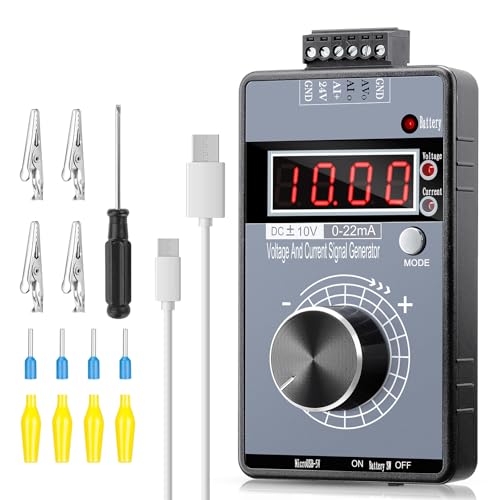
- Adjustable voltage and current output
- Four-digit display with multiple modes
- Rechargeable and externally powered
Best For: PLC, panel, valve, and industrial-control debugging
Bench Audio Pick
ECUTEE 10Hz–1MHz Signal Generator

- 10Hz–1MHz frequency range
- Sine and square wave output
- Six-step attenuator plus level control
Best For: Audio amplifier testing and low-frequency bench work
Best Portable Process-Control Pick
Riiai 0-10V/4-20mA Signal Generator
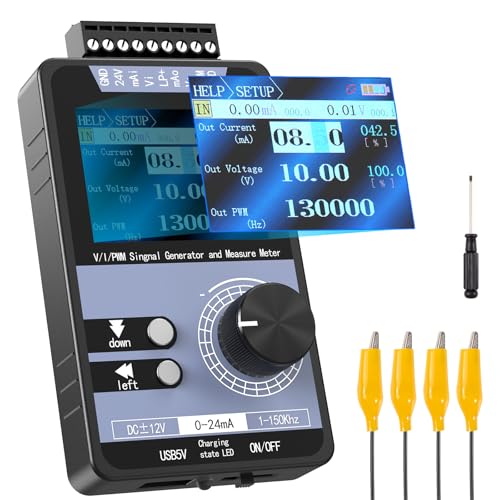
- Combines output, measurement, and PWM functions
- Rechargeable, compact, and suitable for field use
- Supports calibration, storage, and protection features
Best For: Industrial control testing and portable field maintenance
Best Compact Waveform Variety
DDS 1Hz-500kHz Mini Signal Generator

- Generates multiple standard and arbitrary waveforms
- Covers 1Hz to 500kHz
- Compact design with portable power options
Best For: General electronics testing, audio work, and learning
Best Ultra-Low-Frequency Range
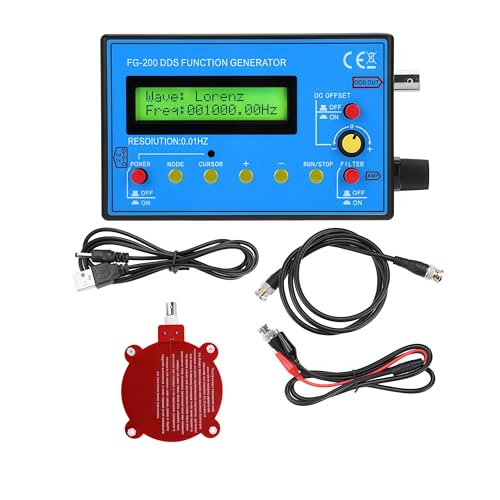
- Offers 0.01Hz resolution
- Includes 15 waveform types
- Portable design with a 7.83Hz resonator feature
Best For: Teaching, field testing, and low-frequency signal experiments
Versatile Bench Choice – YERTAI ET3320C 20MHz DDS Generator
For shoppers comparing signal generators under 500, the YERTAI ET3320C is a capable bench-oriented option with dual channels, DDS output, arbitrary waveforms, USB communication, and built-in frequency counting. Its 2.4-inch TFT display and 600g weight also make it relatively convenient to operate and move.
Best For: Electronics testing, waveform experimentation, and users who need dual-channel output with frequency-counter functionality.
Pros:
- 20MHz frequency range with a 200MSa/S sampling rate and 13-bit vertical resolution.
- Includes five basic waveforms, 32 arbitrary waveforms, and storage for 50 customized waveforms.
- Supports ASK, FSK, and PSK modulation plus USB communication.
- Built-in 100MHz high-precision frequency counter and 32-bit counter.
Cons:
- Arbitrary waveform editing software must be obtained from the manufacturer.
- The supplied notes do not specify output amplitude limits or detailed dual-channel controls.
The ET3320C stands out when waveform flexibility and measurement features matter more than ultra-compact size. Its one-year warranty and broad function set make it a practical candidate for a general electronics bench.
Simple Process Simulator – DROK 4-20mA and 0-10V Generator
Among signal generators under 500, the DROK 4-20mA Generator is a focused tool for industrial control work rather than general waveform generation. It produces adjustable current or voltage signals from one compact module, with control handled by a multi-cycle precision potentiometer.
Best For: Adjusting PLC, panel, valve, and LED test signals where 0/4-20mA or 0-10V simulation is required.
Pros:
- Generates both 0/4-20mA current and 0-10V voltage signals.
- Combines ampere and voltage output in one module.
- Compact 4.6-ounce design is easy to carry between test locations.
- Multi-cycle precision potentiometer enables straightforward manual adjustment.
Cons:
- It is designed for current and voltage simulation, not broad waveform generation.
- The supplied notes do not list a rechargeable battery or display.
This DROK is a sensible choice when the task is simple analog signal adjustment. Its compact form and dual output modes keep it practical for field checks and basic control-panel testing.
Compact DDS Module – FG-200 500kHz Function Generator
For buyers seeking signal generators under 500 for portable circuit work, the FG-200 offers a compact DDS signal source with a 0.01Hz to 500kHz sine-wave range. It is intended to pair with an oscilloscope for circuit debugging, amplifier testing, response measurements, and calibration tasks.
Best For: Portable oscilloscope work, audio-amplifier testing, probe adjustment, and basic frequency-sweep or calibration tasks.
Pros:
- Sine-wave output ranges from 0.01Hz to 500kHz; other listed waveforms reach 100kHz.
- Provides sine, square, and sawtooth waveforms with adjustable amplitude and DC bias.
- Includes selectable filters, shutdown function, and saved settings.
- Can run from a recommended 4-9V DC adapter or a 3.7V lithium battery.
Cons:
- Output amplitude may decrease as sine-wave frequency increases.
- It is a small module, so the supplied notes do not indicate a full benchtop enclosure or extensive connectivity.
- Other waveform modes have a listed 100kHz range, below the sine-wave maximum.
The FG-200 is best viewed as a compact signal source for hands-on electronics work. Its filters, DC offset, saved settings, and low-frequency resolution add useful flexibility, while its module format may suit builders who already have supporting test equipment.
Portable Industrial Tester – Riiai SG003A Multi-Signal Generator
The Riiai SG003A is a strong option for signal generators under 500 when industrial signal simulation and portability are priorities. It handles current, voltage, passive-current, and pulse modes, while its rechargeable battery and color screen support extended field use.
Best For: PLC testing, industrial control troubleshooting, and technicians who need programmable current, voltage, pulse, and conversion functions.
Pros:
- Supports 0-24mA, 0-24V, passive current, and 0-9999Hz pulse output modes.
- Offers fine stated resolution of 0.01mA or 0.01V, with five-digit pulse precision.
- 3000mAh rechargeable battery provides up to 26 hours of working time.
- Includes programmable rise, fall, cycle, PWM, and signal-conversion interfaces.
Cons:
- Charging through the micro 5V USB port may be less convenient than newer USB-C designs.
- The broad interface set may take more time to learn than a simple manual simulator.
- Its functions are oriented toward industrial signal testing rather than general RF or arbitrary-waveform generation.
With its color display, extensive signal modes, and long battery life, the SG003A is especially appealing for field technicians. It provides considerably more automation and conversion capability than a basic 4-20mA hand adjuster.
Versatile DDS Pick – SEESII 500kHz DDS Signal Generator
If you need signal generators under 500 for waveform testing, the SEESII offers a broad 1Hz–500kHz range in a compact package. Its sine, square, triangle, and sawtooth outputs make it suitable for basic circuit, amplifier, and oscilloscope work, while the separate 7.83Hz Schumann resonator adds a distinctive extra function.
Best For: Classroom instruction, lab work, field testing, and users who want multiple waveform types in a portable DDS generator.
Pros:
- Wide 1Hz–500kHz frequency range with four waveform options.
- Switchable filter helps optimize sine and pulse outputs.
- Can run from an AC/DC adapter or an external battery pack.
- Compact 12.3-ounce design is convenient for mobile testing.
Cons:
- The external battery pack is not included.
- The Schumann resonator may be unnecessary for conventional electronic testing.
Choose this model when portability and waveform variety matter more than advanced bench-instrument features. It is a flexible option for routine testing, calibration, and audio-related work.
Portable Control-Signal Pick – Riiai 0-10V/4-20mA Generator
For industrial troubleshooting on a budget, the Riiai is one of the more application-specific signal generators under 500. It generates adjustable voltage and current signals, shows readings on a four-digit display, and includes a rechargeable battery for convenient PLC, valve, and controller testing.
Best For: PLC and panel debugging, frequency-converter checks, flow-valve testing, servo-motor control, and other 0-10V or 0/4-20mA applications.
Pros:
- Generates -10V to +10V and 0-22mA signals with 0.01-unit precision.
- Four display modes provide flexible voltage, current, percentage, and frequency readouts.
- Built-in 1,000mAh rechargeable battery supports portable use.
- Short-circuit and reverse-connection protection add practical safeguards.
Cons:
- It is designed for voltage and current signals rather than general waveform generation.
- Charging uses a micro USB port.
This is the strongest fit for technicians who need controllable process signals rather than audio or oscillator waveforms. Its small size, programmable output points, and multiple power options make field debugging easier.
Bench Audio Pick – ECUTEE 10Hz–1MHz Signal Generator
The ECUTEE is a straightforward choice among signal generators under 500 for low-frequency and audio bench work. It covers 10Hz–1MHz, provides sine and square waves, and combines a six-step attenuator with a level regulator for practical output adjustment.
Best For: Audio amplifier gain measurements, sine-wave oscillator work, and benchtop testing where simple analog-style controls are preferred.
Pros:
- 10Hz–1MHz range divided across five frequency ranges.
- Provides both sine and square wave outputs.
- Six-step 10dB attenuator and level regulator support output adjustment.
- Sine output is rated above 5Vrms unloaded and above 2.8Vrms at 600Ω.
Cons:
- At 4.85 pounds, it is less portable than the compact alternatives.
- Its supplied notes list only sine and square waveforms.
- The listed version is intended for 110V operation.
Pick the ECUTEE when you want a dedicated, easy-to-operate bench generator for audio and low-frequency measurements. Its vertical panel layout and calibrated scale favor hands-on use over compact field portability.
Best Portable Process-Control Pick – Riiai 0-10V/4-20mA Signal Generator
For shoppers comparing signal generators under 500, the Riiai is a practical choice for current-loop and voltage testing. It combines output, measurement, and PWM functions in a compact rechargeable unit, making it useful for bench work and on-site maintenance.
Best For: Industrial control testing, field troubleshooting, and technicians who need current, voltage, and PWM functions in one portable tool.
Pros:
- Combines current and voltage output, current and voltage measurement, and PWM output.
- Supports customizable 0-24mA current and ±12V voltage output with stated accuracy specifications.
- Rechargeable 1500mAh battery, USB-C charging, and compact 7.4-ounce design support portable use.
- Includes one-click calibration, parameter storage, and short-circuit and reverse-connection protection.
Cons:
- Its feature set is focused on industrial current, voltage, and PWM tasks rather than a broad waveform library.
- The supplied notes do not specify a frequency range for the PWM output.
Choose this model when portability and process-signal testing matter more than advanced laboratory waveform generation. Its integrated functions can reduce the need to carry separate meters and signal sources.
Best Compact Waveform Variety – DDS 1Hz-500kHz Mini Signal Generator
Among signal generators under 500, this DDS mini kit stands out for its broad waveform selection and stated 1Hz-500kHz range. Its compact controls and portable power options make it a flexible option for electronics testing, audio work, and development tasks.
Best For: Students, hobbyists, and electronics users who need sine, square, triangle, pulse, and arbitrary waveform generation in a small unit.
Pros:
- Generates sine, square, triangle, pulse, and arbitrary waveforms.
- Offers modulation capabilities for simulating and analyzing communication-system techniques.
- Provides a 1Hz-500kHz frequency range with stated precise and stable signal output.
- Compact 7.4-ounce design and intuitive controls support portable use.
Cons:
- The supplied notes do not list specific accuracy, distortion, amplitude, or modulation figures.
- The notes mention AC/DC adapter or battery operation but do not identify battery runtime.
This is a versatile general-purpose pick when waveform variety and portability are priorities. Buyers needing fully documented laboratory specifications should verify the detailed output and modulation limits before purchase.
Best Ultra-Low-Frequency Range – 0.01Hz-500kHz DDS Generator
For signal generators under 500 that need very fine low-frequency control, this DDS model offers a 0.01Hz resolution and a broad waveform menu. Its small size and low stated cost make it suited to teaching, field use, and general signal experimentation.
Best For: Users who need ultra-low-frequency generation, varied waveform types, or the included 7.83Hz Schumann resonator feature.
Pros:
- Provides a 0.01Hz-500kHz sine-wave range with 0.01Hz resolution.
- Includes 15 waveform types, including sine, square, triangle, sawtooth, pulse, noise, and Schumann waveforms.
- Includes a 7.83Hz Schumann resonator transmitting antenna.
- Small 11.7-ounce design is easy to transport for teaching and field testing.
Cons:
- Other waveform types are limited to a stated maximum of 100kHz.
- The supplied notes do not provide detailed amplitude, accuracy, distortion, or output-drive specifications.
- The wellness-related Schumann resonator claims are not a substitute for medical guidance or established testing specifications.
This generator is a strong fit when frequency resolution and waveform variety are more important than extensive published electrical specifications. Confirm output requirements if you plan to use it for demanding bench measurements.
How We Picked the Best Signal Generators Under 500
We focused on generators that cover practical testing and prototyping tasks while staying below the $500 price range. The selection includes standard function generators, DDS signal sources, audio-frequency models, and 0–10V or 4–20mA process simulators. We considered frequency range, waveform support, adjustment precision, display readability, output flexibility, portability, and the intended application.
Because these products serve different users, the list is not ranked solely by maximum frequency. A compact module may be more useful for embedded projects, while a dedicated process simulator is a better choice for PLC and industrial control testing.
Quick Comparison
| Type | Best For | Typical Outputs | What to Check |
|---|---|---|---|
| Bench or DDS function generator | General electronics testing | Sine, square, sawtooth, arbitrary waveforms | Frequency range, amplitude control, frequency counter |
| Current/voltage simulator | PLC, panels, sensors, and control loops | 0–10V and 0/4–20mA | Loop power, adjustment resolution, display, wiring |
| Audio signal generator | Amplifier and speaker testing | Low-frequency sine and related signals | Output level, distortion, connectors, frequency stability |
| Mini signal generator module | DIY and embedded projects | Basic DDS waveforms | Power requirements, enclosure, controls, and included accessories |
Key Buying Factors for Signal Generators Under 500
Frequency Range and Resolution
Choose a frequency range that exceeds your highest planned test frequency. Resolution matters when tuning filters, clocks, audio equipment, or control loops. A wide range is useful, but accuracy and stability can be more important than a headline maximum.
Waveforms and Output Control
Sine, square, and sawtooth waveforms cover many basic jobs. Arbitrary waveform support adds flexibility for nonstandard signals, while adjustable amplitude, offset, duty cycle, and modulation controls improve circuit testing. Verify the actual output level and load limits before connecting sensitive equipment.
Industrial Signal Compatibility
For PLCs, transmitters, and automation panels, look for the required 0–10V, 0–20mA, or 4–20mA ranges. Confirm whether the unit sources loop power or only simulates a signal, and check terminal polarity and wiring requirements.
Controls, Display, and Connectivity
A clear display and direct controls speed up repeated adjustments. USB communication can help with computer-based testing, while a compact module may be preferable when space and cost matter. For bench work, also consider enclosure quality, power input, and connector placement.
Who Should Buy Which Signal Generators Under 500?
Choose a full DDS or bench-style function generator for broad electronics work, waveform experiments, and frequency-response testing. Audio technicians should prioritize a model designed around low-frequency output and convenient level adjustment. Automation technicians should choose a dedicated 0–10V or 4–20mA simulator with clear readings and the appropriate loop behavior. DIY builders and students may prefer a small DDS module, provided they are comfortable supplying power and building or protecting the unit themselves.
Before buying, match the generator’s output specifications to the equipment under test. The right signal generator is the one that provides the required signal cleanly, safely, and with controls you can use confidently.