The best 3D printers for hobbyists make it easier to turn digital designs into useful parts, creative projects, and personalized gifts. Today’s models range from compact beginner machines to fast printers with automated calibration and multi-color support.
We selected 10 standout options across different budgets, sizes, and skill levels so you can find a printer that matches your workspace, materials, and plans for future upgrades.
Best 10 3d Printers for Hobbyists Picks for 2026
Best Beginner Pick

- Automatic calibration simplifies setup
- Fast, quiet, and detail-focused printing
- Multicolor available with AMS lite
Best For: Beginners, kids, and easygoing hobby projects
Best Advanced Multicolor System

- Four independent toolheads for true multicolor printing
- 5-second changes reduce waiting and filament waste
- Supports rigid, flexible, and engineering materials
Best For: Makers and hobbyists pursuing advanced mixed-material projects
Best Fast Open-Frame Value

- Up to 600mm/s printing speed
- One-click automatic leveling
- Open design with easy plate and nozzle changes
Best For: Fast PLA, PETG, and TPU hobby printing
Best Enclosed Multicolor Pick
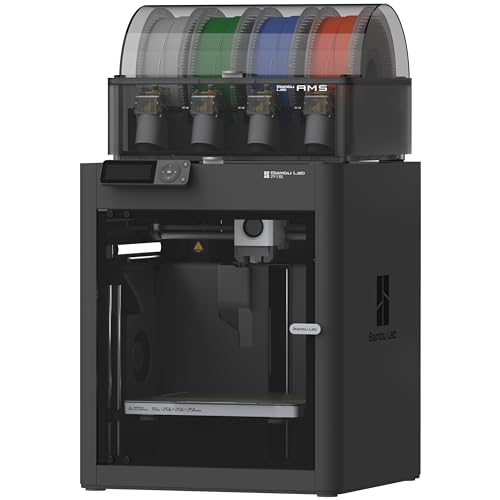
- Enclosed body supports advanced-filament printing
- Up to 16-color printing with AMS
- Fast setup and automatic bed leveling
Best For: Fast enclosed multicolor and multimaterial projects
Best for Easy Setup

- Fully assembled with guided setup
- Auto-leveling and flexible magnetic plate
- Compact WiFi mini printer with model library
Best For: Beginners, families, and STEM projects
Best Premium Multicolor Pick

- Up to 600 mm/s high-speed printing
- AMS 2 Pro enables multicolor and multimaterial work
- Automatic calibration and AI failure detection
Best For: Advanced hobbyists and multicolor projects
Best Value Filament Bundle

- 250 mm/s maximum printing speed
- Auto-leveling and automatic Z-offset sensing
- Includes four colors of PLA filament
Best For: Hobbyists wanting speed and starter materials
Best Multicolor Speed Pick
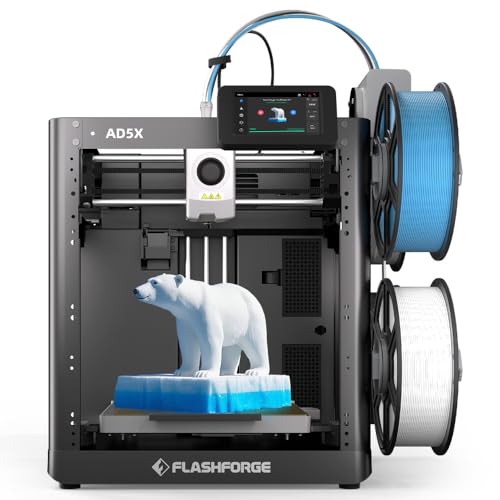
- Four-color IFS printing
- Up to 600mm/s speed
- Automatic leveling and 300°C nozzle
Best For: Hobbyists creating colorful, larger-format projects
Best Beginner-Friendly Value

- Simple setup with auto leveling
- Up to 250mm/s printing
- Direct drive for PLA, PETG, and TPU
Best For: New users and everyday home printing
Best Compact Multimaterial Choice

- Four-color IFS printing
- Supports diverse filament types
- CoreXY design with auto calibration
Best For: Creative users exploring multicolor and multimaterial prints
Best Beginner Pick – Bambu Lab A1
For hobbyists seeking an approachable entry point, the Bambu Lab A1 is a ready-to-use FDM printer with automatic calibration, a simplified touchscreen, and quiet operation. Its high-speed motion system and active flow-rate compensation are designed to make everyday printing straightforward while maintaining detail.
Best For: Beginners, kids, and hobbyists who want easy single-color printing with an optional path to multicolor projects.
Pros:
- Automatic bed leveling, Z-offset, and other calibration processes
- High-speed printing with active flow-rate compensation
- Quiet operation and a convenient 1-Clip quick-swap nozzle
- Supports multicolor printing with the separately purchased AMS lite
Cons:
- AMS lite is required for multicolor printing and is not included with this configuration
- The supplied notes do not indicate an enclosed design for advanced-filament printing
The A1 is a particularly practical choice among 3D printers for hobbyists who value convenience over extensive manual tuning. Choose the A1 Combo or add an AMS lite if multicolor work is a priority.
Best Advanced Multicolor System – Snapmaker U1
The Snapmaker U1 stands out for hobbyists who want true multicolor and multi-material printing without repeated filament purging. Its four independent toolheads, 5-second tool changes, automatic calibration, and 270mm cubed build volume support both creative models and functional parts.
Best For: Experienced hobbyists, makers, workshops, and creators producing multicolor, mixed-material, or prototype parts.
Pros:
- Four toolheads enable true multicolor and mixed-material printing
- Tool changes take about five seconds and can reduce filament waste
- Supports materials including PLA, PETG, TPU, PVA, ABS, ASA, PA, and PC
- Includes smart calibration, AI print monitoring, remote app control, and a one-year warranty
Cons:
- At 59 pounds, it is considerably heavier than the other listed options
- The broader toolhead and material system may be more capability than casual users need
For demanding 3D printers for hobbyists, the U1 offers an unusually capable multicolor workflow. It makes the most sense when material flexibility, reduced waste, and larger functional prints justify its larger footprint and advanced feature set.
Best Fast Open-Frame Value – FlashForge Adventurer 5M
The FlashForge Adventurer 5M is a strong option for 3D printers for hobbyists who want quick setup and high-speed everyday printing. It combines one-click automatic leveling, vibration compensation, a removable dual-sided PEI plate, and a direct extruder in an open design.
Best For: Hobbyists printing PLA, PETG, or TPU who want a fast, practical machine with minimal initial setup.
Pros:
- Up to 600mm/s maximum speed and 20,000mm/s² acceleration
- Full-auto leveling helps produce consistent first layers
- Quick-detachable nozzle and removable PEI steel plate simplify maintenance
- Filament runout sensing and power-loss recovery add printing protection
Cons:
- Its open design is intended for open, well-ventilated environments
- Standard support is centered on PLA, PETG, and TPU; some materials require the optional 0.6mm nozzle
The Adventurer 5M balances speed and accessibility without adding the complexity of a multicolor system. It is a sensible pick for hobbyists who mostly print common materials and want to get from unboxing to a first print quickly.
Best Enclosed Multicolor Pick – Bambu Lab P1S Combo
The Bambu Lab P1S Combo is an enclosed FDM printer for hobbyists who want high-speed printing and multicolor capability in one package. Automatic bed leveling, a 15-minute setup, and support for up to 16 colors make it a convenient choice for detailed creative projects and prints using several supported materials.
Best For: Hobbyists who want enclosed printing, fast production, and multicolor or multimaterial work with the included AMS system.
Pros:
- Enclosed design improves print performance with advanced filaments
- Supports up to 16 colors when connected to the Bambu Lab AMS
- 500mm/s speed and 20,000mm/s² acceleration reduce waiting time
- Automatic bed leveling and a 15-minute setup simplify operation
Cons:
- Carbon- and glass-fiber-reinforced polymers are not recommended
- PA and PC are listed as capable rather than ideal materials
The P1S Combo is a well-rounded choice when enclosure, speed, and multicolor printing matter more than the smallest footprint. It gives hobbyists a streamlined route to more ambitious projects while retaining beginner-friendly setup features.
Best for Easy Setup – Entina Tina2C
For hobbyists searching for approachable 3d printers for hobbyists, the Entina Tina2C emphasizes a quick, low-friction start. It arrives fully assembled, offers guided setup through the Poloprint Cloud app, and combines auto-leveling with WiFi or TF card printing.
Best For: Beginners, families, STEM learning, and small home projects.
Pros:
- Fully assembled and designed to begin printing in as little as 8 minutes.
- Auto-leveling, power-loss recovery, and a flexible magnetic build plate simplify printing.
- Compact, quiet design with app access to 3,500+ models and creative modules.
- Supports WiFi and offline TF card printing across several computer platforms.
Cons:
- The 3.9 × 3.9 × 3.9-inch print volume is suited mainly to small builds.
- Its beginner-focused mini format may be limiting for larger or more advanced projects.
The Tina2C is a practical entry point for hobbyists who value convenience, guided learning, and a small footprint over large-format capability.
Best Premium Multicolor Pick – Bambu Lab P2S Combo
The Bambu Lab P2S Combo is a performance-oriented option among 3d printers for hobbyists, pairing high-speed printing with the AMS 2 Pro system for multicolor and multimaterial work. Automatic calibration, AI failure detection, and filament drying help streamline more ambitious projects.
Best For: Experienced hobbyists who want speed, precision, and multicolor capability.
Pros:
- Prints at speeds up to 600 mm/s with active flowrate compensation for consistent layers.
- AMS 2 Pro supports multicolor or multimaterial printing and dries filament up to 65 °C.
- Automatic calibration, quick-swap nozzles, and AI failure detection simplify operation.
- Adaptive airflow supports different filament needs, with a carbon filter for cleaner air.
Cons:
- The printer is substantially larger and heavier than a compact beginner model.
- Multicolor printing requires the included Combo configuration; the base P2S does not support it.
With its advanced automation and included AMS 2 Pro, the P2S Combo is better suited to hobbyists who will actively use multicolor workflows and high-speed output.
Best Value Filament Bundle – Creality Ender 3 V3 SE
Creality Ender 3 V3 SE 3D Printer Bundle with PLA Filament 4 Packs(Black+White+Red+Blue)
Check Price On AmazonThe Creality Ender 3 V3 SE offers a useful balance for hobbyists comparing 3d printers for hobbyists, combining 250 mm/s printing with automatic leveling and a direct-drive extruder. The included four-pack of PLA filament also provides material for getting started immediately.
Best For: Hobbyists who want a fast, versatile starter setup with included PLA.
Pros:
- Supports maximum speeds of 250 mm/s with stated acceleration of 2,500 mm/s².
- CR Touch auto-leveling and a strain sensor automate leveling and Z-offset adjustment.
- Sprite dual-gear direct extruder supports PLA, TPU, and PETG according to the supplied notes.
- Includes black, white, red, and blue PLA filament packs.
Cons:
- The supplied details do not specify the print volume or overall dimensions.
- Unlike the Tina2C, the notes do not describe WiFi, app control, or a fully assembled setup.
This bundle is a sensible choice for hobbyists who prioritize speed, material flexibility, and included filament, while being comfortable with a more traditional printer setup.
Best Multicolor Speed Pick – FLASHFORGE AD5X
For hobbyists who want vivid projects without giving up speed, the FLASHFORGE AD5X is a flexible choice among 3d printers for hobbyists. Its IFS system supports up to four colors, while automatic leveling and a 220 x 220 x 220mm build volume make it suitable for both detailed designs and larger home projects.
Best For: Hobbyists who want multicolor printing, fast results, and broad filament compatibility.
Pros:
- IFS technology supports up to four-color printing.
- Printing speeds reach up to 600mm/s.
- Fully automatic leveling reduces setup and adjustment work.
- The 300°C nozzle supports materials including PLA, ABS, and PETG.
Cons:
- The printer weighs 30.9 pounds, so it is not especially portable.
- The multicolor features may be more than needed for simple single-color projects.
The AD5X stands out when color flexibility and productivity matter. Its larger build area and high-temperature nozzle give hobbyists room to explore more ambitious projects, while automatic leveling simplifies routine printing.
Best Beginner-Friendly Value – Creality Ender 3 V3 SE
The Creality Ender 3 V3 SE is a practical entry point for people comparing 3d printers for hobbyists. It combines simple assembly, CR Touch auto leveling, automatic Z-offset calibration, and a direct-drive extruder to make everyday printing more approachable.
Best For: Beginners and hobbyists printing prototypes, functional parts, and everyday models.
Pros:
- Auto leveling and automatic Z-offset calibration help simplify setup.
- Print speeds reach up to 250mm/s.
- Sprite direct-drive extrusion supports PLA, PETG, and TPU.
- Quiet operation and a flexible spring steel build plate improve usability.
Cons:
- Its listed speed is lower than the 600mm/s models in this roundup.
- The supplied notes do not specify a build volume or nozzle temperature.
Choose the Ender 3 V3 SE if straightforward setup and reliable everyday features matter more than multicolor printing or maximum speed. Its guided leveling functions and flexible material support make it a balanced starting point.
Best Compact Multimaterial Choice – FLASHFORGE AD5X
For hobbyists prioritizing color variety and material experimentation, this FLASHFORGE AD5X is a strong option among 3d printers for hobbyists. It combines four-color IFS printing with a rigid CoreXY structure, full-auto calibration, filament backup, and compatibility with materials such as PLA, TPU, PETG, and carbon-fiber blends.
Best For: Creative hobbyists who want compact four-color and multimaterial printing.
Pros:
- IFS supports four-color and multimaterial printing.
- Up to 600mm/s speed and 20,000mm/s² acceleration support rapid output.
- Full-auto leveling and calibration help improve first-layer consistency.
- CoreXY construction and vibration compensation support accurate layers.
Cons:
- Its advanced multicolor system may add complexity compared with a basic single-filament printer.
- The supplied notes do not list the build volume.
This AD5X configuration is appealing when a compact footprint and broad material support are important. Its automated calibration and CoreXY design complement the four-color system, making it well suited to ambitious creative projects.
How We Picked the Best 3d Printers for Hobbyists
We compared these printers by focusing on the features that matter most during regular home use: setup time, print reliability, automatic leveling, speed, material compatibility, build volume, software experience, and multi-color or multi-material capability. We also considered whether each model makes sense for beginners, growing makers, or experienced hobbyists who want more automation.
Because product bundles and specifications can vary, check the current listing for included accessories, filament, toolheads, and connectivity features before ordering.
Quick Comparison
| Best For | What to Prioritize | Good Fit |
|---|---|---|
| First-time users | Simple setup, auto-leveling, guided software | Compact beginner models and ready-to-use printers |
| Everyday hobby projects | Reliability, flexible materials, moderate build volume | Well-rounded FDM printers with direct-drive extruders |
| Fast prototyping | High motion speed, stable frame, automatic calibration | Modern high-speed printers |
| Colorful models | Multi-color system, material management, purge efficiency | Printers bundled with AMS or multi-toolhead systems |
Key Buying Factors for 3d Printers for Hobbyists
Print Technology and Materials
All of these selections use FDM-style printing, which is practical for functional parts, toys, organizers, and prototypes. PLA is the easiest starting material. If you plan to print tougher or more heat-resistant parts, look for a printer with a suitable hotend, heated bed, enclosure, and filament path for materials such as PETG or ABS.
Build Volume and Speed
A larger build area lets you create bigger parts or several smaller pieces at once, but it also requires more workspace. High advertised speeds can shorten print times, yet real-world results depend on the model, layer height, filament, and acceleration settings. Reliability is usually more valuable than maximum speed for beginners.
Automation and Ease of Use
Auto-leveling, automatic calibration, a removable build plate, filament runout detection, and Wi-Fi or app control can remove much of the trial and error. These features are especially useful if the printer will be shared with children or used by someone new to 3D printing.
Color and Multi-Material Printing
Multi-color systems add creative flexibility, but they can increase cost, maintenance, filament waste, and print complexity. Choose one if color changes are central to your projects; otherwise, a single-filament printer may offer better value.
Who Should Buy Which 3d Printers for Hobbyists?
Beginners and families: Choose a compact, fully assembled printer with automatic leveling and simple controls. These models minimize setup and make it easier to learn basic slicing and maintenance.
Hobbyists who want an all-purpose machine: Look for a reliable printer with a direct-drive extruder, a useful build volume, and broad PLA and PETG support. This category offers the best balance for household projects and ongoing experimentation.
Makers focused on speed: Select a high-speed model with strong calibration and a stable frame. Confirm that your preferred slicer and filament profiles support the advertised performance.
Creators making colorful models: A bundled AMS or multi-toolhead printer is the most convenient choice. Budget for extra filament, purge waste, and occasional maintenance of the color-changing system.
Value shoppers: A basic single-color printer or bundle with included PLA can be the better entry point. It leaves more of your budget for filament, nozzles, design software, and replacement parts.