Choosing among the best 3D printers for miniatures means balancing fine detail, material cost, print speed, cleanup, and ease of use. Resin printers typically capture the smallest facial features and armor details, while modern FDM machines offer simpler workflows, larger build areas, and more practical everyday versatility.
This roundup compares 10 selected printers across both technologies, including compact resin models, beginner-friendly machines, fast enclosed printers, and multicolor systems. Use the guide below to match resolution, reliability, materials, and budget to the way you plan to print.
Best 10 3d Printers for Miniatures Picks for 2026
Best Detail Value

- 22-micron XY resolution with an 8K mono LCD
- Compact resin printer for models and miniatures
- Compatible with Lychee, Chitubox, and Tango
Best For: Beginners seeking highly detailed tabletop prints
Best Beginner FDM

- Automatic calibration reduces setup work
- Optional AMS lite supports multicolor printing
- Quiet operation with quick-swap nozzle
Best For: Beginners wanting simple, versatile FDM printing
Best Enclosed Speed

- Up to 600 mm/s printing speed
- Auto-leveling, camera monitoring, and shutdown
- Enclosed design with HEPA13 and carbon filtration
Best For: Fast, automated FDM printing in a contained workspace
Best Easy Resin Setup
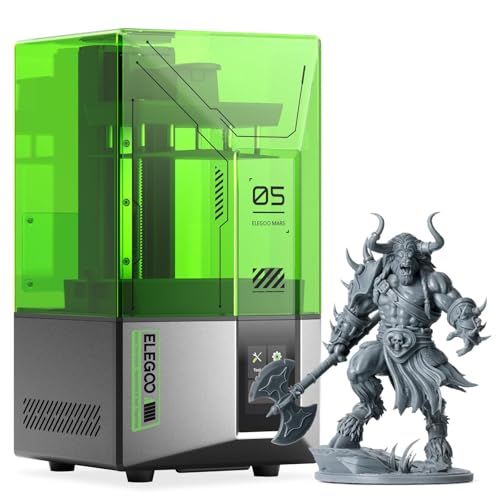
- One-click automatic leveling simplifies setup
- 4K mono LCD with COB light source
- Self-check and residue-detection features
Best For: Beginners seeking approachable detailed resin printing
Best High-Speed Starter

- Auto-leveling supports reliable first layers
- Up to 600mm/s with vibration compensation
- Quick-change nozzle and PEI build plate
Best For: Beginners and hobbyists seeking fast, low-fuss miniature printing
Best for Multicolor Miniatures
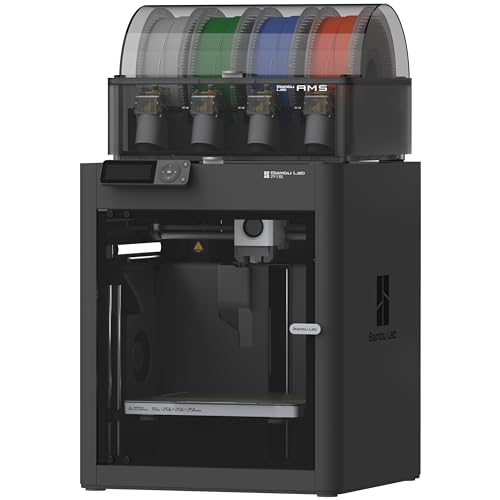
- AMS enables up to 16-color printing
- Enclosed design supports advanced filaments
- Auto-leveling and 500mm/s speed
Best For: Makers creating colorful miniatures with an enclosed printer
Best Customizable Miniature Setup
FLASHFORGE Adventurer 5M for Beginners

- Supports nozzles from 0.25mm to 0.8mm
- 25-point auto-leveling and pressure compensation
- Optional enclosure and remote monitoring
Best For: Beginners wanting detailed prints now and upgrade flexibility later
Best Multicolor Expansion

- Native four-color printing with expansion up to 19 colors
- 49-point auto leveling for easier setup
- 600mm/s speed and broad filament compatibility
Best For: Makers who want expandable multicolor printing for miniatures and larger models
Best Automated Workflow

- 600mm/s printing with active flowrate compensation
- AMS 2 Pro enables multicolor printing and filament drying
- Automatic calibration and AI failure detection
Best For: Users seeking a fast, automated multicolor printing workflow
Best Hands-Off CoreXY
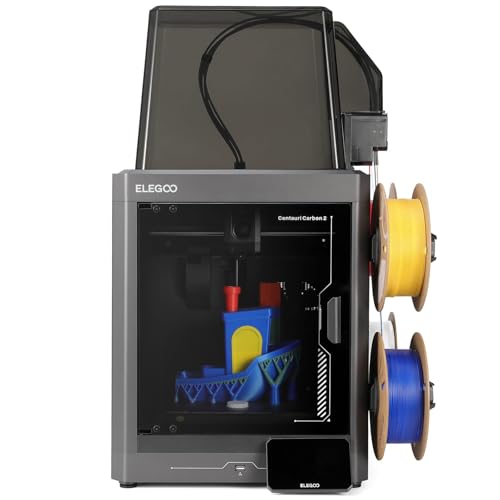
- Four-color CANVAS system with auto refill and tangle detection
- CoreXY design reaches up to 500mm/s
- Automated calibration and vibration compensation
Best For: Makers wanting hands-off four-color printing with fast CoreXY performance
Best Detail Value – Phrozen Sonic Mini 8K
For shoppers comparing 3d printers for miniatures, the Phrozen Sonic Mini 8K is a compact resin option focused on fine detail. Its 22-micron XY resolution, 8K monochrome LCD, and support for popular slicers make it well suited to detailed models, miniatures, and action figures.
Best For: Beginners and hobbyists who prioritize high-resolution miniature detail in a compact resin printer.
Pros:
- 22-micron XY resolution and an 8K monochrome LCD are designed for intricate details.
- Compact 16.5 x 7.2 x 17 cm printing volume suits tabletop models and miniatures.
- Works with open-source software and slicers including Lychee, Chitubox, and Tango.
- Precise Z-axis calibration supports even, accurate printing.
Cons:
- Its resin workflow may require more hands-on handling than an FDM printer.
- The compact build volume is less suitable for large prints.
The Sonic Mini 8K is a strong choice when miniature surface detail matters more than build size. Its beginner-friendly specifications and broad slicer compatibility add flexibility for new users.
Best Beginner FDM – Bambu Lab A1
The Bambu Lab A1 is a ready-to-use FDM printer for beginners and kids, making it a practical alternative when you want to print miniature accessories or larger supporting pieces. Automatic calibration, flow-rate compensation, and a quiet operating design simplify everyday use.
Best For: Beginners who want an easy-to-use FDM printer with optional multicolor printing.
Pros:
- Automatic calibration handles Z-offset and bed-leveling tasks.
- Active flow-rate compensation supports consistent extrusion and smooth prints.
- Optional AMS lite enables multicolor printing; it is included with the A1 Combo or sold separately.
- Quick-swap nozzle design and active motor noise canceling simplify maintenance and operation.
Cons:
- AMS lite is required for multicolor printing and is not necessarily included with the standard printer.
- FDM may not reproduce miniature details as finely as the resin printers in this roundup.
Choose the A1 if convenience, speed, and general-purpose FDM printing matter more than the finest miniature textures. Its automated setup is especially appealing for first-time users.
Best Enclosed Speed – FlashForge Adventurer 5M Pro
For buyers evaluating 3d printers for miniatures alongside broader projects, the FlashForge Adventurer 5M Pro combines a 220 x 220 x 220 mm build area with high-speed FDM printing. One-click leveling, vibration compensation, remote camera monitoring, and an enclosed filtered design make it practical for repeatable household or classroom use.
Best For: Users who want a fast, enclosed FDM printer for miniatures, prototypes, and general projects.
Pros:
- Maximum speed of 600 mm/s and up to 20,000 mm/s² acceleration reduce waiting time.
- Full-auto leveling and vibration compensation support consistent first layers and cleaner surfaces.
- Built-in camera enables remote monitoring, while automatic shutdown follows completed jobs.
- Enclosure includes HEPA13 and activated-carbon filtration and operates at a stated 50 dB.
Cons:
- FDM is generally less suited to the finest miniature details than high-resolution resin printing.
- Its 32.2-pound weight and enclosed design make it less portable than compact printers.
The Adventurer 5M Pro is compelling when speed, automation, and a contained printing environment are priorities. It is a flexible all-around machine rather than a detail-first miniature specialist.
Best Easy Resin Setup – ELEGOO Mars 5
The ELEGOO Mars 5 is a user-friendly resin printer for shoppers seeking detailed 3d printers for miniatures without a complicated initial setup. One-click automatic leveling, a self-check function, residue detection, and a 4K monochrome LCD are designed to make miniature printing more approachable.
Best For: New resin users who want automated setup and reliable checks for detailed miniature printing.
Pros:
- One-click automatic leveling helps users start printing with fewer manual adjustments.
- 4K monochrome LCD and COB lighting reproduce intricate details and textures.
- Self-check functionality verifies components before printing.
- Residue detection, resin-shortage alerts, and overheat protection help reduce avoidable problems.
Cons:
- The 4K resolution is lower than the Phrozen Sonic Mini 8K’s stated 8K display.
- Resin printing still involves handling resin and related cleanup.
The Mars 5 stands out for reducing setup friction while retaining the detail-oriented strengths of resin printing. It is a sensible pick for beginners who value automated checks and straightforward operation.
Best High-Speed Starter – FLASHFORGE Adventurer 5M
The FLASHFORGE Adventurer 5M is a practical choice among 3d printers for miniatures if you want fast setup, automatic leveling, and consistent PLA or PETG results. Its CoreXY design, vibration compensation, and removable PEI plate support a smoother path from setup to finished models.
Best For: Beginners and hobbyists who want fast, low-fuss miniature printing with an open-frame printer.
Pros:
- One-click full-auto leveling helps produce reliable first layers.
- Up to 600mm/s speed, 20,000mm/s² acceleration, and vibration compensation reduce waiting and ghosting.
- Quick-detachable 280°C nozzle and flexible dual-sided PEI plate simplify maintenance and print removal.
- Filament run-out sensing and power-loss recovery help protect longer prints.
Cons:
- The open design is intended for open, well-ventilated environments rather than temperature-controlled printing.
- The supplied 0.4mm nozzle is versatile, but very fine miniature detail may benefit from an optional smaller nozzle.
For buyers prioritizing speed and straightforward operation, the Adventurer 5M offers a strong all-around foundation for miniature projects without requiring extensive calibration.
Best for Multicolor Miniatures – Bambu Lab P1S Combo
The Bambu Lab P1S Combo stands out among 3d printers for miniatures when color variety matters. Its enclosed body, automatic bed leveling, and included AMS enable multi-color or multi-material projects, while 500mm/s printing keeps larger batches moving.
Best For: Makers who want enclosed printing and multicolor miniature designs with minimal setup.
Pros:
- AMS-based printing supports designs with up to 16 colors.
- Enclosed construction improves performance with advanced filaments.
- Automatic bed leveling helps simplify setup and support successful first layers.
- 500mm/s speed and 20,000mm/s² acceleration reduce production time.
Cons:
- Multi-color printing requires the Bambu Lab AMS connection.
- Carbon- or glass-fiber-reinforced polymer is not recommended.
- Its 40.8-pound weight makes it less convenient to move than lighter open-frame options.
If you want colorful display miniatures or mixed-material projects, the P1S Combo provides the most capable workflow here, provided you are comfortable with the AMS-dependent setup.
Best Customizable Miniature Setup – FLASHFORGE Adventurer 5M for Beginners
This beginner-focused Adventurer 5M is one of the more adaptable 3d printers for miniatures, thanks to its compatibility with 0.25mm through 0.8mm nozzles. Automatic calibration, a quick-change system, and a rigid CoreXY frame make it suitable for both detailed models and larger practical prints.
Best For: Beginners and makers who want to start with miniature-scale nozzles and expand toward larger or functional prints.
Pros:
- A 0.25mm nozzle option is suited to miniature models, while 0.8mm supports larger prints.
- 25-point auto-leveling and pressure-sensor compensation help with first-layer consistency.
- CoreXY construction, dual linear rails, and anti-vibration design support dimensional accuracy.
- MagSwitch PEI plate, quick-change nozzle system, filament sensing, and remote monitoring add convenience.
Cons:
- The printer is supplied as a barebones unit; an enclosure is an optional upgrade.
- Some miniature-focused nozzle sizes may require separate purchases.
- The open configuration may be less suitable for temperature-sensitive materials.
This version makes the most sense for buyers who value a growth path: begin with accessible PLA printing, then tune the nozzle size and add an enclosure as projects become more demanding.
Best Multicolor Expansion – Kobra X
For shoppers comparing 3d printers for miniatures, the Anycubic Kobra X stands out for native four-color printing, automatic calibration, and a 260mm cubed build volume. Its hardened steel nozzle and vibration compensation are useful for producing detailed models, while the 600mm/s maximum speed suits larger batch-printing projects.
Best For: Makers who want fast, expandable multicolor printing for miniatures and larger models.
Pros:
- Native four-color printing, expandable to up to 19 colors with four ACE 2 Pro units.
- 49-point auto bed leveling and LeviQ 3.0 calibration simplify first-layer setup.
- Supports PLA, PETG, TPU, PVA, and ASA with a nozzle temperature up to 300°C.
- AI monitoring includes spaghetti and foreign-object detection.
Cons:
- Filament is not included.
- Further color expansion requires additional ACE 2 Pro units, which are not compatible with ACE Pro.
- The larger 23 x 13 x 22-inch body may need substantial desk space.
The Kobra X is a versatile choice when color flexibility and automated setup matter as much as detail. Its large build area and broad filament support make it suitable beyond miniature work, though buyers should budget for filament and any desired expansion hardware.
Best Automated Workflow – Bambu Lab P2S Combo
The Bambu Lab P2S Combo is a strong option among 3d printers for miniatures when consistent results and streamlined operation are priorities. It combines a 600mm/s printer with the AMS 2 Pro system for multicolor and multimaterial printing, plus automatic calibration, AI failure detection, and filament drying.
Best For: Beginners and experienced makers who want a fast, highly automated multicolor workflow.
Pros:
- Prints up to 600mm/s with active flowrate compensation for sharp, smooth layers.
- AMS 2 Pro supports multicolor and multimaterial printing and dries filament up to 65°C.
- Automatic calibration, quick-swap nozzles, and AI failure detection reduce hands-on monitoring.
- Adaptive airflow can cool overhangs or maintain a 50°C chamber for suitable engineering materials.
Cons:
- The standard P2S does not support multicolor printing; the Combo version is required.
- At 47.5 pounds, it is relatively heavy to move.
- The 18 x 22 x 18-inch dimensions require dedicated workspace.
With its integrated AMS 2 Pro and broad software ecosystem, the P2S Combo is designed to make complex prints approachable. It is particularly compelling for users who value convenience, material management, and repeatable results over a minimal setup.
Best Hands-Off CoreXY – Centauri Carbon 2 Combo
The ELEGOO Centauri Carbon 2 Combo is worth considering among 3d printers for miniatures if you want a fast CoreXY platform with integrated four-color printing. Its CANVAS system handles color switching, filament detection, auto refill, and tangle detection, while automated calibration and vibration compensation focus on reliable, crisp results.
Best For: Makers who want hands-off four-color printing with CoreXY speed and broad material flexibility.
Pros:
- CANVAS provides four-color printing with instant switching and smart filament detection.
- Auto refill and tangle detection help maintain uninterrupted printing.
- CoreXY mechanics, a rigid aluminum frame, and up to 500mm/s speed support precise production.
- Automated calibration, monitoring, and active vibration compensation help improve surface quality.
Cons:
- Its 42.6-pound weight makes relocation less convenient.
- The 18.9 x 19.7 x 29.3-inch dimensions call for considerable vertical and horizontal clearance.
- The supplied notes do not specify a miniature-focused build volume.
The Centauri Carbon 2 Combo offers a practical balance of speed, automation, and multicolor capability. Its feature set is well suited to repeat printing, although buyers focused on miniature-scale work should confirm the build area and material requirements before purchasing.
How We Picked the Best 3d Printers for Miniatures
We evaluated the selected models by the factors that most affect miniature printing: detail potential, printer type, build volume, ease of setup, material compatibility, speed, and useful automation. Resin printers were considered for their ability to reproduce small details, while FDM models were assessed for dependable general-purpose printing, larger terrain pieces, and lower-mess operation.
We also considered practical features such as automatic leveling, direct-drive extrusion, enclosed designs, removable build plates, touchscreen controls, and optional or included multicolor systems. These features do not replace print quality, but they can make a major difference in setup time and day-to-day reliability.
Quick Comparison
| Printer type | Best suited for | Main advantage | Main trade-off |
|---|---|---|---|
| Resin | Highly detailed figures | Excellent small-feature resolution | Requires washing, curing, and careful handling |
| FDM | Terrain, props, and larger models | Cleaner workflow and broad material choice | Fine details may show more visible layer lines |
| Multicolor FDM | Terrain, characters, and display pieces | Multiple colors in one print | Higher cost, waste, and setup complexity |
Key Buying Factors for 3d Printers for Miniatures
Resin Versus FDM
Choose resin when miniature scale and surface detail are the priority, especially for tabletop figures, faces, weapons, and intricate accessories. Choose FDM when you want to print terrain, scenery, bases, storage pieces, or larger models with less post-processing. FDM is generally easier to manage, but it still benefits from careful calibration and appropriate layer heights.
Resolution and Print Quality
For resin printers, XY resolution and the screen size influence how sharply small features can be reproduced. For FDM machines, nozzle diameter, layer height, cooling, extrusion accuracy, and slicer settings matter more than headline speed alone. A fast printer is useful only when it can maintain consistent dimensional accuracy and clean surfaces.
Build Volume and Materials
Check the build area against your intended models. Compact printers are efficient for individual figures, while larger beds are better for terrain and batches of bases. Also verify supported materials: PLA is an easy starting point, PETG adds toughness, and specialty filaments may require higher temperatures or an enclosure.
Workflow and Safety
Automatic leveling, quick-detach nozzles, flexible build plates, remote monitoring, and enclosed chambers can reduce frustration. Resin printing requires gloves, ventilation, washing, curing, and safe disposal of contaminated materials, so budget for the complete workflow rather than the printer alone.
Who Should Buy Which 3d Printers for Miniatures?
Buy a high-resolution resin model if you primarily print detailed tabletop figures and are comfortable with post-processing. Pick a beginner-friendly FDM printer for a cleaner introduction, terrain, props, and household projects. A fast enclosed FDM printer suits users who value reliable production and broader material options. Choose a multicolor combo when color changes and display-ready models matter more than minimizing material use or equipment cost.