Choosing among benchtop LCR meters means balancing measurement accuracy, test frequency, component range, display quality, and connectivity. The right instrument can speed up component verification, production checks, repair work, and electronics development.
This roundup compares 10 selected models across different performance levels, from compact general-purpose analyzers to precision instruments with broad frequency coverage and advanced test capabilities.
Best 10 Benchtop Lcr Meters Picks for 2026
Wide-Range Precision Pick
MATRIX MCR5200 Benchtop LCR Meter

- 0.1% accuracy and 40Hz–200kHz testing
- Broad L/C/R and impedance measurement ranges
- USB, RS232C, SCPI, calibration, and data saving
Best For: R&D, repair, QC, and production testing
Balanced Lab and Production Choice

- 0.1% accuracy with ten frequencies to 10kHz
- Adjustable test levels and internal DC bias
- DCR, calibration, SCPI, and comparator sorting
Best For: Labs, incoming inspection, and production screening
Ultra-Low-Frequency Specialist
NF Corp. ZM2371 Benchtop LCR Meter

- Tests from 1mHz to 100kHz
- Measurement speed of 2ms or less
- Optional component-specific test fixtures
Best For: Low-frequency component measurement and specialized testing
Programmable Sorting Value

- 0.2% accuracy with ten test frequencies
- Dual 5-digit display and broad component ranges
- Five-group sorting, SCPI, RS232, and USB
Best For: QC inspection and production-line component sorting
Reliable Bench Choice

- 2 kHz bench LCR meter
- Wide L, C, and R measurement limits
- RoHS compliant
Best For: General-purpose bench component testing
Precision Production Tool

- 40 Hz–100 kHz range with 38 points
- 0.1% basic accuracy and five-digit resolution
- Comparator supports five sorting grades
Best For: Production testing and passive-component sorting
Flexible Testing Value
- 10 Hz–10 kHz with 1 Hz steps
- 0.1% basic capacitance accuracy
- Calibration and five-group sorting tools
Best For: R&D, quality control, and batch testing
Compact Value Pick

- 10 fixed frequencies from 100Hz to 10kHz
- Measures L/C/R/Z, ESR, Q, D, and more
- USB and RS232 connectivity with calibration
Best For: Compact component testing and electronics bench work
Frequency Flexibility Pick

- 10–100kHz frequency adjustment in 1Hz steps
- Five-digit TFT LCD display with 0.1% accuracy
- Includes screening, calibration, and comparator functions
Best For: Detailed laboratory and production component testing
Lab-Ready Precision Pick
MATRIX MCR-5030 Benchtop LCR Meter
- 0.1% accuracy with five-digit resolution
- 38 frequency points from 40Hz to 75kHz
- Comparator, USB storage, and three-year warranty
Best For: Lab, inspection, and production testing workflows
Wide-Range Precision Pick – MATRIX MCR5200 Benchtop LCR Meter
The MATRIX MCR5200 is a versatile choice among benchtop LCR meters when you need broad measurement ranges, adjustable test conditions, and computer-friendly data handling. Its 0.1% basic accuracy and 40Hz–200kHz frequency range suit component development, repair, quality control, and production testing.
Best For: R&D, component inspection, repair work, and users who need extensive measurement ranges with USB or RS232C connectivity.
Pros:
- 0.1% basic accuracy with 41 selectable frequencies from 40Hz to 200kHz.
- Measures L, C, R, impedance, ESR, D, Q, and phase across broad ranges.
- Includes open/short calibration, comparator functions, data saving, and SCPI support.
- Offers three measurement speeds, averaging, and 30Ω/100Ω source resistance options.
Cons:
- Its larger feature set may require more setup than a basic LCR tester.
- The unit weighs 7.7 pounds and is intended for corded benchtop use.
Choose the MCR5200 if flexibility and connectivity matter more than a compact design. The 4.3-inch display, calibration functions, and extensive range make it a capable general-purpose laboratory instrument.
Balanced Lab and Production Choice – ET4401 Bench LCR Meter
The ET4401 is a practical option among benchtop LCR meters for component analysis and routine laboratory or production work. It combines 0.1% basic accuracy with ten fixed test frequencies, adjustable test levels, DC bias, and interfaces for PC control.
Best For: Incoming inspection, laboratory testing, electronic production, component screening, and capacitor or resistor evaluation.
Pros:
- Measures L, C, R, and Z while also reporting X, D, Q, phase, and ESR.
- Provides ten test frequencies from 100Hz to 10kHz and six test levels up to 2V.
- Includes DCR measurement, electrolytic capacitor mode, and open/short calibration.
- USB Device, RS232, SCPI, comparator sorting, and list scanning support automated workflows.
Cons:
- Its maximum test frequency is lower than models designed for higher-frequency analysis.
- The 3.5-inch display is smaller than the display on some competing benchtop instruments.
The ET4401 suits buyers who want a focused, flexible tester for standard component measurements. Its adjustable conditions and sorting functions make it particularly useful where repeatable inspection and PC-connected testing are important.
Ultra-Low-Frequency Specialist – NF Corp. ZM2371 Benchtop LCR Meter
The NF Corp. ZM2371 stands out among benchtop LCR meters for its unusually low starting frequency of 1mHz. It is a specialized instrument for electronic component measurement, with a maximum frequency of 100kHz, measurement speeds of 2ms or less, and optional component-specific test fixtures.
Best For: Engineers and manufacturers evaluating components at very low frequencies or needing a specialized high-performance benchtop measurement instrument.
Pros:
- Supports an exceptionally broad 1mHz to 100kHz frequency range.
- Offers measurement speed of 2ms or less.
- Optional test fixtures can be selected by component type.
- Designed and manufactured in Japan, with CE, NIST, RoHS, and UL specifications listed.
Cons:
- Its listed 0.8% basic accuracy is lower than the 0.1% accuracy offered by some alternatives.
- Optional fixtures may be needed for specific component-testing setups.
- The supplied notes provide fewer details about interfaces and onboard analysis functions.
The ZM2371 is best considered a frequency-range specialist rather than an all-purpose feature leader. Its 1mHz capability and fast measurement rate make it worth considering when low-frequency testing is central to the application.
Programmable Sorting Value – Upgraded ET4401 LCR Meter
This upgraded ET4401 is a production-oriented option among benchtop LCR meters, pairing 0.2% basic accuracy with programmable test settings and five-group comparator sorting. Its dual 5-digit display, ten test frequencies, and PC interfaces support fast component analysis and batch inspection.
Best For: R&D labs, QC inspection, production lines, and users who need programmable sorting with Kelvin-clamp testing.
Pros:
- Measures inductance, capacitance, and resistance across broad stated ranges.
- Provides ten selectable frequencies from 100Hz to 10kHz.
- Includes DCR, electrolytic capacitor mode, open/short calibration, and adjustable test speed.
- Supports RS232, USB Device, SCPI, and five-group comparator sorting with customizable limits.
Cons:
- Its 0.2% accuracy is less precise than the 0.1% rating of the standard ET4401 and MATRIX model.
- Its frequency range is limited to 10kHz at the upper end.
- The supplied package information lists the meter and manual but does not specify included test leads.
For production environments, the upgraded ET4401’s strongest advantage is workflow support rather than maximum frequency. Its comparator groups, programmable limits, and communication interfaces can simplify repeatable screening and automated test integration.
Reliable Bench Choice – GW INSTEK LCR-6002
The GW INSTEK LCR-6002 is a straightforward option for buyers seeking benchtop LCR meters for general component measurement. Its 2 kHz test frequency and broad measurement limits cover inductance, capacitance, and resistance testing in a compact bench instrument.
Best For: Labs, repair benches, and users who need a dedicated 2 kHz LCR meter with wide measurement ranges.
Pros:
- Measures inductance up to 9.99999 kH.
- Measures capacitance up to 9.99999 F.
- Measures resistance up to 99.9999 MΩ.
- RoHS compliant specification.
Cons:
- Maximum test frequency is limited to 2 kHz.
- No warranty is listed in the supplied details.
The LCR-6002 makes sense when broad component ranges matter more than high-frequency testing. Consider another model if you need multiple test frequencies or built-in sorting features.
Precision Production Tool – MATRIX MCR-5100
The MATRIX MCR-5100 is a feature-rich choice among benchtop LCR meters, combining 0.1% basic accuracy with a 40 Hz–100 kHz range. Its 4.3-inch TFT display, comparator, stored settings, and multiple test parameters suit detailed laboratory and production work.
Best For: Incoming inspection, passive-component sorting, production testing, and users who need flexible frequency selection.
Pros:
- Offers 38 selectable test-frequency points from 40 Hz to 100 kHz.
- Provides 0.1% basic test accuracy and five-digit resolution.
- Supports parameters including L, C, R, impedance, D, Q, ESR, and phase.
- Includes a comparator with five qualification grades and pass/fail alarming.
Cons:
- Its 13 x 16 x 8-inch size and 10.6-pound weight require substantial bench space.
- Operation depends on corded power.
With its wide frequency coverage and sorting functions, the MCR-5100 is the most versatile option here for repeatable component evaluation. It is better suited to a permanent workstation than occasional portable use.
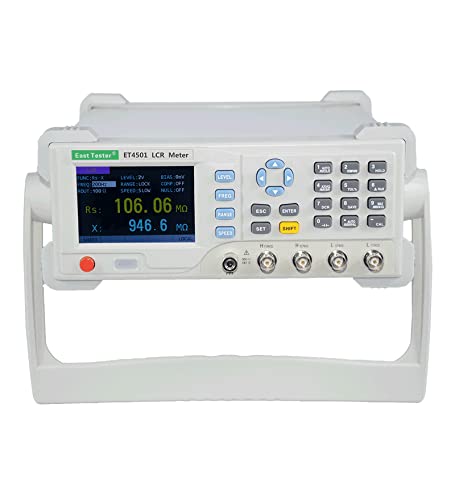
Flexible Testing Value – ET4501 LCR Meter
The ET4501 targets buyers comparing benchtop LCR meters for component analysis across low-to-mid test frequencies. It supports 10 Hz–10 kHz operation, 0.1% basic capacitance accuracy, adjustable reading speed, calibration functions, and comparator-based sorting.
Best For: R&D, quality control, and production users who need adjustable test conditions and broad component ranges.
Pros:
- Supports 10 Hz–10 kHz testing with 1 Hz steps.
- Measures inductance from 0.001 µH to 9999 H and capacitance from 0.001 pF to 99.999 mF.
- Offers 0.1% basic capacitance accuracy.
- Includes open/short calibration and a five-group comparator.
Cons:
- Frequency range ends at 10 kHz, below the MATRIX MCR-5100’s maximum.
- The supplied notes list a solar-powered source, which may require clarification for fixed-bench use.
The ET4501 is appealing when adjustable speed, bias, calibration, and sorting are more important than an especially high maximum frequency. Verify the power arrangement before purchasing for a conventional laboratory bench.
Compact Value Pick – ET1090A Digital LCR Meter
For shoppers comparing benchtop LCR meters, the ET1090A offers a compact, flexible setup for measuring inductance, capacitance, resistance, and impedance. It uses 10 fixed test frequencies from 100Hz to 10kHz, provides a five-digit display, and includes Kelvin-clamp testing for component work.
Best For: Electronics hobbyists and technicians who want broad component measurement ranges, basic calibration features, and computer connectivity in a compact meter.
Pros:
- Measures L/C/R/Z along with X, D, Q, theta, and ESR.
- Wide ranges, including 0.001µH to 9999H inductance and 0.001pF to 99.999mF capacitance.
- Includes open/short calibration, electrolytic capacitor mode, RS232, and USB Device connectivity.
Cons:
- Test frequency is limited to 10 fixed points rather than continuous adjustment.
- The supplied notes do not specify a warranty or included Kelvin-clamp details beyond the product title.
The ET1090A is a practical choice when measurement coverage and connectivity matter more than a broad, continuously adjustable frequency range. Its adjustable display brightness and calibration functions add useful bench convenience.
Frequency Flexibility Pick – ET4510 10–100kHz LCR Meter
The ET4510 stands out among benchtop LCR meters for its adjustable 10–100kHz test frequency with 1Hz steps. Its 3.5-inch TFT LCD, five-digit display, broad component ranges, and 0.1% basic accuracy make it suited to detailed laboratory or production testing.
Best For: Technicians who need precise frequency selection, clear on-screen readings, and measurement, screening, calibration, and comparator functions in one instrument.
Pros:
- Adjustable 10–100kHz test frequency in 1Hz increments.
- Measures L/C/R/Z plus X, D, Q, theta, and ESR.
- Offers 0.1% basic accuracy, calibration, screening, and multiple-group comparator settings.
Cons:
- The supplied details list the power source as solar powered, which may require clarification before purchase.
- The notes do not specify included test leads or a warranty.
With its fine frequency adjustment and versatile parameter set, the ET4510 is the stronger fit for users evaluating components under different test conditions. The TFT interface should also make frequent measurements easier to monitor.
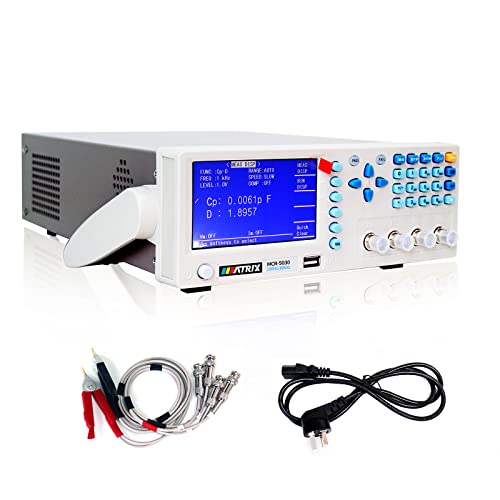
Lab-Ready Precision Pick – MATRIX MCR-5030 Benchtop LCR Meter
The MATRIX MCR-5030 is a full-size benchtop LCR meter for lab and inspection work. It combines 0.1% accuracy, a five-digit 4.3-inch TFT display, two signal-source impedances, and 38 selectable frequency points spanning 40Hz to 75kHz.
Best For: Laboratories, repair departments, and production environments that need sorting, saved test setups, USB data handling, and a long manufacturer warranty.
Pros:
- Provides 38 frequency points from 40Hz through 75kHz.
- Measures L, C, R, impedance, D, Q, X, ESR, and phase in degrees or radians.
- Built-in comparator supports five-level sorting, pass/fail alarms, saved settings, and USB file expansion.
- Includes a three-year manufacturer warranty and four-terminal test cord.
Cons:
- At 7.7 pounds and 9.5 × 13 × 4.3 inches, it is less portable than compact meters.
- Its listed frequency range does not extend to 100kHz.
The MCR-5030 is the most feature-rich option here for repeatable bench workflows. Its comparator, data-saving capabilities, multiple signal-source impedances, and included test accessories make it particularly suitable for organized inspection and production testing.
How We Picked These Benchtop Lcr Meters
We focused on the specifications that most affect real-world component testing: stated accuracy, measurement frequency range, supported parameters, display readability, test-terminal design, and computer connectivity. The selection includes instruments suited to hobby benches, service work, education, production testing, and laboratory development.
Because specifications can vary by measurement mode, frequency, impedance, and test fixture, treat advertised accuracy as a starting point. Before buying, verify the manufacturer’s datasheet for your intended component values and operating conditions.
Quick Comparison
| What to Compare | Why It Matters |
|---|---|
| Frequency range | Higher or lower test frequencies can reveal how components behave in switching, filtering, RF, and precision applications. |
| Basic accuracy | Better accuracy improves confidence when sorting parts, validating designs, or checking production tolerances. |
| Measured parameters | Look beyond L, C, and R if you need impedance, dissipation factor, quality factor, phase, or equivalent series resistance. |
| Interface and automation | USB, RS-232, or remote-control support can simplify logging and repeated production measurements. |
| Fixture and display | Kelvin connections, readable displays, and stable fixtures reduce handling errors and improve repeatability. |
Key Buying Factors for Benchtop Lcr Meters
Accuracy and Repeatability
Choose a model with enough accuracy for the tolerances you actually measure. Repeatability is equally important: a highly specified meter is less useful if readings fluctuate because of poor connections, inadequate calibration, or an unstable fixture.
Frequency Coverage
For basic capacitor, inductor, and resistor checks, a 100 Hz to 10 kHz range may be sufficient. Wider coverage can be valuable for filter design, transformer testing, power electronics, and components whose characteristics change substantially with frequency.
Connection Method and Calibration
Four-wire Kelvin measurement is helpful for low-resistance parts and low-impedance measurements because it reduces lead and contact resistance errors. Open and short compensation, fixture compatibility, and accessible calibration procedures also deserve attention.
Workflow Features
A clear five-digit or TFT display, selectable test frequencies, programmable measurement conditions, internal memory, and remote interfaces can make a noticeable difference when testing many components.
Who Should Buy Which Benchtop Lcr Meters?
For general bench work: Choose a straightforward meter with dependable L/C/R measurements, a clear display, and a practical midrange frequency span.
For precision development: Prioritize lower stated uncertainty, broader frequency coverage, Kelvin connections, and advanced parameters such as impedance, phase, ESR, or quality factor.
For production or repetitive testing: Select a model with programmable settings, fast stable readings, remote control, and fixtures that support consistent operator handling.
For education and repair: Favor intuitive controls, readable results, flexible test frequencies, and included accessories over features you will rarely use. Whatever your application, confirm range limits and accuracy at the component values you measure most often.