The best compound microscopes for children make it easier to explore pond water, plant cells, prepared slides, and other small specimens without turning science time into a frustrating setup exercise.
We selected 10 beginner-friendly models and kits spanning simple junior options, STEM bundles, and more capable microscopes that can grow with a student’s interests.
Best 10 Compound Microscopes for Children Picks for 2026
Best All-Around Starter
National Geographic Dual LED Microscope

- Dual LED viewing for slides and solid objects
- 10 prepared and 10 blank slides included
- Designed for ages 8-12 with 20x and 50x optics
Best For: Young beginners wanting a complete STEM microscope kit
Best High-Power Student Pick
PalliPartners Compound Microscope

- 100x-2000x listed magnification range
- Dual LED lighting and fine/coarse focus controls
- 28-slide set plus phone adapter and remote
Best For: Older students and supervised intermediate biology work
Best Beginner-Friendly Kit
National Geographic Junior Microscope

- Simple focus, platform, and zoom controls
- 50x-250x magnification with dual viewing lights
- Includes 12 slides and an experiment lab guide
Best For: Young first-time users who prefer guided activities
Best Sturdy Value
HUTACT 40x-2000x Compound Microscope

- Aluminum-alloy body with achromatic glass lenses
- Listed magnification range reaches up to 2000x
- Includes five slides, storage bag, and manual
Best For: Beginners and families seeking a sturdier shared microscope
Best High-Magnification Option
BEBANG 2000X Compound Microscope
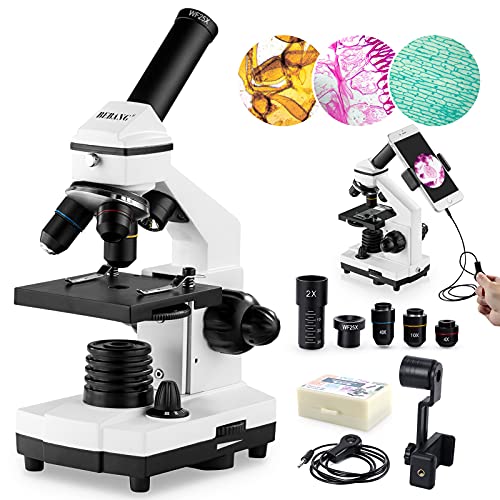
- Six settings listed up to 2000X
- Coarse and fine focus controls
- Dual LEDs, slides, bag, and phone adapter
Best For: Students and beginners seeking higher magnification for biology study
Best for Young STEM Explorers

- Prepared and blank slides with activity tools
- Dual lighting for opaque and translucent objects
- Compact design with phone adapter and two-year warranty
Best For: Children ages 6–12 beginning hands-on microscopy
Best Rechargeable Pick
MAXLAPTER 2000X Kids Compound Microscope

- 40X–2000X magnification with multiple objectives
- Rechargeable battery lasts up to four hours
- Includes slides, case, and phone holder
Best For: Children ages 8–12 and beginner home science
Best Complete Starter Kit
PALOBIL 100X–2000X Compound Microscope

- Six listed magnification settings up to 2000X
- Top and bottom adjustable LED illumination
- Includes an 11-piece experiment accessory kit
Best For: Students, homeschool use, and guided experiments
Best Portable Lab Kit
Wevision M2 2000X Compound Microscope
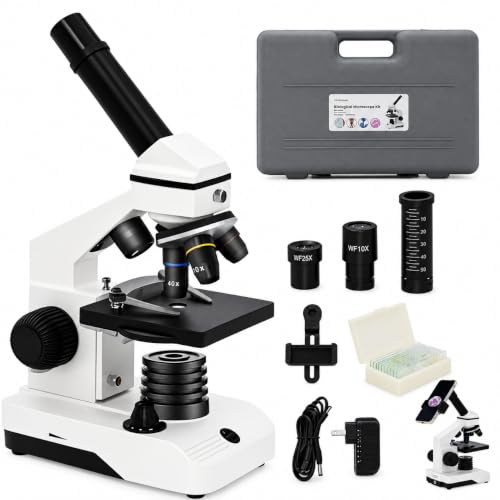
- 40X–2000X range with glass optics
- Hard-shell case and all-metal construction
- Includes slides, cleaning tissues, and phone adapter
Best For: Portable classroom, home, and field STEM activities
Best All-Around Starter – National Geographic Dual LED Microscope
For families seeking compound microscopes for children, this National Geographic kit offers an approachable introduction to slide-based biology and hands-on observation. Its dual LED lighting supports both prepared slides and some solid objects, while the included accessories make it easy to begin experimenting.
Best For: Children ages 8-12 who want a guided, ready-to-use STEM microscope kit.
Pros:
- Dual LED illumination for slides and 3D objects
- Includes 10 prepared slides, 10 blank slides, and 50+ accessories
- Simple 20x and 50x optical magnification
- Includes a color learning guide, geode specimen, and padded storage container
Cons:
- Its maximum listed magnification is lower than that of more advanced student microscopes
- Battery-powered operation requires batteries
This is a particularly convenient choice for younger beginners because the experiments, supplies, and instructions are bundled together. It prioritizes accessibility and variety over high-power cellular detail.
Best High-Power Student Pick – PalliPartners Compound Microscope
This PalliPartners model is a stronger fit for older children, teens, and supervised student use than basic toy scopes. Among compound microscopes for children, its 100x-2000x range, glass optics, dual lighting, and focusing controls provide room for more detailed biology work.
Best For: Students ages 8-18, homeschoolers, and families wanting a high-magnification microscope with phone accessories.
Pros:
- 4x, 10x, and 40x objectives with listed magnification up to 2000x
- Top and bottom LED illumination for solid and translucent specimens
- Includes 10 prepared slides and 18 blank slides
- Phone adapter and Bluetooth remote support specimen photography
Cons:
- Higher-power controls may be more involved for younger beginners
- Adult supervision is recommended for children
- It requires a power adapter for operation
With coaxial coarse and fine focus controls and a substantial slide set, this model bridges beginner and intermediate use. It is worth considering when a child’s interest is moving beyond simple viewing into repeatable biology experiments.
Best Beginner-Friendly Kit – National Geographic Junior Microscope
For children just starting out, this National Geographic Junior kit keeps the process straightforward. Its 50x-250x zoom, adjustable platform, dual viewing lights, and guided lab materials make it one of the more accessible compound microscopes for children.
Best For: Young beginners who benefit from simple controls, prepared specimens, and structured activities.
Pros:
- Easy-to-use focus dial, adjustable platform, and zoom dial
- 50x-250x magnification with upper and lower lights
- Includes six prepared slides and six blank slides
- Lab guide, pipette, tweezers, and slide covers support experiments
Cons:
- Lower maximum magnification than high-power compound models
- Plastic construction may feel less substantial than metal-bodied options
- Battery-powered operation requires batteries
This is a practical entry point for children who need clear instructions and manageable controls. The included lab guide adds educational value, while the moderate magnification keeps the kit focused on introductory exploration.
Best Sturdy Value – HUTACT 40x-2000x Compound Microscope
This HUTACT microscope offers a metal-bodied alternative for families comparing compound microscopes for children and adults. It combines achromatic glass lenses, LED lighting, and a broad listed magnification range with a compact slide set and storage bag.
Best For: Beginners, students, and families wanting a sturdier microscope for homeschooling or general science exploration.
Pros:
- 4x, 10x, and 40x objectives with eyepiece options up to a listed 2000x
- Aluminum-alloy body is designed for stability
- Achromatic glass lenses are intended to provide clear, bright images
- Includes five prepared slides, storage bag, and user manual
Cons:
- The included slide set is smaller than those supplied with several competing kits
- The broad magnification range may require practice to use effectively
- No phone adapter is listed among the included accessories
Its lightweight metal construction and high-power configuration make it a flexible choice for shared family use. However, buyers should expect to add more specimens or slides if they want a larger variety of experiments right away.
Best STEM Starter Kit – AmScope M30-ABS-KT2-W
The AmScope M30-ABS-KT2-W is a well-equipped choice for families comparing compound microscopes for children. Its six magnification settings, LED illumination, rotating color filter wheel, and included accessories give beginners a structured way to start examining prepared samples and other specimens.
Best For: Children and beginners who want a comprehensive, portable STEM microscope kit with a protective carrying case.
Pros:
- Offers six magnification settings from 120X to 1200X.
- Includes 52 pieces, including sample slides and operating accessories.
- Combines a metal body with LED lighting and a hard ABS carrying case.
- Battery-powered design supports portable use.
Cons:
- Plastic slides may be less durable than glass slides.
- The extensive accessory set may be more than a very young beginner needs.
- It uses a monocular viewing head rather than binocular viewing.
Overall, this AmScope kit stands out when included materials and portability matter as much as magnification. The one-year manufacturer warranty and substantial accessory selection also make it a practical introduction to hands-on microscopy.
Best High-Magnification Option – BEBANG 2000X Compound Microscope
The BEBANG 2000X compound microscope is aimed at students, children, and adults who want broad magnification flexibility for biology education. Its metal frame, coarse and fine focus controls, dual LED illumination, slides, and phone adapter support more detailed home or classroom observation.
Best For: Older children, students, and beginners who want high stated magnification plus smartphone-assisted viewing.
Pros:
- Provides six listed magnification settings up to 2000X.
- Coarse and fine focusing knobs help refine image sharpness.
- Dual illumination supports brightfield viewing of different specimen types.
- Includes 15 slides, operating accessories, a carrying bag, and phone adapter.
Cons:
- Its higher magnification range may be less useful for very young children still learning basic focusing.
- The kit is powered by AC or battery, so users must manage two power options.
- The monocular design provides one-eye viewing.
This BEBANG model is a strong fit for learners who expect to progress beyond simple observations. The adjustable focus system and dual illumination add useful control, while the included phone adapter can help share discoveries during lessons.
Best for Young STEM Explorers – DOUBLE CC Micro World Kit
The DOUBLE CC Micro World kit is designed specifically for children and beginners exploring compound microscopes for children. It pairs a monocular optical system with prepared slides, blank slides, a phone adapter, dual illumination, and a seven-color aperture disk to make early experiments approachable.
Best For: Children ages 6–12 who want a colorful, accessory-rich introduction to observing specimens at home.
Pros:
- Includes prepared and blank slides plus tools such as droppers and tweezers.
- Dual lighting can illuminate translucent specimens and opaque objects.
- Seven-color aperture disk helps adjust contrast and light conditions.
- Compact, lightweight design includes a phone adapter and two-year warranty.
Cons:
- The supplied details list different magnification figures, so buyers should verify the current specifications.
- The kit uses a monocular viewing head.
- Its plastic construction may feel less substantial than a fully metal microscope.
This kit emphasizes guided discovery rather than advanced laboratory work. Its prepared specimens, simple controls, dual lighting, and child-focused accessories make it a convenient starting point for hands-on STEM activities.
Best Rechargeable Pick – MAXLAPTER 2000X Kids Compound Microscope
For families looking at compound microscopes for children, the MAXLAPTER combines broad 40X–2000X magnification with a rechargeable design and beginner-friendly accessories. Its metal frame, dual illumination, prepared slides, and phone holder make it a practical option for home science activities and school projects.
Best For: Children ages 8–12, beginners, and families wanting a rechargeable microscope kit for home learning.
Pros:
- Offers 40X–2000X magnification using multiple eyepieces and objectives.
- Rechargeable battery provides up to four hours of use after a full charge.
- Includes adjustable LED and mirror illumination, prepared slides, a phone holder, and a carrying case.
- Aluminum-alloy construction provides a stable metal frame.
Cons:
- The kit is monocular rather than binocular.
- The supplied notes do not specify whether the phone holder fits every smartphone.
This is a well-rounded choice when portability and ready-to-use accessories matter. The rechargeable power and phone holder are particularly convenient for children who want to document their observations.
Best Complete Starter Kit – PALOBIL 100X–2000X Compound Microscope
The PALOBIL is a feature-rich option among compound microscopes for children, with six listed magnification settings, dual LED lighting, a metal frame, and an 11-piece beginner experiment kit. It is designed for students, homeschool use, demonstrations, and beginner biological observations.
Best For: Kids, students, and homeschool families seeking a broad accessory bundle and adjustable lighting.
Pros:
- Provides six listed magnification settings from 100X to 2000X.
- Uses top incident and bottom transmitted LED lighting for different specimen types.
- Includes prepared and blank slides, droppers, tweezers, a cell phone adapter, and instructions.
- Metal construction and shockproof packaging support storage and transport.
Cons:
- Requires three AA batteries, which are not included, or the included AC adapter.
- The extensive controls and accessories may be more than very young beginners need.
With its two illumination methods and substantial starter kit, this microscope offers flexibility for structured experiments. Buyers should plan for batteries if they want to use it away from an outlet.
Best Portable Lab Kit – Wevision M2 2000X Compound Microscope
The Wevision M2 stands out among compound microscopes for children when a durable, portable setup is important. It combines 40X–2000X magnification, glass optics, dual LED lighting, a hard-shell carrying case, and accessories for both classroom work and home STEM exploration.
Best For: Students, families, and hobbyists who need a portable all-metal microscope kit with smartphone sharing.
Pros:
- Combines 10X and 25X eyepieces with 4X, 10X, and 40X objectives plus a 2X lens.
- Includes prepared and blank slides, tweezers, a dropper, and 50 lens-cleaning tissues.
- Hard-shell case protects the components for classroom or field use.
- Supports corded or battery power and includes a smartphone adapter.
Cons:
- At about 2,951 grams, it is heavier than the other listed options.
- The supplied notes do not state the battery runtime.
- The all-metal construction may be less convenient for very young children to carry.
This model is a strong fit for buyers who prioritize a complete, rugged setup over minimum weight. The case, cleaning supplies, and phone adapter add practical value for repeated STEM activities.
How We Picked the Best Compound Microscopes for Children
We focused on models that provide genuine compound-microscope functionality, useful magnification ranges, dependable illumination, and controls young users can learn to operate. We also considered whether each microscope includes prepared slides, blank slides, tools, or other accessories that help children begin experimenting immediately.
Because product specifications and kit contents vary, buyers should confirm the current listing before ordering. Extremely high advertised magnification is not automatically a sign of better performance; optical clarity, focusing control, and stable construction matter more for everyday use.
Quick Comparison
| Type | Best for | What to look for |
|---|---|---|
| Junior microscope kit | First-time users and younger children | Simple controls, prepared slides, and clear instructions |
| Beginner STEM microscope | School projects and regular home use | Multiple objectives, adjustable LED lighting, and a sturdy stand |
| Student compound microscope | Older children and serious learners | Glass optics, fine focus, mechanical controls, and durable construction |
| High-magnification kit | Users studying very small specimens | Useful optical resolution rather than magnification claims alone |
Key Buying Factors for Compound Microscopes for Children
Magnification and Optical Quality
A range around 40x to 400x is suitable for many introductory activities, while 1000x or 2000x settings can support more advanced work when the optics and specimen preparation are good. High power also narrows the field of view and makes focusing more difficult, so it should not be the only selection criterion.
Lighting and Focusing
Built-in LED illumination is convenient and usually easier for children than mirror-based lighting. Coarse focus is useful for locating a specimen; fine focus becomes increasingly important at higher magnification. A smooth focus mechanism helps prevent frustration and accidental movement.
Stability and Ergonomics
Choose a base that stays planted on the table, a stage with usable clips, and controls that are accessible without forcing a child to move the entire instrument. Metal construction can improve durability, while a lighter body may be preferable if the microscope must be stored after each session.
Included Accessories
Prepared slides provide immediate results, while blank slides, covers, droppers, tweezers, and specimen tools encourage open-ended exploration. Check whether accessories are reusable and whether replacement slides are easy to find.
Who Should Buy Which Compound Microscopes for Children?
For younger children or a first introduction to microscopy, choose a junior kit with straightforward controls and ready-made slides. For elementary and middle-school projects, a beginner STEM kit with several objectives, LED lighting, and a broader accessory set offers better flexibility. Older students who expect to use the microscope frequently should consider a sturdier student model with glass optics, fine focus, and dual-power capability.
Families buying for multiple users may prefer a durable microscope with a comfortable monocular head and easy-to-adjust lighting. If the goal is biology coursework rather than occasional discovery, prioritize mechanical stability and optical performance over the largest number printed on the box. Always supervise younger children around glass slides, pointed tools, and small detachable parts.