Testing a USB charger, battery pack, or DC power supply takes more than checking its no-load voltage. The right electronic load applies a controlled demand so you can measure output stability, capacity, heat, and charging behavior under realistic conditions.
This roundup covers 10 electronic loads with USB, ranging from simple adjustable discharge modules to programmable bench instruments. Use the buying guide below to match current range, power handling, interfaces, and safety features to your work.
Best 10 Electronic Loads with USB Picks for 2026
Best USB Constant-Current Tester
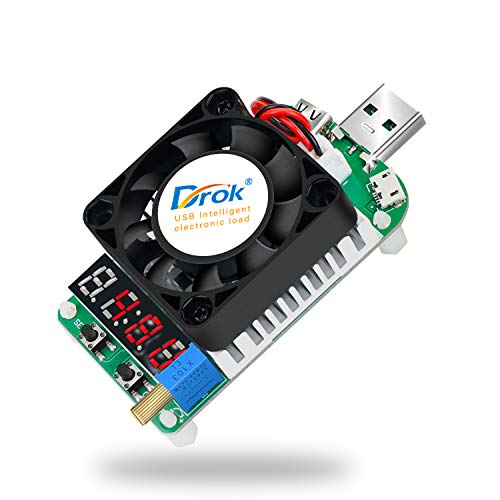
- Adjustable 0.25A–4A constant-current load
- Measures voltage, current, and power
- Temperature-controlled fan with protection features
Best For: USB and Type-C charger and cable testing up to 25W
Best Programmable Bench Load

- Handles up to 150V, 30A, and 300W
- USB, RS232, and RS485 with SCPI support
- Adds dynamic and battery testing modes
Best For: Automated lab and production power testing
Best Portable High-Power Load
Treedix 120W Mini Electronic Load
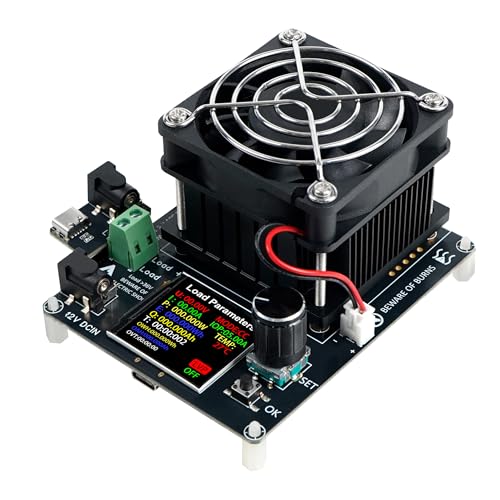
- Supports up to 50V, 15A, and 120W
- Monitors capacity, energy, time, and temperature
- Compact color-screen design with Type-C PD power
Best For: Portable charger, power-bank, and battery discharge testing
Best USB-C Monitoring Meter
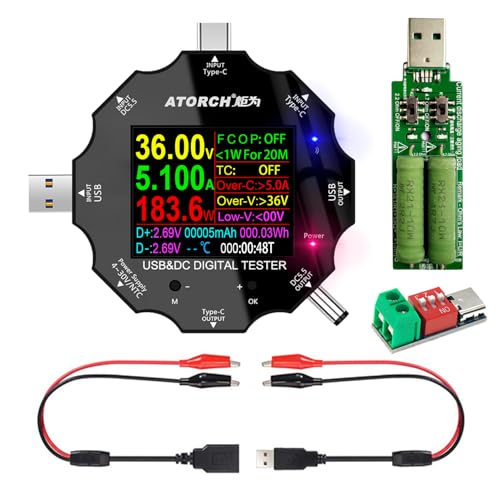
- Supports USB, Type-C, DC5.5, and micro USB
- Measures voltage, current, power, resistance, and capacity
- Recognizes PD and QC fast-charge protocols
Best For: Everyday charging and DC-device diagnostics
Best Multifunction Pick

- 35W adjustable discharge capacity
- Tests QC, AFC, and FCP protocols
- USB, Micro USB, and Type-C ports
Best For: Multi-purpose charger, cable, and power-bank testing
Best High-Power Option
180W USB Electronic Load Tester

- Up to 180W, 200V, and 20A
- Four selectable load modes
- Color display with temperature monitoring
Best For: High-power battery, charger, and aging tests
Best Measurement Features

- OLED monitoring with capacity estimates
- Adjustable 0–3A current control
- Includes QC2.0/3.0 trigger
Best For: Charger, cable, and power-bank measurement
Versatile USB Load Testing
Eyes.sys 180W Electronic Load Tester

- Four operating modes for varied discharge tests
- 2.4-inch display with automatic data reports
- External temperature probe and safety protections
Best For: Makers testing batteries, chargers, and USB cables
Protected Four-Wire Testing

- Four-wire measurement improves voltage accuracy
- Four load modes with app and PC connectivity
- Protective case and intelligent temperature control
Best For: Accurate, extended testing of batteries and USB power equipment
Best USB Constant-Current Tester – DROK LD25 USB Load Tester
For shoppers seeking electronic loads with usb connectivity, the DROK LD25 is a focused option for testing charger and cable output. It provides adjustable constant-current discharge from 0.25A to 4A, with readings for voltage, current, and power on a four-digit display.
Best For: USB and Type-C charger, cable, and power-output testing up to 25W.
Pros:
- Supports up to 4A, 25V, and 25W within its specified limits.
- Displays voltage, current, and power values.
- Includes temperature-controlled fan cooling and multiple protection functions.
Cons:
- Has no reverse-connection protection; incorrect polarity can permanently damage the unit.
- Its 25W maximum limits higher-power testing.
This is a practical, compact choice for routine USB and Type-C discharge work, provided you carefully observe the polarity and operating limits.
Best Programmable Bench Load – OWON OEL1530 Electronic Load
The OWON OEL1530 is a full bench instrument for buyers who need electronic loads with usb control as part of automated testing. It handles up to 150V, 30A, and 300W, while offering USB, RS232, and RS485 connectivity with SCPI support.
Best For: Lab, R&D, production-line, and automated power-supply testing.
Pros:
- Offers CV, CC, CR, and CP operating modes.
- Supports dynamic testing up to 5kHz with adjustable slew rate.
- Provides battery charge/discharge testing and PC-managed test curves.
- Includes OCP, OVP, OPP, OTP, and reverse-polarity protection.
Cons:
- Its 2.5 kg benchtop design is less portable than compact USB testers.
- May be more capability than needed for basic charger checks.
Choose this model when programmability, high power, and system integration matter more than minimum size or simplicity.
Best Portable High-Power Load – Treedix 120W Mini Electronic Load
The Treedix mini tester suits buyers who want electronic loads with usb-related flexibility without committing to a large bench unit. It supports loads up to 50V, 15A, and 120W, and tracks discharge parameters such as energy, capacity, time, and temperature.
Best For: Portable testing of chargers, power banks, batteries, and current adapters.
Pros:
- Supports up to 50V, 15A, and 120W.
- Provides configurable discharge energy, capacity, and time limits.
- Uses a 1.54-inch color screen in a compact 10 × 8 × 5 cm body.
- Can be powered by DC 12V or Type-C to Type-C PD 12V.
Cons:
- Type-C power requires a Type-C to Type-C cable; Type-C to Type-A is not supported for powering the tester.
- It is a constant-current discharge module rather than a full programmable bench load.
This is a strong middle ground for field work and battery or power-bank evaluation when compact size and higher power capacity are both useful.
Best USB-C Monitoring Meter – UD18 3-in-1 USB Tester
For everyday diagnostics, the UD18 is a convenient alternative to larger electronic loads with usb interfaces. This compact meter supports USB, Type-C, DC5.5, and micro USB connections while displaying voltage, current, power, resistance, capacity, and charging data.
Best For: Monitoring charging performance across phones, notebooks, routers, power supplies, and other DC devices.
Pros:
- Supports USB, Type-C, DC5.5, and micro USB connections.
- Offers color-screen readouts, fast-charge recognition, capacity tracking, and temperature measurement.
- Supports PD2.0/3.0 and QC2.0/3.0 protocols.
- Includes over-voltage, over-current, low-voltage, timing, and auto-off protections.
Cons:
- It is primarily a monitoring meter, not a high-power standalone electronic load.
- The temperature probe is not included.
Select this model when you need broad connector compatibility and live charging measurements in a small, lightweight device rather than a dedicated high-power load module.
Best Multifunction Pick – UCTRONICS 35W USB Load Tester
If you need electronic loads with USB connectivity for checking chargers, cables, and power banks, the UCTRONICS RS2818 combines adjustable discharge testing with fast-charge protocol support. It accepts USB, Micro USB, and Type-C connections, operates from 4.0 to 25.0V, and supports up to 35W of discharge power.
Best For: Testing USB power sources and triggering compatible QC, AFC, and FCP fast-charge outputs.
Pros:
- Supports QC2.0, QC3.0, AFC, and FCP protocol testing with selectable 5V, 9V, 12V, and 20V outputs.
- Offers USB, Micro USB, Type-C, and external wiring connections.
- Includes reverse-polarity, overvoltage, overcurrent, over-power, low-voltage, and over-temperature protection.
- Built-in temperature control and cooling fan support loads up to 35W.
Cons:
- Its 35W maximum is lower than the capacity of the 180W tester in this roundup.
- Fast-charge triggering is limited to the protocols listed by the manufacturer.
This is a flexible choice for hobbyists and technicians who want one compact electronic load for USB testing, protocol triggering, and equipment aging work.
Best High-Power Option – 180W USB Electronic Load Tester
For higher-power electronic loads with USB support, this tester provides substantially more headroom than compact 35W models. It offers constant-current, constant-voltage, constant-power, and constant-resistance modes, plus a color screen for monitoring discharge data.
Best For: High-power load testing, battery capacity checks, charger evaluation, and extended discharge or aging tests.
Pros:
- Supports four operating modes: CC, CV, CW, and CR.
- Rated for up to 180W, 200V, and 20A according to the supplied specifications.
- Uses a 2.4-inch color screen to display multiple test values and digital curves.
- Temperature-controlled cooling fan and optional external NTC thermometer support thermal monitoring.
Cons:
- Its higher power capability may be unnecessary for basic USB cable or charger checks.
- The supplied notes do not specify a complete set of USB connector types.
- High-power testing requires careful attention to heat and electrical limits.
Choose this model when testing capacity, power adapters, or discharge behavior demands more than a small USB load can provide; its multiple modes make it the most versatile high-power option here.
Best Measurement Features – Eversame 35W USB Load Tester
The Eversame combines a 35W adjustable USB load with multimeter-style monitoring, making it useful when you want more than a simple discharge resistor. Its OLED display tracks voltage, current, resistance, capacity, temperature, and time while the included trigger supports QC2.0 and QC3.0 testing.
Best For: Measuring USB charger performance, cable quality, and power-bank capacity with adjustable current control.
Pros:
- Displays current, voltage, resistance, capacitance, temperature, and elapsed time.
- Two adjustment knobs provide coarse and fine current control across a 0–3A range.
- Includes a QC2.0/QC3.0 trigger for testing compatible fast chargers.
- Automatic fan control starts above 55°C and stops below 45°C.
Cons:
- Its 35W and 0–3A ranges are more limited than the higher-power tester.
- The QC trigger is intended for QC2.0/3.0 chargers, not ordinary chargers.
- Users must turn both current knobs fully counterclockwise before testing.
This is a strong choice for USB-focused bench work where readable measurements and capacity estimates matter as much as adjustable load control.
Versatile USB Load Testing – Eyes.sys 180W Electronic Load Tester
If you need electronic loads with USB support for batteries, chargers, cables, or power adapters, the Eyes.sys tester offers four operating modes and a large color display. Its adjustable testing functions and safety monitoring make it suitable for both routine checks and DIY projects.
Best For: Makers and electronics users who want a flexible USB load tester with multiple operating modes, temperature monitoring, and report generation.
Pros:
- Supports constant current, constant voltage, constant power, and constant resistance modes.
- 2.4-inch HD color screen and automatic data-report generation.
- Includes external NTC temperature sensing and three intelligent safety protections.
- Can test the charging speed and quality of charging and data cables.
Cons:
- Requires a battery-powered input with a minimum operating voltage of 2 volts.
- Its broad DIY connectivity may require more setup than a simple plug-in tester.
With its four test modes, temperature probe, and flexible wiring interface, this is a well-rounded choice for users who want more than basic USB power measurements.
Budget USB Discharge Module – MakerHawk 150W Electronic Load Tester
For affordable electronic loads with USB support, the MakerHawk module provides adjustable constant-current testing with voltage and current readings. Its compact design and Micro USB or DC power options make it practical for battery-capacity and discharge experiments, provided you stay within its limits.
Best For: DIY electronics users who need a compact, manually adjusted USB load tester for batteries and controlled discharge testing.
Pros:
- Measures up to 200V and 20A, with a maximum body discharge power of 150W.
- Supports DC 6–12V or Micro USB power input.
- Provides reset controls for capacity, power, and timed discharge data.
- Compact and lightweight at approximately 83 grams.
Cons:
- Current must be increased gradually to reduce the risk of burning the discharge tube.
- Exceeding 150W can create a burnout risk.
- Requires careful manual operation rather than offering the more automated features of advanced testers.
This MakerHawk is a straightforward, budget-oriented module, but its power limits and adjustment warnings make careful setup essential before every high-load test.
Protected Four-Wire Testing – 180W USB Battery Load Tester
This 180W USB battery load tester is designed for accurate, extended discharge and aging tests. It combines four adjustable load modes, a four-wire measurement system, protective casing, app compatibility, and temperature-controlled cooling for users testing batteries, power banks, chargers, and cables.
Best For: Users who prioritize measurement accuracy, protective features, and long-duration testing across batteries and USB power equipment.
Pros:
- Supports constant current, constant power, constant resistance, and constant voltage modes.
- Four-wire system helps reduce the effect of wire resistance on voltage readings.
- Includes overload, overcurrent, and high-temperature protection with real-time monitoring.
- Works with Android, iOS, PC Bluetooth, and wired connections.
Cons:
- Its 180W, 200V, and 20A capabilities may be more than casual users need.
- The larger enclosure and protective case make it less compact than a basic module.
The upgraded four-wire design and intelligent cooling make this a strong option for repeatable, longer-running USB and battery tests, especially when accuracy matters.
How We Picked These Electronic Loads with USB
We focused on models that combine controlled electrical loading with USB or USB-C compatibility, making them useful for evaluating chargers, power banks, lithium batteries, and small DC supplies. We compared maximum voltage, current, and wattage, along with operating modes, display quality, adjustment range, protocol support, measurement functions, and computer connectivity.
Products with higher power ratings are not automatically better. A compact 25W module may be the most practical choice for routine USB checks, while a programmable 300W unit is better suited to engineering work and repeatable test sequences. Treat advertised limits as operating ceilings, and verify cooling, wiring, and input requirements before applying a sustained load.
Quick Comparison
- Best for basic USB testing: Compact adjustable modules such as the DROK-style 25W load are simple and portable.
- Best for USB-C and fast-charge checks: Choose a model with USB-C input and QC, AFC, or FCP trigger support.
- Best for battery capacity testing: Look for constant-current control, voltage monitoring, capacity readouts, and four-wire measurement.
- Best for lab work: A programmable load with USB or RS232 control, multiple operating modes, and dynamic loading offers the most repeatability.
- Best for higher-power experiments: 150W to 300W instruments provide more headroom, but require serious attention to ventilation and heat dissipation.
Key Buying Factors for Electronic Loads with USB
Power, Voltage, and Current Limits
Check all three ratings rather than relying on wattage alone. A load may support high current at low voltage but reach its power limit quickly at higher voltage. Select a unit with margin above your intended test point, especially for long discharge cycles.
Load Modes and Adjustment
Constant current is the essential mode for many USB and battery tests. Constant resistance, constant power, and constant voltage modes are useful for simulating different devices or regulating a test condition. Fine adjustment and stable control make results easier to reproduce.
Measurement and Connections
Look for clear voltage, current, power, resistance, and capacity readings. USB-C, USB-A, screw terminals, and separate sense leads each serve different setups. Four-wire measurement can improve accuracy when cable resistance matters.
Cooling and Protection
Electronic loads turn electrical energy into heat. Fans, heatsinks, thermal protection, over-voltage protection, and short-circuit protection are valuable safeguards. Never assume a high-wattage rating means the unit can run continuously without airflow.
Controls and Computer Interface
A front-panel display is convenient for quick checks, while USB or RS232 control is more useful for automated testing and data logging. If you need dynamic load profiles, confirm the supported frequency and software requirements before buying.
Who Should Buy Which Electronic Loads with USB?
Choose a compact USB load if you mainly test phone chargers, power banks, cables, and low-power adapters. Choose a protocol-aware model if you need to trigger higher-voltage fast-charge modes. Choose a 150W–180W tester for battery capacity work and broader DC testing. Choose a programmable bench load for development labs, automated measurements, or repeatable production testing. For any option, match the rating to your source, use suitable cables, and monitor temperature throughout the test.