Choosing the right LCR meter can make component diagnosis faster, especially when repairing boards with unknown, damaged, or surface-mount parts. The best models measure resistance, capacitance, and inductance while adding useful functions such as ESR testing, auto-ranging, component identification, and frequency selection.
This roundup compares 10 options for electronics repair, from affordable testers for hobby benches to more capable handheld meters for troubleshooting and verification.
Best 10 Lcr Meters for Electronics Repair Picks for 2026
Best Precision Pick

- 19,999-count display with dual parameters
- Measures ESR, Q, D, phase, and reactance
- Includes calibration and component sorting
Best For: Detailed repair-bench testing and screening
Best Proven Handheld
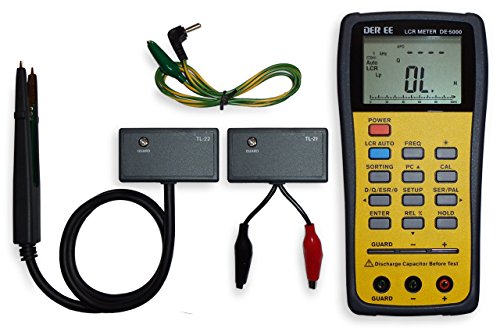
- Automatic LCR measurement and ranging
- Five selectable test frequencies
- Includes leads and SMD tweezers
Best For: Flexible handheld component testing
Best Compact Resolution
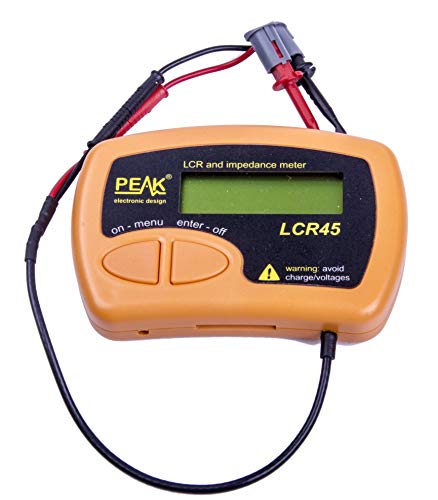
- Automatic or manual component selection
- Test frequencies up to 200kHz
- Fine stated measurement resolution
Best For: Compact, focused bench measurements
Best Durable Workbench Option

- Dual-display handheld design
- Battery powered for portable testing
- Durable construction for long service
Best For: Routine repair work and portable bench use
Versatile Bench Companion
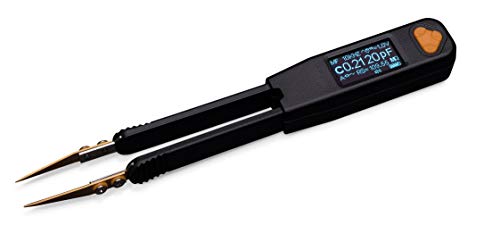
- Five test frequencies and three test-voltage settings
- Wide R, C, and L measurement ranges
- Adds diode and LED testing with USB charging
Best For: General electronics repair and component testing
High-Accuracy Diagnostic Pick

- Multiple LCR, DCR, ESR, phase, D, and Q modes
- Five selectable test frequencies with backlit display
- Includes SMD leads, alligator leads, and carrying case
Best For: Detailed component verification and repair diagnostics
Portable SMD Testing Favorite
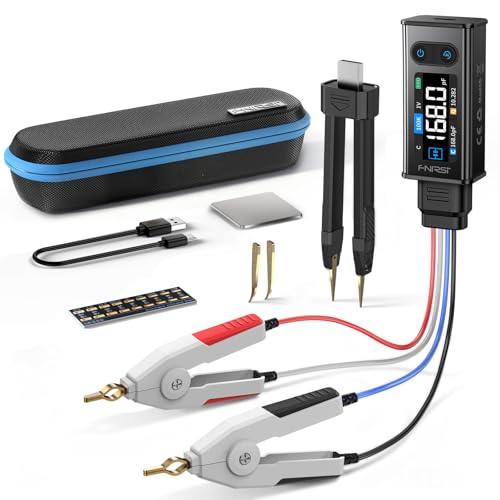
- Tweezer, Kelvin clip, and hook options for varied components
- Auto sorting with R/C/L/Z and X/D/Q/θ displays
- Rechargeable, magnetic, and supplied with a storage pouch
Best For: SMD-focused repair and portable component testing
Versatile Component Detective

- Automatic testing for R, L, C, ESR, transistors, diodes, and batteries
- Replaceable patch seat with test hooks for varied components
- Includes NEC infrared decoding and USB-C rechargeable battery
Best For: Mixed-component electronics repair and remote-control troubleshooting
Pocket Precision Tweezers
FNRSI LCR-ST1 Mini Smart LCR Meter

- Three test frequencies from 100 Hz to 10 kHz
- Tweezer-style testing with pointed and hook replacement heads
- Measures R, C, L, diodes, continuity, ESR, and displayed secondary values
Best For: Portable SMD testing and quick component checks
High-Frequency Bench Bridge
ET430 100 kHz Handheld LCR Meter

- Six test frequencies spanning 100 Hz to 100 kHz
- 2.8-inch display shows primary and secondary parameters
- Lists 0.3% basic accuracy and includes capacitor mode
Best For: Frequency-variable component characterization and bench repair
Best Precision Pick – FNIRSI LC1020E
For electronics repair, the FNIRSI LC1020E is a feature-rich choice among lcr meters for electronics repair. It combines 19,999-count readings, selectable frequencies through 100kHz, dual-parameter display, and calibration tools for detailed component testing.
Best For: Repair technicians and hobbyists who need detailed measurements, ESR readings, and component sorting.
Pros:
- Displays primary and secondary parameters such as ESR, Q, D, phase angle, and reactance.
- Supports capacitance, resistance, and inductance ranges from small components to larger values.
- Includes open/short calibration, adjustable test voltage, sorting mode, and Kelvin-style fixtures.
- Battery powered with a 2.8-inch TFT display and USB-C charging.
Cons:
- Requires careful calibration and complete component discharge before testing.
- Its extensive settings may be more than casual users need.
The LC1020E is a strong all-around option when repair work calls for component screening and more than basic LCR readings. Its calibration and sorting functions are particularly useful for repeatable bench testing.
Best Proven Handheld – DE-5000 LCR Meter
The DE-5000 is a versatile handheld option for lcr meters for electronics repair, offering automatic LCR identification, dual display counts, multiple test frequencies, and serial or parallel measurement modes.
Best For: Technicians who want flexible handheld testing with supplied leads and SMD tweezers.
Pros:
- Automatically measures inductance, capacitance, and resistance in smart AUTO-LCR mode.
- Shows secondary values including ESR or Rp, dissipation factor, quality factor, and phase angle.
- Supports 100Hz, 120Hz, 1kHz, 10kHz, and 100kHz test frequencies.
- Includes an alligator test lead case, SMD tweezers, guard line, battery, and manual.
Cons:
- The optional IR-to-USB cable is not included.
- At 450g, it is heavier than some compact handheld meters.
With automatic ranging and useful accessories included, the DE-5000 is practical for varied repair tasks. Its sorting mode also helps when checking batches of similar components.
Best Compact Resolution – Peak Atlas LCR45
The Peak Atlas LCR45 offers a compact approach to lcr meters for electronics repair, with automatic or manual component selection, multiple frequency options, and fine stated resolution for inductors, capacitors, and resistors.
Best For: Users who prioritize a lightweight meter with straightforward controls and high measurement resolution.
Pros:
- Provides automatic or manual component type selection.
- Offers automatic or manual testing at DC, 1kHz, 15kHz, or 200kHz.
- States resolution of 0.2uH, 0.2pF, and 0.2 ohms.
- Includes a hold function, menu system, and one-year manufacturer warranty.
Cons:
- Uses corded electric power rather than a battery.
- Its supplied notes provide less detail about ranges and advanced sorting features.
The LCR45 is appealing for a focused bench setup where a lightweight instrument and selectable testing modes matter. Its 200kHz option also provides flexibility for specialized impedance checks.
Best Durable Workbench Option – B&K Precision 878B
The B&K Precision 878B is a straightforward dual-display handheld choice among lcr meters for electronics repair. Its durable construction and universal LCR design suit users who want a conventional instrument for repeated bench work.
Best For: Repairers seeking a durable handheld LCR meter from an established test-equipment brand.
Pros:
- Uses a dual-display handheld design.
- Designed as a universal LCR meter for component testing.
- Battery powered for portable use.
- Durable construction is intended for long service life.
Cons:
- The supplied notes do not specify test frequencies, measurement ranges, or included accessories.
- Fewer detailed features are documented here than for the other listed meters.
The 878B makes the most sense when durability and a familiar handheld format are higher priorities than a long list of documented advanced functions. Confirm the specifications and accessory package before purchase if your repairs require particular test modes.
Versatile Bench Companion – Pro1 Plus 100KHz LCR Meter
LCR Research Pro1 Plus - 100KHz LCR Meter with 0.1% Accuracy/LED Tester/ESR Meter/Smart SMD Tweezers
Check Price On AmazonThe Pro1 Plus is a practical choice among lcr meters for electronics repair when you need broad component coverage in a compact, rechargeable tester. It offers five test frequencies, three test-voltage settings, and dedicated diode and LED testing.
Best For: Electronics repairers testing SMD and through-hole components across a wide resistance, capacitance, and inductance range.
Pros:
- Offers 100Hz, 120Hz, 1kHz, 10kHz, and 100kHz test frequencies.
- Measures resistance from 20mΩ to 10MΩ, capacitance from 0.1pF to 10mF, and inductance from 10nH to 1H.
- Includes diode and LED testing, USB charging, and a one-year warranty with lifetime support.
Cons:
- Its listed basic accuracy varies by measurement type: 0.1% for resistance, 0.2% for inductance, and 0.2% for capacitance.
- The supplied notes do not specify display size or included accessories beyond the meter.
With flexible frequency and voltage options plus an unusually wide stated measurement range, the Pro1 Plus is well suited to general repair-bench work where versatility matters.
High-Accuracy Diagnostic Pick – DE-5000 Handheld LCR Meter
The DE-5000 is a strong option among lcr meters for electronics repair when detailed measurements and component verification are priorities. It combines multiple LCR modes, ESR-related parameters, selectable frequencies, and included SMD and alligator test leads.
Best For: Repair technicians and advanced hobbyists who need series/parallel analysis, sorting, tolerance checks, and a high-resolution backlit display.
Pros:
- Supports 100Hz, 120Hz, 1kHz, 10kHz, and 100kHz test frequencies.
- Provides Ls, Lp, Cs, Cp, Rs, Rp, and DCR modes, along with D, Q, phase angle, and ESR parameters.
- Includes TL-21 alligator leads, TL-22 SMD test leads, a protective case, and selectable tolerance settings from 0.25% to 20%.
Cons:
- At 1.3 pounds, it is heavier than the compact pocket-style meters in this group.
- The supplied notes identify it as handheld but do not mention rechargeable or USB power.
Its broad measurement modes and component-sorting functions make the DE-5000 particularly useful when repair work requires more than basic resistance, capacitance, and inductance readings.
Portable SMD Testing Favorite – FNIRSI LCR-ST2 100kHz Tester
The FNIRSI LCR-ST2 is designed for hands-on electronics repair, combining tweezer-style SMD testing with through-hole support, automatic sorting, and a full-band frequency scan. Its rechargeable design and included probe options make it convenient for mobile or crowded workbenches.
Best For: Repairers who frequently test SMD parts but also need Kelvin clips, hooks, voltage, continuity, diode, and through-hole component testing.
Pros:
- Scans at 100Hz, 120Hz, 1kHz, 10kHz, and 100kHz and offers four RMS test levels.
- Measures capacitors from 1pF to 22mF, resistors from 10mΩ to 10MΩ, and inductors from 1μH to 10H.
- Includes auto sorting, primary and secondary parameter displays, a rechargeable 300mAh battery, Kelvin clips, tweezer tips, hooks, and a storage pouch.
Cons:
- The stated diode measurement is limited to ≤0.7V, and voltage measurement is specified as ±30V.
- Its 1.47-inch display is compact, which may be less convenient for users who prefer larger readouts.
For repair benches centered on SMD work, the LCR-ST2 stands out by pairing fast automatic identification with interchangeable probes, magnetic mounting, and support for both component and basic electrical checks.
Versatile Component Detective – FNIRSI LCR-P1
For electronics repairers who want broad component coverage in a compact tester, the FNIRSI LCR-P1 combines automatic identification with LCR, ESR, transistor, battery, and diode testing. Its replaceable patch seat is designed for both tiny precision parts and higher-power devices.
Best For: Repair benches handling mixed components, SMD parts, transistors, and remote-control troubleshooting.
Pros:
- Tests resistors, capacitors, inductors, transistors, MOSFETs, diodes, batteries, and more.
- Replaceable patch seat plus included test hooks support different component sizes and testing styles.
- Automatically identifies component pins and parameters, with NEC infrared protocol analysis for remote-control work.
- Rechargeable 300 mAh battery, USB-C connectivity, and a 1.44-inch full-color screen.
Cons:
- The compact 1.44-inch display may show less information than larger bench instruments.
- The supplied notes do not specify measurement accuracy or detailed test ranges.
The LCR-P1 is a strong choice when convenience and component versatility matter more than detailed bench-meter specifications. Automatic testing and infrared decoding add useful repair-oriented functions beyond basic LCR measurements.
Pocket Precision Tweezers – FNRSI LCR-ST1 Mini Smart LCR Meter
The FNRSI LCR-ST1 is a lightweight option for electronics repairers who need a pocket-sized LCR meter for SMD and component checks. It supports three test frequencies, automatic component recognition, and interchangeable tweezer heads for different testing situations.
Best For: Portable SMD testing, quick resistance-capacitance-inductance checks, and repairers who value tweezer-style probing.
Pros:
- Measures resistance, capacitance, inductance, diodes, continuity, ESR, and related values.
- Offers 100 Hz, 1 kHz, and 10 kHz testing with selectable 0.3 V and 0.6 V RMS test levels.
- Includes pointed and hook-style replaceable tweezer heads for different electronics.
- Compact 1.45-ounce design with a 1.4-inch color screen and 240 mAh built-in battery.
Cons:
- Its small screen and tweezer-focused format may be less convenient for larger components.
- The supplied notes do not list a carrying case or detailed measurement accuracy.
With useful frequency choices and a stated range from 1 pF to 22 mF for capacitance, the LCR-ST1 suits quick component identification in the field or at the bench. Its automatic data handling and PC transfer support can also help organize test results.
High-Frequency Bench Bridge – ET430 100 kHz Handheld LCR Meter
The ET430 is a handheld bridge tester for electronics repairers who need a wider frequency selection and dual-parameter readings. Its 2.8-inch color LCD displays primary L/C/R values alongside secondary measurements such as D, Q, phase angle, or ESR.
Best For: Repair work requiring multiple test frequencies, larger on-screen readings, and capacitor or inductor characterization.
Pros:
- Provides six test frequencies from 100 Hz to 100 kHz.
- Displays primary values and secondary parameters on a 2.8-inch color TFT screen.
- Lists 0.3% basic accuracy and includes capacitor mode plus support for free software.
- Includes power line, short-circuit chip, and red-and-black rubber test contacts.
Cons:
- Kelvin test clips are not included.
- The instrument must be set for open and short circuit before use to reduce fixture error.
- The supplied notes do not provide detailed resistance, capacitance, or inductance ranges.
The ET430 is the most bench-instrument-oriented option here, particularly for users who want readings up to 100 kHz and a larger display. Plan to perform the required open/short setup and obtain Kelvin clips separately if your repair work needs that connection style.
How We Picked the Best Lcr Meters for Electronics Repair
We focused on the features that matter most during real repair work: measurement accuracy, test frequency, component coverage, display readability, connection options, portability, and ease of use. Models with auto component detection, ESR measurement, multiple test frequencies, SMD probing, or included test leads received particular consideration because these functions can reduce setup time.
We also considered the range of users each meter serves. A compact tester may be ideal for quick bench checks, while a higher-specification handheld instrument is better suited to repeated measurements, service work, and comparing components against expected values.
Quick Comparison
| Best For | Look For |
|---|---|
| General bench repairs | Auto-ranging, clear display, and standard leads |
| SMD troubleshooting | Tweezer probes or dedicated SMD sockets |
| Capacitor diagnosis | ESR measurement and selectable test frequencies |
| Component identification | Auto detection and broad measurement modes |
| Precision work | Higher accuracy, calibration support, and stable readings |
| Portable repairs | Battery operation, compact design, and durable controls |
Key Buying Factors for Lcr Meters for Electronics Repair
Measurement Accuracy and Range
Check the stated accuracy and the minimum and maximum values the meter can measure. High resolution is useful, but accuracy and repeatability matter more when checking components against a schematic or datasheet.
Test Frequency
Many basic meters test at one frequency, while more flexible models offer 100 Hz, 1 kHz, 10 kHz, or 100 kHz settings. Multiple frequencies help reveal how capacitors, inductors, and filters behave in different circuits.
ESR and Component Functions
ESR testing is valuable when diagnosing electrolytic capacitors, but it does not replace a complete in-circuit assessment. Auto identification, Q factor, dissipation factor, phase angle, and impedance readings can provide additional context for advanced troubleshooting.
Probes, Sockets, and Usability
Included test leads are suitable for general components, while tweezer probes are faster for small SMD parts. Consider the display, control layout, zeroing or calibration process, battery life, and whether the meter can test components in-circuit or only out of circuit.
Who Should Buy Which Lcr Meters for Electronics Repair?
Choose a compact auto-ranging model if you need quick checks during hobby repairs or occasional projects. An SMD-focused tester with tweezer probes is a better match for densely populated circuit boards and small passive components. For capacitor troubleshooting, prioritize a meter with ESR measurement and more than one test frequency.
Technicians and serious electronics enthusiasts should consider a model with stronger accuracy specifications, broad measurement modes, dependable test connections, and calibration features. If portability matters most, select a battery-powered handheld unit with a readable display and straightforward controls. Before buying, confirm the included accessories and measurement limits so the meter matches the component sizes and values you work with most often.