The best microscopes for children make science feel immediate: kids can inspect leaves, fabric, insects, rocks, and prepared slides without a complicated setup.
This roundup compares 10 beginner-friendly options, including classic optical kits, talking educational microscopes, and portable digital models with built-in screens.
Best 10 Microscopes for Children Picks for 2026
Best Interactive Microscope
Talking Microscope for Young Learners

- 100+ narrated facts and quizzes
- 60 colorful images on 20 slides
- Designed for ages 4–8
Best For: Guided science play for preschool and early elementary children
Best Traditional Starter Kit

- 100x–1200x magnification range
- 13 prepared and 31 blank slides
- Includes carrying box and lab tools
Best For: Hands-on beginner experiments at home or in classrooms
Best Portable Digital Microscope

- 200x–1000x digital magnification
- 4K camera with 2.4-inch display
- Lightweight design with 32GB card
Best For: Outdoor exploration, photos, and videos
Best Dual-Light Microscope
National Geographic Science Kit

- Upper and lower LED illumination
- 20x and 50x optical lenses
- 50+ accessories and a geode
Best For: Ages 8–12 studying slides and 3D objects
Editor's Pick
Cat-Shaped 1000X Digital Microscope

- 1000X magnification and 2.4-inch IPS display
- Kid-friendly focus wheel and cat-shaped housing
- Up to 3 hours of rechargeable use
Best For: Kids ages 3–12 seeking an easy standalone microscope
Best Complete Kit
1000X Microscope with Case and Real Slides

- Includes 32GB card and five real glass slides
- Custom EVA case keeps the set organized
- Lightweight design for indoor or outdoor use
Best For: Families wanting a ready-to-use science gift set
Best Slide Variety

- Includes 12 prepared slides in four categories
- 1080P camera with 100X–1000X magnification
- Compact body with lanyard for portable use
Best For: Younger children who benefit from guided slide activities
Pocket Explorer
Portable 1600X Digital Microscope

- 4.0-inch IPS screen with 1080P imaging
- 100X–1600X magnification and adjustable lighting
- Handheld design with hotspot sharing and 8GB card
Best For: Portable science exploration for children ages 3–8
Young Scientist Station
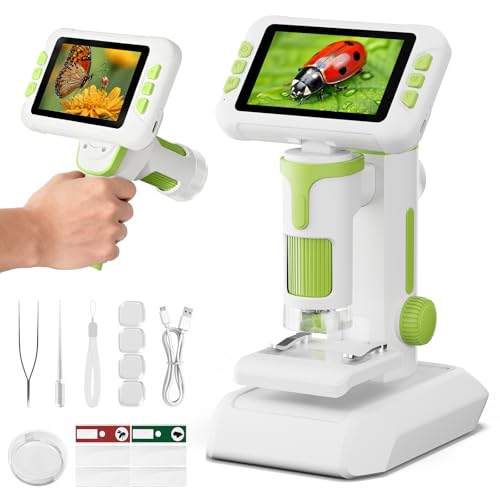
- Desktop, handheld, and portable configurations
- 4.0-inch screen with 1080P camera
- Slides and sample preparation kit included
Best For: Structured learning and science projects for ages 3–14
Rugged STEM Scout
1000X Handheld STEM Microscope

- 1000X magnification with manual focus
- Lightweight, shock-absorbent body and carry lanyard
- 2.0-inch screen with photo and video storage
Best For: Active outdoor exploration and hands-on STEM learning
Best Interactive Microscope – Talking Microscope for Young Learners
For younger children, the Educational Insights GeoSafari Talking Microscope offers a guided introduction to microscopes for children through voice-led facts and quizzes rather than traditional specimen viewing. Bindi Irwin’s narration and colorful image slides make it approachable for preschool-age explorers.
Best For: Children ages 4–8 who benefit from interactive, guided science play.
Pros:
- Includes more than 100 facts and quiz prompts narrated by Bindi Irwin.
- Comes with 60 full-color images on 20 slides.
- Offers separate Fact Mode and Quiz Mode, plus slide storage.
Cons:
- It is an educational talking toy rather than a conventional optical microscope.
- Requires three AAA batteries, which are not included.
This is a strong choice when the priority is early science engagement and independent learning. Families seeking real magnification and hands-on specimen preparation should consider a traditional microscope kit instead.
Best Traditional Starter Kit – 58-Piece Microscope Kit
This 58-piece optical microscope kit gives children a more traditional introduction to microscopes for children, with prepared specimens, blank slides, and basic lab tools. Its metal-and-plastic construction, LED illumination, and included guide support supervised hands-on exploration.
Best For: Beginners ages 5–12 exploring plants, insects, and everyday objects at home or in classroom activities.
Pros:
- Provides 100x–1200x magnification with an LED light source.
- Includes 13 prepared specimens, 31 blank slides, and essential tools.
- Comes with a carrying box and a guide for learning basic microscope skills.
Cons:
- Requires two AA batteries, which are not included.
- Higher magnification settings may require adult guidance for beginners.
With its broad accessory set and high stated magnification range, this kit offers plenty of room for experimentation. It is best used with an adult or teacher helping children learn slide preparation and focusing.
Best Portable Digital Microscope – 4K Handheld Microscope
The Odatay handheld digital microscope is a convenient option for children who want to inspect bugs, plants, and other objects indoors or outdoors. Its built-in screen, camera functions, lightweight design, and included 32GB card make digital microscopes for children easy to carry and use during exploration.
Best For: Young explorers ages 5–13 who want portable viewing, photos, and videos.
Pros:
- Offers 200x–1000x magnification with a 4K camera and 2.4-inch screen.
- Supports photo capture, video recording, and file transfer to a computer.
- Includes a 32GB TF card, 12 prepared slides, lanyard, case, and tripod connection.
Cons:
- It is a digital handheld design rather than a conventional eyepiece microscope.
- The supplied notes do not specify battery runtime or charging time.
This model stands out for portability and immediate digital feedback, especially when children want to document what they find. The lower magnification setting also supports longer-distance viewing, while the included accessories help get started quickly.
Best Dual-Light Microscope – National Geographic Science Kit
The National Geographic Dual LED Microscope is a straightforward science kit for older children comparing slide specimens and solid objects. Its two illumination modes, optical lenses, prepared slides, and blank-slide supplies make it a well-rounded option among microscopes for children ages 8–12.
Best For: School-age children who want structured biology activities and 3D object observation.
Pros:
- Uses lower LED lighting for slides and upper lighting for 3D objects.
- Includes more than 50 accessories, including prepared and blank slides.
- Provides 20x and 50x optical magnification with a learning guide.
Cons:
- Its maximum stated magnification is lower than some beginner microscope kits.
- Battery operation means batteries must be available for use.
The dual-light setup gives children two distinct ways to investigate specimens, while the geode and slide materials add variety. It is a practical fit for guided science projects rather than very high-magnification work.
Editor's Pick – Cat-Shaped 1000X Digital Microscope
For families comparing microscopes for children, this handheld model combines high magnification with a relatively spacious 2.4-inch IPS display. Its simple focus wheel, rechargeable battery, and standalone operation make it a practical choice for independent exploration at home or outdoors.
Best For: Kids ages 3–12 who want an easy-to-use digital microscope with photo and video recording.
Pros:
- Up to 1000X magnification with a 2.4-inch IPS HD display
- Large textured focus wheel is designed for little hands
- Offers device, computer, and memory-card viewing modes
- Includes a 600mAh rechargeable battery with up to 3 hours of exploration
Cons:
- Memory card is not included
- Internal photos cannot be directly transferred without using a memory card
- Computer software must be downloaded according to the manual
The cat-shaped design and eye-friendly screen give this model extra kid appeal, while the flexible viewing options add usefulness for school projects and sharing discoveries. The storage-transfer limitation is worth noting before purchase.
Best Complete Kit – 1000X Microscope with Case and Real Slides
This complete option stands out among microscopes for children because it includes a 32GB memory card, five real glass specimens, and a fitted EVA case. Its compact design and adjustable 200X–1000X magnification suit both indoor lessons and outdoor observation.
Best For: Families, homeschoolers, and young explorers who want a ready-to-use science gift with organized storage.
Pros:
- Includes a 32GB card for storing photos and videos
- Comes with five real glass prepared slides and a custom EVA case
- Lightweight 0.34-pound design with a wide neck strap
- Five magnification levels from 200X to 1000X
Cons:
- Battery life is approximately 2.5 hours per charge
- Glass slides require more careful handling than plastic slides
- Focusing may require adjusting both distance and LED lighting
With its included accessories and storage case, this is one of the easiest kits to give as a complete learning activity. The real slides add authenticity, while the lightweight build supports field trips, camping, and backyard exploration.
Best Slide Variety – Odatay 1000X Microscope Kit
For shoppers seeking microscopes for children with plenty of starter materials, the Odatay kit includes 12 prepared plastic slides covering plants, vegetables, insects, and animals. Its 1080P camera, 2-inch IPS screen, and portable design support quick observations at home or outside.
Best For: Children ages 3–12 who enjoy guided discovery activities and need a lightweight microscope for everyday use.
Pros:
- 100X–1000X magnification with 1080P photo and video capture
- Includes 12 slides across four subject categories
- Eight LED fill lights help illuminate specimens
- Built-in storage holds up to 500 photos, with computer connectivity
Cons:
- Micro SD card for expanded storage is not included
- Its display is smaller than the 2.4-inch screen on some competing models
- Included slides are plastic rather than glass
The broad slide selection makes this a welcoming starting point for younger children, while the lanyard and compact body encourage outdoor use. It offers strong basic functionality, though families planning extensive recording may want to budget for a Micro SD card.
Pocket Explorer – Portable 1600X Digital Microscope
For families seeking microscopes for children that can travel easily, this handheld model combines a 4.0-inch IPS display with 1080P imaging and 100X–1600X magnification. Its compact design, built-in hotspot, and included 8GB TF card make it practical for recording and sharing discoveries.
Best For: Portable backyard exploration, viewing plant veins and insect details, and introducing children ages 3–8 to digital microscopy.
Pros:
- Large 4.0-inch screen with 1080P photo and video capture
- Adjustable 100X–1600X magnification for varied specimens
- Compact handheld design with eight adjustable lights
- Built-in hotspot supports sharing results to a mobile phone
Cons:
- Charging adapter is not included
- Designed for indoor use according to the supplied details
- Manual operation may require adult help for younger children
This is a convenient choice when portability and easy digital sharing matter more than a traditional microscope setup. The simple handheld format should appeal to curious young explorers, while the screen and lighting make specimens easier to view.
Young Scientist Station – 3-in-1 1600X Kids Microscope
This 3-in-1 model is one of the more versatile microscopes for children, switching between desktop, handheld, and portable modes. It pairs a 4.0-inch IPS display with 100X–1600X magnification, a 1080P camera, slides, and a sample preparation kit for more structured exploration.
Best For: Children ages 3–14 who want both stable tabletop viewing and portable observation for school projects, gifts, or outdoor discoveries.
Pros:
- Three configurations support desktop, handheld, and portable use
- 4.0-inch screen provides real-time viewing with 1080P capture
- Includes slides and a sample preparation kit
- Six LED lights offer three adjustable brightness modes
Cons:
- Built-in lithium-polymer battery is non-removable
- The included materials may still require adult assistance for preparation
- Its larger feature set may be more than younger children need
With its flexible mounting options and included preparation accessories, this microscope is suited to children who may move from casual play into more deliberate science activities. It offers a stronger all-around setup than a pocket-only model while remaining screen-based and approachable.
Rugged STEM Scout – 1000X Handheld STEM Microscope
For younger users who need a straightforward handheld option, this microscope for children offers 1000X magnification, manual focus, a 2.0-inch IPS screen, and an anti-shake design. Its lightweight ABS body, rubber casing, carry lanyard, and adjustable LEDs are aimed at active, hands-on exploration.
Best For: Children ages 3–12 who want to examine specimens outdoors, practice manual focusing, and save discoveries for school or family projects.
Pros:
- 1000X magnification with manual focus control
- Lightweight 200g body with shock-absorbent rubber casing
- Eight LEDs with three brightness modes help illuminate specimens
- Stores photos and AVI videos, with USB transfer to compatible computers
Cons:
- Smaller 2.0-inch display than the other listed models
- Battery runtime is specified at up to two hours
- Manual focusing may take practice for very young children
This model emphasizes durability, portability, and active use rather than a large viewing screen. The manual focus and storage features can make it a useful introduction to documenting observations, especially for children who enjoy taking the microscope outdoors.
How We Picked the Best Microscopes for Children
We focused on products that balance age-appropriate design, useful magnification, ease of focusing, lighting, included accessories, and overall value. The selection covers traditional eyepiece microscopes as well as handheld digital models, so families can match the experience to a child’s interests and attention span.
We also considered practical details such as portability, screen size, storage, slide supplies, power requirements, and whether a child can use the microscope with limited adult help. Magnification claims are not the only measure of performance: stable construction, clear illumination, and easy focusing often matter more for beginners.
Quick Comparison
| Type | Best for | Main advantage | Watch for |
|---|---|---|---|
| Talking optical microscope | Young learners | Guided discovery and simple operation | Less flexibility than digital models |
| Traditional kit | Hands-on experiments | Eyepiece viewing and included accessories | Requires careful focusing and slide handling |
| Handheld digital microscope | Exploring everyday objects | Portable viewing on a built-in screen | May not provide true laboratory-style magnification |
| Digital screen kit | Shared family or classroom use | Several children can view the same subject | Battery life and screen quality vary |
Key Buying Factors for Microscopes for Children
Age and Ease of Use
For preschool and early elementary users, choose large controls, a stable base, simple focusing, and guided content. Older children may appreciate interchangeable objectives, more detailed slide work, or the challenge of adjusting a traditional eyepiece.
Optical Versus Digital Viewing
Optical microscopes offer a more traditional science experience and encourage careful positioning at the eyepiece. Digital microscopes are often easier for quick exploration because the subject appears on a screen. They are especially useful when siblings, parents, or teachers need to view the sample together.
Magnification and Illumination
Higher advertised magnification is not automatically better. Look for usable lower settings, steady focus, and bright LED lighting. A microscope that produces a clear image at moderate magnification is generally more useful than one with a difficult-to-control maximum setting.
Accessories and Durability
Slides, specimen containers, tools, batteries, carrying cases, and storage trays add value for beginners. Check whether slides are prepared or blank, whether small accessories need supervision, and whether the body and base can withstand regular handling.
Who Should Buy Which Microscopes for Children?
Choose a talking or simplified optical model for a young child who benefits from instructions and themed learning. Pick a traditional metal-body kit for a child who enjoys experiments, collecting specimens, and learning how lenses work. A handheld digital microscope is the better fit for travel, quick inspections, and children who prefer screens. For family demonstrations or group projects, choose a larger digital display and a kit with plenty of slides and accessories.
Before buying, match the microscope to the child’s patience, workspace, and intended subjects. Adult supervision is recommended for small parts, glass slides, batteries, and specimen preparation.