The best microscopes for students make biology and science experiments easier to explore, whether learning happens in a classroom, homeschool setting, or at the kitchen table.
This roundup compares 10 options across beginner kits, durable compound microscopes, and higher-magnification models so you can choose equipment that matches a student’s age, experience, and intended projects.
Best 10 Microscopes for Students Picks for 2026
Best Introductory Kit
National Geographic Dual LED Microscope

- Dual LED viewing for slides and 3D objects
- 50+ accessories with prepared and blank slides
- Simple 20x and 50x magnification for beginners
Best For: Children ages 8–12 beginning hands-on STEM activities
Best All-Metal Student Microscope
AmScope M150C Compound Microscope

- Five settings from 40x to 1000x
- Optical glass elements and achromatic objective
- All-metal frame with outlet or battery operation
Best For: Students needing a durable compound microscope for biology study
Best Complete Compound Kit
Emarth 40x–1000x Student Microscope
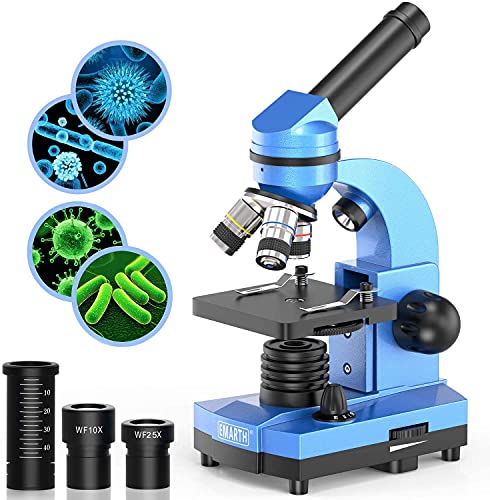
- 40x–1000x compound magnification
- Dual lighting for opaque and translucent specimens
- 52-piece kit with slides and experiment tools
Best For: Young learners, homeschoolers, and adult biology beginners
Best Overall
TOMLOV CM101 Compound Microscope

- Coarse and fine focus for easier specimen viewing
- Dual LED lighting for slides and opaque objects
- Includes achromatic objectives, filters, and slide supplies
Best For: Students, beginners, and homeschool STEM projects
Best Starter Kit
Uarzt 58-Piece Kids Microscope

- Complete 58-piece kit with specimens and lab tools
- Colorful guide supports early STEM learning
- Battery-powered LED design for beginner use
Best For: Children ages 5-12 and guided science activities
Best for Phone Viewing
JECONE High-Power Student Microscope

- 40X-2500X range with six magnification levels
- Phone holder supports photos and videos
- Dual LED lighting and coarse/fine focus controls
Best For: Students documenting observations at home or school
Best Lightweight Metal Pick
HUTACT 40-2000X Compound Microscope

- 40X-2000X magnification range
- Achromatic glass optics with LED light
- Five-piece slide set and storage bag included
Best For: Students and beginners who want a portable educational starter kit
Best Binocular Comfort Pick
Herwicm 40X-2500X Compound Microscope

- Binocular wide-angle eyepieces
- Top and bottom LED lighting
- Coarse/fine focus and mechanical stage
Best For: Students and hobbyists who value binocular viewing and positioning control
Best Complete Student Kit
PALOBIL 100X-2000X Microscope Kit

- Six listed magnification settings
- Dual LED lighting for varied specimens
- Slides, tools, and smartphone adapter included
Best For: Homeschool and classroom learners who need a ready-to-use experiment kit
Best Introductory Kit – National Geographic Dual LED Microscope
For younger learners comparing microscopes for students, this National Geographic kit emphasizes accessible exploration rather than high magnification. Its dual LED lighting supports both slide-based specimens and three-dimensional objects, while the included materials make it easy to begin experimenting.
Best For: Children ages 8–12 starting hands-on STEM activities at home.
Pros:
- Dual LED illumination supports biological slides and opaque 3D objects.
- Includes 10 prepared slides, 10 blank slides, covers, tweezers, an eye-dropper, and a geode.
- Simple 20x and 50x optical magnification is approachable for beginners.
- Includes a full-color learning guide and padded storage container.
Cons:
- Its 20x and 50x magnification range is more limited than compound student microscopes.
- Battery-powered operation requires batteries.
This is a practical choice when ease of use and included activities matter more than advanced magnification. The broad accessory package gives young scientists plenty to explore right away.
Best All-Metal Student Microscope – AmScope M150C Compound Microscope
Students who need a more traditional biology instrument may prefer the AmScope M150C. This compound microscope combines optical glass elements, a sturdy all-metal frame, and five magnification settings spanning 40x to 1000x.
Best For: Elementary through high-school students, homeschool science, and learners who want a durable compound microscope.
Pros:
- Offers five magnification settings from 40x through 1000x.
- Uses widefield optical glass elements with an achromatic objective.
- All-metal construction provides a sturdy platform for student use.
- LED illumination can run from an adapter or three AA batteries.
Cons:
- The kit does not list prepared slides or a larger accessory collection.
- Its monocular design provides single-eye viewing.
The M150C is a stronger fit for coursework and repeated biology practice than for gift-style experimentation. Its broad magnification range and metal construction give it a more conventional classroom-instrument profile.
Best Complete Compound Kit – Emarth 40x–1000x Student Microscope
For shoppers seeking microscopes for students that combine real compound viewing with hands-on materials, the Emarth model is a versatile option. It provides 40x–1000x magnification, top and bottom LED illumination, and a 52-piece educational kit.
Best For: Kids ages 8–12, homeschool learners, and adult beginners exploring biology.
Pros:
- 40x–1000x compound magnification supports beginner biology work.
- Top and bottom illumination accommodates opaque and translucent specimens.
- 52-piece kit includes prepared slides, blank slides, and experiment tools.
- Metal frame, rotatable head, smooth focusing, and six color filters support comfortable viewing.
Cons:
- Batteries are not included.
- The enclosure combines metal and plastic rather than using an all-metal body.
This model balances a serious compound-microscope format with enough supplies to start experimenting immediately. Its dual lighting is especially useful for students who want to view more than standard transparent slides.
Best High-Magnification Kit – AmScope M30 STEM Microscope
The AmScope M30 is designed for students ready to examine specimens at higher magnification. Its six settings reach 1200x, and the 52-piece kit adds sample slides, a color filter wheel, LED lighting, and a hard ABS carrying case.
Best For: Young scientists who want a portable kit with high magnification for introductory microscopy.
Pros:
- Six magnification settings span 120x to 1200x.
- 52-piece kit supports hands-on specimen exploration.
- Rotating color filter wheel can help students adjust viewing conditions.
- Hard ABS case makes the portable kit easier to store and carry.
Cons:
- The kit includes plastic slides rather than a stated collection of prepared biological slides.
- Its 120x minimum magnification is less flexible for low-power viewing than models starting at 40x.
- The one-year manufacturer warranty is shorter than the five-year warranty listed for the AmScope M150C.
The M30 stands out when maximum listed magnification and portability are priorities. It offers a substantial accessory package while retaining a student-friendly monocular design and LED illumination.
Best Overall – TOMLOV CM101 Compound Microscope
For students who want a microscope that can grow with their skills, the TOMLOV CM101 combines straightforward controls with useful versatility. Its coarse and fine focus, achromatic objectives, and dual LED illumination make it suitable for prepared slides as well as everyday surface specimens.
Best For: Students, beginners, adult hobbyists, classroom study, and homeschool STEM projects.
Pros:
- Coarse and fine focus controls help users locate specimens quickly and refine details.
- Dual LED lighting supports transparent slides and opaque objects such as leaves, insects, and coins.
- Includes 4X, 10X, and 40X achromatic objectives, two eyepieces, and prepared and blank slides.
- Six-position diaphragm and filter system provides options for adjusting brightness, contrast, and illumination color.
Cons:
- Its monocular design may be less comfortable for users who prefer binocular viewing.
- The 40X-2000X range includes high magnifications that may require careful focusing and slide preparation.
The CM101 is a strong all-around choice among microscopes for students because it balances beginner-friendly operation with features that support more detailed observation as skills develop.
Best Starter Kit – Uarzt 58-Piece Kids Microscope
The Uarzt 58-piece kit is designed to make microscopy approachable for younger learners. With prepared specimens, blank slides, basic lab tools, and a colorful guide, it gives children a hands-on introduction to microscopes for students in home or classroom settings.
Best For: Children ages 5-12, guided STEM activities, elementary classrooms, and beginner science gifts.
Pros:
- Includes 58 pieces, including 13 prepared specimens, 31 blank slides, tweezers, a dropper, and a scalpel.
- Colorful guide introduces basic microscope parts and exploration skills.
- Metal-and-plastic construction with LED lighting is suited to beginner experimentation.
- Battery-powered design supports use away from a wall outlet.
Cons:
- Requires two AA batteries, which are not included.
- Its beginner-focused design is better suited to introductory exploration than advanced microscopy.
- The compact size may provide less working space than larger student microscopes.
This kit prioritizes accessibility and activity-based learning rather than advanced control, making it a practical first microscope for younger children exploring science with adult or teacher guidance.
Best for Phone Viewing – JECONE High-Power Student Microscope
The JECONE compound microscope is a flexible option for students who want high stated magnification and a way to share observations. Its dual illumination, coarse and fine focus, rotating filter wheel, and included phone holder support both traditional slide work and photo or video capture.
Best For: Students, school labs, homeschooling, and users who want to document microscope observations with a phone.
Pros:
- Offers six magnification levels from 40X to 2500X using WF10X and WF25X eyepieces with 4X, 10X, and 100X objectives.
- Dual LED illumination handles translucent slides and opaque objects viewed from above.
- Coarse and fine focus controls support fast locating and more precise adjustments.
- Includes a phone holder, prepared and blank slides, coverslips, and basic tools.
Cons:
- The highest magnifications can demand careful focusing and suitable specimens.
- Its accessory set includes only five prepared slides and five blank slides.
With its phone holder and broad magnification range, the JECONE is especially appealing for students who want to record or share their work, while its dual lighting keeps it useful for more than prepared slides.
Best Lightweight Metal Pick – HUTACT 40-2000X Compound Microscope
For students who want a capable introduction to microscopy, this HUTACT model combines a lightweight metal body with achromatic glass optics, LED illumination, and multiple eyepiece and objective options. Its included slide set also makes it easier to begin exploring prepared specimens immediately.
Best For: Students, beginners, homeschoolers, and science enthusiasts who want high magnification and a ready-to-use starter kit.
Pros:
- Offers magnification options from 40X to 2000X using its eyepieces, objectives, and 2X lens.
- Achromatic glass lenses are designed to provide clear, bright images.
- Includes five prepared slides, a storage bag, and a user manual.
- Lightweight aluminum-alloy construction helps provide stability while remaining portable.
Cons:
- The highest 2000X figure relies on the included 2X magnifying lens.
- The kit is designed for beginners and education rather than specialized laboratory work.
This is a practical choice among microscopes for students when portability, included specimens, and broad magnification options matter more than advanced laboratory features.
Best Binocular Comfort Pick – Herwicm 40X-2500X Compound Microscope
This Herwicm compound microscope stands out for students who prefer binocular viewing and a larger field of view. It pairs wide-angle eyepieces with dual LED lighting, coaxial coarse and fine focusing, and a mechanical stage for more controlled observation.
Best For: Students, adult beginners, and hobbyists seeking binocular viewing and flexible illumination for extended observation.
Pros:
- Binocular ultra-wide-angle eyepieces are intended to provide a broad, sharp viewing experience.
- Top and bottom LED lights support observation of specimens from different lighting directions.
- Coaxial coarse and fine focus controls allow quicker image adjustment.
- Large mechanical stage with a spiral moving scale supports more controlled specimen positioning.
Cons:
- Its corded electric design may be less convenient for portable use.
- The supplied information does not list the included accessories in detail.
- The product listing presents a 40X-2500X range, while the specifications separately list a 40X maximum, so buyers should confirm the exact configuration.
For microscopes for students used in classroom or home settings, the binocular design and dual lighting make this a feature-rich option, provided the buyer confirms the stated magnification details.
Best Complete Student Kit – PALOBIL 100X-2000X Microscope Kit
For families and homeschoolers comparing microscopes for students, the PALOBIL kit offers a broad set of learning features in one package. It includes prepared and blank slides, tools, a smartphone adapter, dual LED lighting, and a metal frame suited to repeated educational use.
Best For: Students and young beginners using a microscope for homeschool labs, classroom demonstrations, and guided science experiments.
Pros:
- Provides six listed magnification settings from 100X to 2000X using the 25X eyepiece, 2X lens, and objective lenses.
- Adjustable top incident and bottom transmitted LED lighting can handle opaque and translucent specimens.
- Includes prepared slides, blank slides, droppers, tweezers, a smartphone adapter, and other beginner accessories.
- Metal construction and a shockproof, drop-proof package support storage and transport.
Cons:
- Three AA batteries are required and are not included, although an AC adapter is supplied.
- The kit is relatively heavier than a lightweight beginner microscope at 1.65 kg.
- The wide accessory set may be more than a student needs for basic viewing.
This PALOBIL model is especially appealing when a complete experiment-ready package matters. Its lighting flexibility and smartphone compatibility add useful options for documenting student observations.
How We Picked the Best Microscopes for Students
We focused on the features that have the greatest impact on student learning: usable magnification, clear optics, stable construction, straightforward focusing, dependable illumination, and included accessories. We also considered age recommendations and whether each model is better suited to casual children’s exploration, structured schoolwork, or more advanced home lab use.
Magnification claims can be misleading, so we gave greater weight to practical optical performance than to the highest number printed on the box. A microscope with a stable stage, useful 40X to 400X range, and good lighting is often more valuable than one advertising extreme magnification that is difficult to focus.
Quick Comparison
| Best For | Look For | Typical Strength |
|---|---|---|
| Young beginners | Simple controls, durable body, prepared slides | Easy first experiments |
| School projects | Compound optics, mechanical stage, adjustable LED | Repeatable viewing and measurement |
| Older students | Fine focus, glass lenses, metal construction | More precise observation |
| Portable learning | Battery operation or cordless lighting | Flexible use away from an outlet |
Key Buying Factors for Microscopes for Students
Magnification and Optical Quality
Most student work benefits from several useful magnification levels rather than one inflated maximum. Compound microscopes commonly use 4X, 10X, and 40X objective lenses with 10X eyepieces, producing practical ranges for cells, plant material, fibers, and prepared slides. Confirm whether the advertised maximum comes from real objective lenses or only eyepiece multiplication.
Focusing and Stage Design
Coarse focus helps locate a specimen, while fine focus brings details into view. Fine adjustment is especially important at higher magnification. A mechanical stage makes it easier to move slides smoothly and keep specimens centered; basic clips can work for occasional use but may frustrate students during longer projects.
Lighting, Stability, and Accessories
Adjustable LED lighting is efficient and useful for different specimens. A metal frame and stable base reduce vibration, while a carrying case can help younger users store equipment safely. Included slides, blank slides, covers, droppers, and specimen tools add value, but verify that consumables are suitable for the intended age and experiments.
Who Should Buy Which Microscopes for Students?
For children beginning independent exploration, choose a straightforward kit with durable construction, prepared slides, and modest controls. For elementary or middle-school coursework, prioritize a compound model with multiple objectives, adjustable LED illumination, and a mechanical stage. Older students and serious homeschool users should consider glass optics, separate coarse and fine focus, a stable metal body, and comfortable viewing over extended sessions.
Before buying, check available workspace, power requirements, warranty coverage, and replacement-slide availability. The right microscope is the one a student can set up, focus, and use confidently—not necessarily the model with the largest magnification number.