Choosing a nas enclosure with four bays is a smart way to balance capacity, performance, and long-term flexibility without jumping straight to a larger rack setup.
Whether you want simple home backups, shared media storage, or a faster workflow for a small team, the right model depends on drive support, networking, expansion, and how much management you want.
Best 10 Nas Enclosure with Four Bays Picks for 2026
Fast Home NAS

- Up to 144TB storage with RAID support
- 10GbE and 10Gbps USB for quick transfers
- AI photo album and broad device compatibility
Best For: Families, creators, and small teams needing private cloud storage
USB-C RAID Expansion
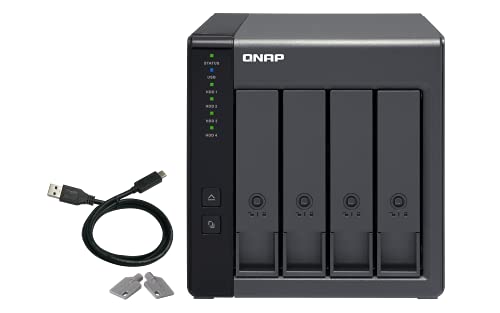
- Hardware RAID with RAID 0/1/5, JBOD, and individual disks
- USB-C direct-attached storage for Windows, macOS, and Linux
- Works as backup expansion for compatible QNAP NAS
Best For: Users expanding storage or backing up a compatible QNAP NAS
Power User NAS

- Intel Core i3, DDR5 RAM, and dual high-speed networking
- Docker, virtual machines, and AI photo recognition support
- Up to 144TB capacity with dual M.2 slots
Best For: Developers, IT pros, and power users
4-Bay JBOD Dock
SABRENT DS-SC4B 4-Bay USB-C Dock
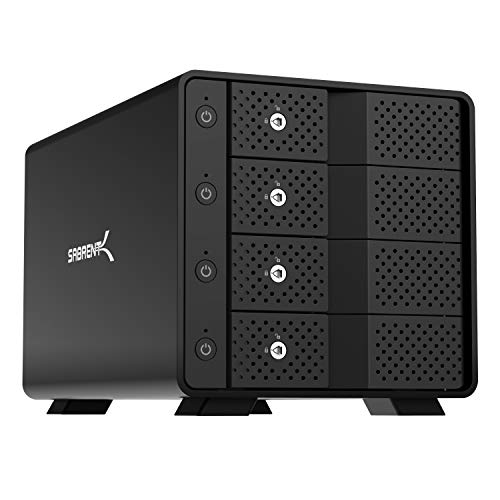
- Independent controller for each bay
- 10Gbps USB-C support with trayless hot-swap
- Aluminum build with active cooling and locking key
Best For: Workstations and users who want separate-drive access without RAID
Creator-Grade Performance

- AMD Ryzen Embedded CPU with 8GB DDR4, expandable to 64GB
- Dual 10GbE and SSD expansion for fast transfers
- Supports Docker, VMs, and Surveillance Center
Best For: Creators and teams needing speed, expansion, and local control
Fast Direct-Attached Storage

- USB 3.2 Gen2 up to 10Gbps for fast transfers
- Four drive support with no RAID function
- Tool-free, hot-swappable design
Best For: Users who want simple, high-speed local storage
Beginner Private Cloud

- Entry-level 4-bay NAS with Docker support
- Smart photo backup and AI album organization
- 2.5GbE, 8GB RAM, and 4K HDMI output
Best For: Beginners, home users, and remote workers
AI-Powered 4-Bay Performance NAS
TERRAMASTER F4-425 Pro 4-Bay NAS

- Intel N305 8-core CPU with 8GB RAM
- Dual 5GbE ports and three M.2 NVMe slots
- TOS 7 adds AI tools, office editing, and search
Best For: Power users who want fast networking and AI features
Simple Backup Hub for Home Offices
Synology DS223 2-Bay Backup NAS

- Centralizes files and protects data across devices
- Automated backups with cloud and external drive support
- Can also serve as a DIY IP camera monitoring hub
Best For: Home offices that want simple backup and sharing
Quiet 4-Bay Media NAS
TERRAMASTER F4-425 Quiet 4-Bay NAS

- Intel x86 quad-core CPU with 4GB RAM
- 4K H.265 decoding and Plex/Emby/Jellyfin support
- Quiet 21dB(A) operation with tool-free trays
Best For: Home users who want quiet media streaming and backup
Fast Home NAS – UGREEN DXP4800 Plus 4-Bay NAS
If you want a nas enclosure with four bays that feels more like a private cloud than a simple drive box, the UGREEN DXP4800 Plus is built for that role. It combines centralized storage, remote access, RAID options, and fast 10GbE/USB 10Gbps connectivity for home users, creators, and small teams who want better data organization and backup protection.
Best For: Families, creators, and small teams that want a fast, private four-bay NAS with easy sharing.
Pros:
- Up to 144TB capacity with support for multiple RAID options for backup flexibility.
- 10GbE and 10Gbps USB ports enable very fast transfers for large files.
- AI photo album features can recognize faces, scenes, objects, and locations.
- Works across Windows, macOS, Linux, iOS, Android, and web access.
Cons:
- Hard drives are not included and must be purchased separately.
- Wired Ethernet only; this model does not support Wi-Fi.
- Peak speed depends on your router, CPU, drives, and file sizes.
For buyers who want a four-bay NAS enclosure that does more than store files, this model stands out for its mix of app support, private-cloud control, and high-speed networking. It is especially appealing if you want one box to handle backups, collaboration, and media organization.
USB-C RAID Expansion – QNAP TR-004 4-Bay USB-C DAS
QNAP TR-004 4 Bay USB Type-C Direct Attached Storage (DAS) with hardware RAID (Diskless)
Check Price On AmazonIf you need a nas enclosure with four bays for expansion rather than a full standalone server, the QNAP TR-004 is a practical direct-attached option. It connects over USB Type-C and gives you hardware RAID support, lockable trays, and simple disk expansion for Windows, macOS, Linux, and compatible QNAP NAS systems.
Best For: Users who want a four-bay USB-C enclosure for RAID expansion or NAS backup.
Pros:
- Hardware RAID modes include RAID 0, 1, 5, JBOD, and individual disks.
- USB Type-C direct-attached design is compatible with Windows, macOS, and Linux.
- Can be used to expand a compatible QNAP NAS or as external storage for backup.
- Lockable drive bays add a bit of physical security.
Cons:
- Not a full NAS, and NAS applications cannot be installed on it.
- Compatibility is limited; some older QNAP NAS models are not supported.
- It uses 3.5-inch SATA drives only and ships diskless.
As a four-bay enclosure, the TR-004 is best when you want reliable expansion without replacing your main system. It is a sensible choice for backup storage or adding more capacity to a supported QNAP setup.
Power User NAS – UGREEN DXP4800 Pro 4-Bay NAS
For buyers looking for a nas enclosure with four bays that can handle heavier workloads, the UGREEN DXP4800 Pro is aimed at developers, IT professionals, and power users. It combines a strong Intel Core i3 processor, dual high-speed networking, Docker and virtual machine support, and on-device AI photo management in one all-in-one storage system.
Best For: Power users, developers, and small teams running demanding storage and virtualization tasks.
Pros:
- Intel Core i3-1315U, 8GB DDR5 RAM, and dual 10GbE + 2.5GbE networking.
- Supports Docker and virtual machines for advanced workflows and self-hosted services.
- Up to 144TB capacity plus dual M.2 PCIe 4.0 slots for cache or storage.
- Multiple RAID options and Data Vault encryption add flexibility and privacy.
Cons:
- Hard drives are not included.
- Real-world performance will vary based on the network and drive setup.
- It is a more advanced system than a basic plug-and-play storage box.
This model makes sense if your four-bay NAS needs to do more than file storage. Its mix of fast networking, virtualization tools, and security features makes it a strong fit for demanding personal or business setups.
4-Bay JBOD Dock – SABRENT DS-SC4B 4-Bay USB-C Dock
If you want a nas enclosure with four bays in the loose, external-storage sense, the SABRENT DS-SC4B is really a direct-attached JBOD dock rather than a true NAS. It gives each drive its own controller, supports up to four 3.5-inch SATA HDDs or SSDs over 10Gbps USB-C, and is built for straightforward multi-drive access on Windows, macOS, and Linux.
Best For: Users who need a four-bay USB-C JBOD dock for individual drive access and simple expansion.
Pros:
- Dedicated controller per bay for stable, independent drive connections.
- Tool-free trayless design with per-bay switches, activity LEDs, and a locking key.
- Aluminum and metal build with a 92mm fan for active cooling.
- Supports up to 80TB total with 4 x 20TB drives.
Cons:
- It is not RAID and does not function as a true NAS.
- Drives are not included.
- Bulkier than a simple portable enclosure at 9 pounds.
This dock is a good fit if you need dependable multi-drive access without RAID complexity. It is best thought of as a sturdy four-bay storage dock for separate drives, backups, or workstation use.
Creator-Grade Performance – UGREEN DXP4800 GT 4-Bay NAS
If you want a nas enclosure with four bays that can handle demanding creative work, the UGREEN DXP4800 GT is built for fast multitasking, high-speed transfers, and local storage control. It combines a Ryzen Embedded processor, dual 10GbE networking, and expandable memory with NAS software that supports files, media, Docker, virtual machines, and surveillance workflows.
Best For: Creators, tech enthusiasts, and office teams that want a high-performance 4-bay NAS for media, backups, and self-hosted apps.
Pros:
- AMD Ryzen Embedded R2514 with 4 cores, 8 threads, and up to 3.70GHz for multitasking
- Dual 10GbE networking and SSD expansion for fast transfers and smoother 4K/8K workflows
- UGOS Pro includes Docker, virtual machines, SAN Manager, and app access across devices
- Built-in Surveillance Center supports ONVIF/RTSP cameras, live view, PTZ control, and playback
Cons:
- Drives are not included
- Some storage features depend on compatible SATA, U.2 NVMe, or M.2 SSD configurations
This is a strong choice if you want one enclosure to centralize storage, media, and security footage while keeping everything local. It leans more toward performance and expansion than basic home storage, which makes it especially appealing for heavier workloads.
Fast Direct-Attached Storage – TerraMaster D4-320 4-Bay DAS
The TerraMaster D4-320 is not a NAS, but it can still be a smart pick if you’re comparing a nas enclosure with four bays and want a fast, simple direct-attached storage setup instead. With USB 3.2 Gen2 10Gbps, hot swapping, and tool-free trays, it is built for straightforward local expansion on Mac, Windows, or Linux.
Best For: Users who want a 4-bay DAS for fast local backups, media transfer, and plug-and-play storage.
Pros:
- USB 3.2 Gen2 connection delivers up to 10Gbps bandwidth
- Supports four individual disks with no RAID requirement
- Tool-free trays and hot-swappable bays make drive changes easy
- Quiet design with temperature-controlled fan and vibration damping
Cons:
- This is a DAS, not a NAS
- No RAID function
- Requires a computer connection for use
If you do not need network sharing or NAS apps, the D4-320 is a practical way to add a lot of local storage without much setup. It makes the most sense for users who want speed, simplicity, and compatibility over server-style features.
Beginner Private Cloud – UGREEN DH4300 Plus 4-Bay NAS
The UGREEN DH4300 Plus is a beginner-friendly nas enclosure with four bays that focuses on private cloud storage, easy sharing, and home media use. It adds practical features like smart photo backup, AI album organization, and remote access across mixed devices, while keeping setup approachable for first-time NAS buyers.
Best For: Home users and remote workers who want an easy 4-bay NAS for private storage, photos, and backups.
Pros:
- Entry-level 4-bay NAS with support for Docker
- Smart Photo Backup and AI album tools for organizing family memories
- 2.5GbE networking, 8GB LPDDR4X RAM, and 4K HDMI output
- Designed for easy setup and remote access from phones, PCs, browsers, and smart TVs
Cons:
- Does not support virtual machines
- Storage disks are not included
For users moving on from cloud subscriptions or external drives, this NAS offers a clear step up into private storage without a steep learning curve. It is less about advanced server features and more about easy, secure everyday use.
AI-Powered 4-Bay Performance NAS – TERRAMASTER F4-425 Pro 4-Bay NAS
If you want a nas enclosure with four bays that leans heavily into speed and automation, the TERRAMASTER F4-425 Pro is built for demanding home and small-office workloads. Its Intel N305 8-core CPU, 8GB RAM, dual 5GbE ports, and three M.2 NVMe slots make it a strong fit for multitasking, media streaming, and heavier NAS use.
Best For: Power users, media editors, and small teams that want fast networking, AI-assisted workflows, and expandability.
Pros:
- Intel N305 8-core processor with 8GB memory for responsive multitasking
- Dual 5GbE ports with link aggregation support up to 1020 MB/s
- Three M.2 NVMe slots with Hyper Cache acceleration
- TOS 7 adds AI-native features, online office editing, and global search
Cons:
- Diskless enclosure, so drives must be purchased separately
- Some advanced features may be more than casual backup users need
Overall, this is the most feature-packed option in the group for buyers who want a modern four-bay NAS with serious performance headroom. It stands out most when you care about speed, AI-driven software, and flexible storage expansion.
Simple Backup Hub for Home Offices – Synology DS223 2-Bay Backup NAS
For buyers comparing a nas enclosure with four bays to a more compact two-bay option, the Synology DS223 is a straightforward home and office backup hub. It is designed to centralize files, protect data, support collaboration, and even handle basic IP camera monitoring, making it a practical choice if your needs are more about organization than raw storage expansion.
Best For: Home users and small offices that want easy backup, file sharing, and surveillance features in a simple NAS.
Pros:
- Centralizes files from computers, phones, and external drives
- Supports automated backups for Macs, PCs, mobile devices, and cloud destinations
- Includes professional file collaboration and version control features
- Can be used as a DIY surveillance system for IP cameras
Cons:
- Only two bays, so it offers less drive capacity than a four-bay NAS enclosure
- Diskless design means you still need to buy and install drives
The DS223 makes sense if you value Synology’s backup and sharing workflow more than maximum drive count. It is a compact, reliable option for users who want a centralized data hub without the complexity of a larger enclosure.
Quiet 4-Bay Media NAS – TERRAMASTER F4-425 Quiet 4-Bay NAS
If you want a nas enclosure with four bays for home media and everyday file storage, the TERRAMASTER F4-425 is a balanced pick with a quieter, simpler design. It pairs an Intel x86 quad-core CPU, 4GB RAM, and a 2.5GbE port with media-focused features like 4K H.265 decoding and support for Plex, Emby, and Jellyfin.
Best For: Home users who want a quiet four-bay NAS for media streaming, photo backup, and general storage.
Pros:
- Intel x86 quad-core processor with 4GB RAM for multitasking
- Hardware 4K H.265 decoding with Plex, Emby, and Jellyfin support
- Quiet operation at 21dB(A) with tool-free Push-Lock drive trays
- Supports TRAID/TRAID+ and up to 120TB total storage
Cons:
- Only a single 2.5GbE port, so networking is less flexible than dual-port models
- Plastic enclosure is less premium than metal alternatives
For buyers who want a practical four-bay NAS without stepping into higher-end hardware, this model offers a solid mix of quiet operation and media-friendly features. It is especially appealing if streaming and simple backup are your main priorities.
How We Picked the Best Nas Enclosure with Four Bays
We focused on four-bay options that offer a strong mix of value, ease of use, and upgrade room. That means looking at processor class, RAM, network speed, RAID support, software ecosystem, and whether the unit is best suited for true network storage or direct-attached expansion.
We also favored models that make sense for real buyers: beginners who want simple setup, creators who need faster file access, and power users who want better multitasking or future-proof hardware.
Quick Comparison: What a Four-Bay NAS Gives You
A Nas Enclosure with Four Bays usually gives you a good middle ground between capacity and redundancy. With four drives, you can build mirrored or parity-based arrays for protection, or use more aggressive layouts if speed and usable space matter more.
Compared with two-bay systems, four-bay units are typically better for growing media libraries, large photo/video projects, and shared office storage. Compared with larger systems, they are easier to place, cheaper to populate, and simpler to manage.
Key Buying Factors for a Nas Enclosure with Four Bays
RAID and Data Protection
Look for support for RAID 1, 5, 6, or vendor-specific equivalents if uptime and recovery matter. If you only need simple backup storage, basic mirroring may be enough. If you plan to expand over time, choose a system that handles drive migration cleanly.
Processor and Memory
For light home use, modest hardware can be fine. For virtualization, large file transfers, indexing, or multiple users, choose a faster CPU and more RAM. Intel x86-based units often offer broader app compatibility and better flexibility for advanced workloads.
Networking and Connectivity
Fast networking matters more as drive counts rise. If you move large files or edit from the NAS, look for 2.5GbE or faster, and consider USB-C or expansion options if the device doubles as DAS. A slower network can become the bottleneck even with powerful drives installed.
Software and Ease of Use
The best enclosure is not just about hardware. Storage management, mobile apps, backups, user permissions, and remote access tools all shape the experience. Beginners usually benefit from polished software, while advanced users may prefer more control and customization.
Who Should Buy Which Nas Enclosure with Four Bays?
Choose a home-friendly model if you mainly want centralized backups, family file sharing, and simple media storage. Pick a creator- or team-focused unit if you need better throughput, more app support, and smoother multi-user access.
If your priority is direct-attached storage for a desktop workflow, a DAS-style four-bay enclosure may be the better fit. But if you want network sharing, remote access, and always-available storage, a full NAS is usually the stronger long-term choice. In short, the best Nas Enclosure with Four Bays is the one that matches your data growth, speed needs, and comfort level with setup and maintenance.