The best play kitchens for families make pretend cooking more engaging while giving children a shared space to practice creativity, communication, and everyday routines. The right set should match your available room, children’s ages, and tolerance for assembly and noise.
We compared these 10 options by design, interactive features, storage, durability, and family-friendly play value so you can choose a kitchen that fits your home and the way your children play.
Best 10 Play Kitchens for Families Picks for 2026
Best Compact Interactive Pick
Step2 Fun with Friends Kitchen
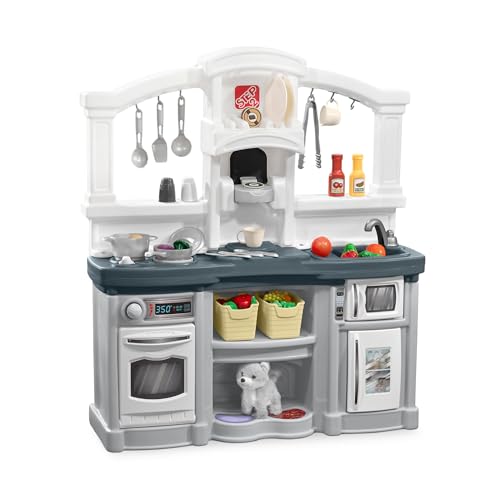
- Light-up burner with sizzling sounds
- 25 accessories and built-in storage
- Compact, durable plastic design
Best For: Families wanting interactive features and easy cleanup
Best Feature-Rich Wooden Design

- Includes numerous pretend appliances
- Smooth wooden construction with refined styling
- Side handles support easier moving
Best For: Families wanting an expansive wooden pretend kitchen
Best Growing-With-You Option

- Three adjustable height settings
- Lights, sounds, and realistic play features
- Includes chef outfit and cooking accessories
Best For: Families seeking an adjustable wooden kitchen for ages 3 to 8
Best Safety-Focused Traditional Set

- Light-up pretend cooking design
- Opening appliance doors and storage
- Non-toxic wood with safety standards noted
Best For: Families wanting a compact traditional wooden play kitchen
Spacious Modern Pick
Tiny Land Trendy Home Play Kitchen

- Room for up to three children
- Includes coffee maker, microwave, oven, and ice maker
- ASTM F963 and EN-71 tested
Best For: Families wanting a roomy setup for cooperative pretend play
Organized Storage Pick
labebe Wooden Play Kitchen Set

- Includes 15 play accessories
- Two foldable bins plus cabinet storage
- Designed for ages 3 and up
Best For: Families who want easy cleanup and a complete starter set
Realistic Learning Pick
Tiny Land Toddlers' Wooden Kitchen

- Separate cooking, washing, baking, and coffee areas
- Interactive knobs, faucet, and ice dispenser
- Natural wood with non-toxic water-based paint
Best For: Families seeking realistic role play and hands-on learning
Best Premium Pick
Shaker-Style Kitchen with Island
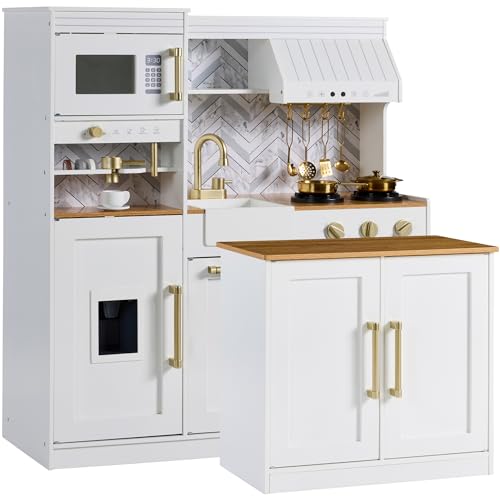
- Movable island adds storage and serving space
- Light-up burners plus espresso maker and microwave
- 17 accessories for varied pretend play
Best For: Families seeking a spacious, feature-rich wooden play kitchen
Best Interactive Value
Steam-Effect Toddler Kitchen Set

- Light-and-sound stovetop includes a steam effect
- Recirculating sink supports water play
- Comes with play food and many accessories
Best For: Families wanting interactive features in a plastic toddler set
Best for Group Play
Spacious Wooden Kitchen with Lights

- Wide design supports playdates and siblings
- Wooden set includes lights, sounds, and 15-plus accessories
- Includes stove, sink, oven, coffee maker, and ice maker
Best For: Families prioritizing collaborative pretend play
Best Compact Interactive Pick – Step2 Fun with Friends Kitchen
For families comparing play kitchens for families, the Step2 Fun with Friends stands out as a compact plastic option with interactive burner lights, sizzling sounds, and click-style knobs. Its built-in storage and 25-piece accessory set also make cleanup easier.
Best For: Families wanting an interactive, easy-to-clean kitchen with built-in organization.
Pros:
- Light-up burner and sizzling sounds add engaging sensory play.
- Includes a coffee maker, sink, faucet, refrigerator, oven, and 25 accessories.
- Built-in storage helps children tidy accessories independently.
- Durable plastic construction is designed for everyday use and easy wiping.
Cons:
- Requires two AA batteries, which are not included.
- Plastic construction may appeal less to families seeking a wooden aesthetic.
With a 35.75-inch width and 12.5-inch depth, this model offers substantial pretend-kitchen features without taking up excessive floor space. Its three-year limited warranty is an added consideration for long-term family use.
Best Feature-Rich Wooden Design – ROBUD Wooden Play Kitchen
The ROBUD Play Kitchen is a feature-rich wooden choice for families comparing play kitchens for families. It includes pretend appliances ranging from a refrigerator and ice maker to a coffee machine, microwave, oven, dishwasher, and juicer.
Best For: Families seeking a stylish wooden kitchen with many pretend appliances and accessories.
Pros:
- Offers a broad selection of pretend appliances and kitchen functions.
- Smooth, burr-free surfaces and rounded design details support comfortable play.
- Hollow side handles make the 37.5-pound set easier to move.
- Green finish with gold handles creates a distinctive modern look.
Cons:
- At 37.5 pounds, it is heavier than the plastic option in this roundup.
- Its numerous features may require more assembly and setup time despite the included instructions.
This kitchen combines an extensive pretend appliance lineup with a sturdy wooden construction. Its 31.3-inch width and 11.6-inch depth can work well in homes that want a substantial play center without a particularly deep footprint.
Best Growing-With-You Option – Tiny Land Adjustable Kitchen
The Tiny Land Play Kitchen is a strong option for families comparing play kitchens for families who want an adjustable setup. Its three height settings, real-style lights and sounds, and sage green wooden design are intended to keep play comfortable and engaging as children grow.
Best For: Families wanting a height-adjustable wooden kitchen for children ages 3 to 8.
Pros:
- Three height settings can accommodate growing children.
- Light-up stove elements and an interactive range hood add realistic play effects.
- Includes pretend food, cookware, plates, utensils, a cup, chef hat, and apron.
- Uses non-toxic, BPA-free materials and is designed to meet ASTM F963 and EN71 standards.
Cons:
- The included accessory count is more limited than the 25-piece Step2 set.
- Wood construction may require more assembly care than a plastic playset.
With a space-friendly 30.3-inch width and 11.8-inch depth, this kitchen balances a full pretend-play experience with a manageable footprint. The adjustable height is its main differentiator for families planning to use the set across multiple developmental stages.
Best Safety-Focused Traditional Set – Wooden Light-Up Kitchen
This espresso wooden play kitchen gives families comparing play kitchens for families a traditional pretend-cooking setup with a light, opening appliance doors, and storage space. It is designed for children ages 3 to 8 and includes cooking utensils for role-play.
Best For: Families wanting a classic wooden kitchen with storage, light-up play, and safety-focused materials.
Pros:
- Light-up design and opening oven, cabinet, freezer, refrigerator, and microwave doors encourage immersive play.
- Storage space supports tidying habits and organization.
- Made with non-toxic wood and designed to comply with ASTM F963 and CPSIA standards.
- Reinforced, anti-scratch surface is intended to withstand everyday contact.
Cons:
- Assembly requires a screwdriver.
- The 9.44-inch depth provides less front-to-back space than the other listed wooden models.
- The notes do not specify the full number of included accessories.
This model focuses on straightforward role-play, durable construction, and storage rather than a large appliance lineup. Its 31.2-inch width and espresso finish make it a practical fit for families seeking a compact, traditional wooden kitchen.
Spacious Modern Pick – Tiny Land Trendy Home Play Kitchen
For families seeking play kitchens for families, the Tiny Land Trendy Home Play Kitchen stands out with a wide operating area designed for up to three children. Its modern cream-white wooden design combines realistic kitchen stations with room for cooperative pretend play.
Best For: Families with multiple young children who want a spacious kitchen for shared, hands-on play.
Pros:
- Large 43-by-40-inch design with a 22-inch countertop and room for three children.
- Includes an ice maker, coffee maker, microwave, stove, faucet, sink, oven, clock, weather table, and cupboards.
- Wood construction is tested to ASTM F963 and EN-71 standards.
- Backed by a 90-day quality guarantee.
Cons:
- The wide footprint may require substantial playroom space.
- The manufacturer recommends airing it out if a temporary odor is noticed after unpacking.
- Assembly details are not provided in the supplied notes.
This is a strong choice when shared play and feature variety matter most. Its generous work surface supports several pretend-play roles at once, while the many stations give children plenty to explore.
Organized Storage Pick – labebe Wooden Play Kitchen Set
Among play kitchens for families, the labebe Wooden Play Kitchen is a practical option for ages 3 and up, pairing classic pretend-cooking features with cabinets and two foldable fabric bins. Its 15-piece accessory set helps children begin playing without needing as many extras.
Best For: Families prioritizing accessible storage and a ready-to-use accessory set for children ages 3 and up.
Pros:
- Includes a stove, sink, ice maker, clicking knobs, and pretend ice dispenser.
- Two foldable fabric bins and cabinets help organize play food and accessories.
- Comes with 15 accessories for cooking and serving role play.
- Uses durable wood with smooth, rounded edges and meets ASTM F963 and EN71 standards.
Cons:
- At about 31.5 inches wide, it offers less play space than larger multi-child models.
- The supplied notes do not specify countertop height.
- Its 15 kg listed weight may make moving it inconvenient.
Choose this model if cleanup and organization are central concerns. The built-in storage and included accessories make it a balanced choice for everyday independent play or family role-playing.
Realistic Learning Pick – Tiny Land Toddlers' Wooden Kitchen
For play kitchens for families that emphasize realistic routines, this Tiny Land wooden set divides play into cooking, washing, baking, and coffee-station areas. Its interactive details and storage spaces encourage role play while helping children practice organizing and everyday-life skills.
Best For: Families wanting a realistic, educational kitchen setup for children ages 3 and up.
Pros:
- Combines a stovetop, sink, microwave, oven, ice dispenser, coffee station, and open shelving.
- Clicking knobs, a turning faucet, and wooden ice cubes add hands-on interaction.
- Cabinets and open shelves provide space for toy food and cookware.
- Made with natural wood, non-toxic water-based paint, and rounded edges; meets ASTM and CPSIA standards.
Cons:
- The 31.89-inch width and 11.42-inch depth provide a relatively compact work area.
- At 35.6 pounds, it may not be easy to reposition frequently.
- Assembly is required, even though numbered parts and illustrated instructions are included.
This model is especially appealing for families who want pretend play tied to practical routines. Its distinct activity zones, realistic interactions, and built-in storage create a structured setup for imaginative and cooperative play.
Best Premium Pick – Shaker-Style Kitchen with Island
For families comparing play kitchens for families, this Best Choice Products set stands out with a full-size layout, modern styling, and a separate movable island. Its light-up burners, espresso maker, microwave, ice maker, and 17 accessories support varied pretend-play scenarios for children ages 3 and up.
Best For: Families wanting a feature-rich wooden play kitchen that supports shared cooking, serving, and café-style role-play.
Pros:
- Includes a movable island with storage cubbies and a towel rack.
- Offers light-up burners, clickable knobs, a microwave, espresso maker, and ice maker.
- Includes 17 accessories, including pans, utensils, coffee pieces, and pretend ice.
- Its farmhouse sink, backsplash, gold hardware, and shaker-style cabinets create a polished look.
Cons:
- The kitchen weighs 70.5 pounds, so moving it may take effort.
- The main kitchen and island require a substantial amount of floor space.
- Assembly is required, and the listed warranty period is 60 days.
This is a strong choice when you want a play kitchen to become a central family-play station rather than a compact toy. The island and broad feature set encourage cooperative play, but shoppers should measure their space before buying.
Best Interactive Value – Steam-Effect Toddler Kitchen Set
Among play kitchens for families, this plastic set offers an engaging collection of electronic and water-based features in a relatively compact design. Children can use the light-and-sound stovetop, steam effect, circulating-water sink, refrigerator, oven, play food, and utensils for hands-on pretend cooking.
Best For: Families looking for an interactive toddler kitchen with realistic effects and a broad assortment of included play pieces.
Pros:
- The stovetop provides lights, cooking sounds, and a steam effect using water.
- The sink has a water-circulation system for washing pretend food and dishes.
- Includes play food, kitchen utensils, a refrigerator, oven, storage basket, blackboard, and clock.
- ABS plastic construction is described as having smooth, rounded edges.
Cons:
- The electronic and water features require setup and ongoing supervision during use.
- Its included dimensions are listed inconsistently in the supplied specifications, so shoppers should verify the assembled size.
- The plastic design may be less furniture-like than a wooden play kitchen.
The steam and recirculating sink make this set especially appealing for children who enjoy sensory, action-oriented play. It offers many features for the category, although families should confirm measurements and plan for water cleanup.
Best for Group Play – Spacious Wooden Kitchen with Lights
This wooden option is a practical contender for families who want play kitchens for families to support cooperative role-play. Its wide layout includes a light-and-sound stove, clicking oven knob, sink, coffee maker, ice maker, cabinets, and more than 15 accessories.
Best For: Families with playdates or siblings who need a larger shared pretend-cooking space.
Pros:
- The larger design is intended to accommodate play with up to three friends.
- Includes a stove, sink, oven, coffee maker, ice maker, cabinets, and 15-plus accessories.
- Wood construction has a smooth, rounded design and is described as meeting ASTM F963 and CPSIA standards.
- Assembly instructions, a video QR code, and necessary tools are included.
Cons:
- At about 35.8 inches wide and nearly 20 kg, it may be difficult to reposition.
- The larger footprint may not suit small playrooms.
- It is recommended for children ages 3 and up, so it is not intended for younger toddlers.
Choose this model when collaboration is a priority. Its broad work area and substantial accessory set can turn pretend cooking into a group activity, while the wooden construction and safety-standard claims add reassurance for family use.
How We Picked the Best Play Kitchens for Families
We focused on features that matter in real family spaces: sturdy construction, age-appropriate layouts, useful storage, manageable dimensions, and play features that encourage more than occasional use. We also considered whether each kitchen supports cooperative play, since siblings and friends may use it together.
Interactive details such as lights, sounds, ice makers, steam effects, and adjustable height can add realism, but they also increase battery needs and potential noise. Wooden models often provide a more furniture-like appearance, while plastic sets may be lighter and easier to wipe clean.
Quick Comparison
| Best For | Look For | Notable Options |
|---|---|---|
| Shared sibling play | Large work surfaces, multiple stations, and storage | Island and full-size wooden designs |
| Toddlers | Simple controls, rounded edges, and reachable features | Lower-profile toddler sets |
| Interactive play | Lights, sounds, steam, or ice-maker features | Feature-rich electronic models |
| Small rooms | Compact footprint and vertical storage | Streamlined single-wall kitchens |
| Decor-conscious homes | Wooden construction and neutral styling | Modern white or natural-wood designs |
Key Buying Factors for Play Kitchens for Families
Size and Layout
Measure the intended area, including clearance for children to stand and move around the kitchen. An island can improve group play but requires substantially more floor space. For apartments or shared bedrooms, a compact wall-style unit may be more practical.
Age Range and Accessibility
Check the manufacturer’s age recommendation, counter height, and control placement. Toddlers need easy-to-reach components and simple pretend-play functions, while older preschoolers may appreciate microwaves, ice makers, adjustable counters, and more detailed accessories.
Materials, Stability, and Cleanup
Wooden kitchens tend to feel substantial and blend into living spaces, but they usually require more assembly. Plastic options can be lighter and simpler to clean. Whichever material you choose, look for a stable base, secure doors, smooth edges, and surfaces that tolerate frequent wiping.
Storage and Accessories
Built-in shelves, hooks, bins, and cabinets help keep play food and utensils contained. Count the included accessories, but prioritize storage and layout over a large accessory total; a well-organized kitchen is easier for children to use independently.
Electronic Features
Lights and sounds can make pretend cooking more immersive, yet they require batteries and may not suit noise-sensitive households. Confirm whether batteries are included and whether interactive functions can be switched off.
Who Should Buy Which Play Kitchens for Families?
Choose a compact toddler-focused kitchen for younger children or smaller rooms. Families with siblings should prioritize broad counters, multiple play zones, and accessible storage. If realism is the main goal, select a model with lights, sounds, steam, or an ice-maker feature. For a living room or open-plan space, a neutral wooden design may be the best visual fit. Families seeking easier cleanup or a lighter set should consider plastic construction, while shoppers who want a more permanent, furniture-like play station may prefer a sturdier wooden model.