Choosing among precision balances is easier when you match readability, capacity, calibration, and connectivity to the work you actually do. The models in this roundup range from compact 0.01-gram scales to analytical balances capable of 0.0001-gram resolution.
Use the comparison and buying advice below to narrow the options for laboratory measurements, jewelry, pharmacy work, research, or general high-accuracy weighing.
Best 10 Precision Balances Picks for 2026
Best Value 0.01g Scale
Bonvoisin 600g Digital Lab Scale

- 600g capacity with 0.01g readability
- Six units plus counting and tare functions
- AC or AA-battery operation
Best For: General-purpose jewelry, coin, bead, and small-item weighing
Best Connected Precision Balance
Bonvoisin 220g x 0.0001g Analytical Balance
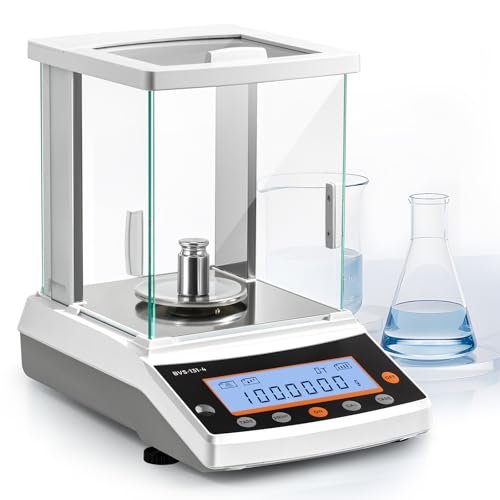
- 0.0001g readability with 220g capacity
- Percentage, counting, and memory functions
- RS232 output for computers and printers
Best For: Fine-resolution lab, pharmacy, jewelry, and data-recording work
Best Portable Precision Scale

- Pocket-size design with 0.01g readability
- Clear cover doubles as a weighing tray
- AAA batteries, six units, and overload protection
Best For: Portable weighing of jewelry, coins, food, tea, and powders
Best Draftshielded Analytical Balance
Hanchen 220g 0.1mg Analytical Scale

- 0.1mg readability with a three-sided glass draftshield
- USB and RS232 connectivity with matching software
- Eight unit conversions and backlit display
Best For: Controlled bench-top lab, pharmacy, chemical, and jewelry work
Portable Workhorse
Bonvoisin 6000g x 0.1g Gram Scale

- 6,000g capacity with 0.1g readability
- Tare and counting functions
- Adapter and AA-battery operation
Best For: Portable jewelry, parts, and general lab weighing
Feature-Rich Lab Pick
UXILAII 5000g x 0.01g Analytical Balance

- 5,000g capacity with 0.01g readability
- Calibration weights and external calibration
- RS-232, counting, tare, and multi-unit functions
Best For: Connected laboratory and professional weighing workflows
Ultra-Fine Measurement
Lab Analytical Balance 500g x 0.001g

- 0.001g readability for detailed measurements
- Windshield and 500g calibration weight included
- RS232, tare, and quick stabilization
Best For: Scientific, QC, jewelry, and other fine-resolution work
High-Capacity Precision Pick
5000g x 0.01g Bonvoisin Lab Scale
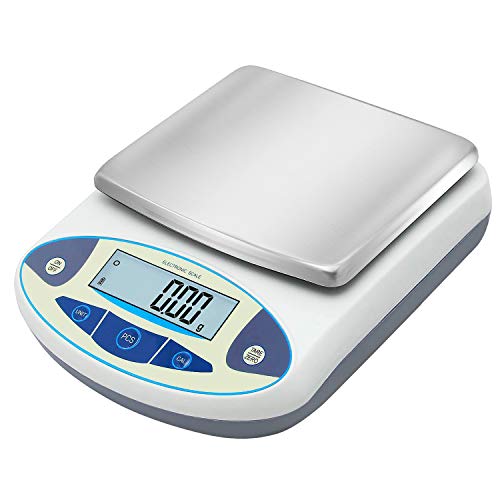
- 5000g maximum capacity with 0.01g readability
- Stainless steel pan and adjustable leveling features
- Includes counting, tare, memory, and 13 unit conversions
Best For: High-capacity lab, jewelry, school, and business weighing
Milligram-Level Choice
500g x 0.001g Bonvoisin Analytical Balance

- 0.001g readability with 500g maximum capacity
- Integrated windshield limits environmental impact
- Battery operation and RS-232 data connectivity
Best For: Fine weighing of gemstones, jewelry, and small samples
Versatile Calibrated Option
5000g x 0.01g Scientific Lab Scale

- 5000g capacity with 0.01g precision
- Large 170 x 170mm stainless steel weighing pan
- Includes calibration weights and counting function
Best For: General-purpose weighing of powders, jewelry, coins, and medicines
Best Value 0.01g Scale – Bonvoisin 600g Digital Lab Scale
For shoppers comparing precision balances for jewelry, coins, beads, or small workshop items, the Bonvoisin 600g model offers 0.01g readability with a relatively generous capacity. Its simple controls, multiple units, and dual power options make it a practical general-purpose choice.
Best For: Everyday weighing of jewelry, beads, coins, food, pins, and screws when 0.01g readability is sufficient.
Pros:
- Measures up to 600g with 0.01g readability and a fast-response strain-gauge sensor.
- Supports six units: g, oz, ct, dwt, T, and gr.
- Includes counting and tare functions, plus a large LCD display.
- Can run from the included AC adapter or two AA batteries, which are not included.
Cons:
- Calibration weights are not included.
- It does not offer the 0.0001g readability of the more laboratory-focused options.
This is a sensible pick when capacity and ease of use matter more than ultra-fine laboratory resolution. The automatic shutoff after 270 seconds also helps conserve battery power.
Best Connected Precision Balance – Bonvoisin 220g x 0.0001g Analytical Balance
If your search for precision balances centers on fine readability and repeatable workflows, this Bonvoisin analytical model reaches 0.0001g (0.1mg) readability. Its percentage mode, memory function, and RS232 connection make it more capable for lab, pharmacy, and data-recording tasks than a basic pocket scale.
Best For: Laboratory, pharmacy, and jewelry users who need 0.1mg readability, percentage weighing, counting, and serial data output.
Pros:
- Offers 220g capacity with 0.0001g readability and a stated 0.0004g tolerance.
- Provides percentage weighing for working with experimental ratios.
- RS232 connectivity supports output to a computer or printer.
- Includes a weighing pan, adapter, manual, and calibration weight.
Cons:
- Its 220g maximum capacity is lower than the 600g general-purpose model.
- The notes recommend counted items weigh more than 50mg, limiting very light-item counting.
The upgraded circuitry is described as more stable and responsive than the older model. Choose it when fine resolution and data handling are priorities, rather than maximum capacity or portability.
Best Portable Precision Scale – MAXUS 500g Pocket Gram Scale
For portable precision balances, the MAXUS pocket scale combines 0.01g readability with a compact 5.0-by-2.90-by-0.67-inch body. The clear cover doubles as a tray, while battery power and overload protection make it convenient for quick weighing away from a dedicated bench.
Best For: On-the-go weighing of jewelry, coins, tea, powders, food, gemstones, and other small items.
Pros:
- Measures up to 500g with 0.01g readability.
- Includes a clear cover that also serves as a weighing tray.
- Offers six units: g, oz, ozt, dwt, ct, and gn.
- Includes two AAA batteries and features auto-off, tare, and overload protection.
Cons:
- Its 0.01g readability is not intended for 0.1mg analytical work.
- The compact weighing platform is better suited to small items than bulky objects.
This is the most travel-friendly option in the group. It also provides a stated 10-year warranty and a user-performed calibration procedure using a 100g weight.
Best Draftshielded Analytical Balance – Hanchen 220g 0.1mg Analytical Scale
Among precision balances intended for more controlled environments, the Hanchen stands out with a three-sided glass draftshield, electromagnetic load cell, and temperature-compensation technology. It is designed to reduce the effects of airflow, small vibrations, and temperature changes when repeatability matters.
Best For: Laboratory, pharmacy, chemical-plant, and jewelry-store users seeking a draftshielded 0.1mg balance with data connectivity.
Pros:
- Provides 0.1mg readability with a 220g maximum capacity.
- Three-sided glass draftshield helps reduce airflow effects during weighing.
- USB and RS232 connectivity support data handling with a computer and matching software.
- Offers eight unit conversions and a backlit LCD display.
Cons:
- Its 220g capacity limits larger sample work.
- The bench-top design is less portable than a pocket scale.
The compact 12-by-8-inch footprint keeps it practical for a workbench while the spacious weighing chamber improves usability. Its stated one-year free guarantee and English manual are useful additions for professional users.
Portable Workhorse – Bonvoisin 6000g x 0.1g Gram Scale
For buyers seeking practical precision balances for general lab, jewelry, or parts work, the Bonvoisin offers a useful combination of capacity and readability. Its 6,000g maximum, 0.1g resolution, compact footprint, and dual-power operation make it convenient for everyday weighing.
Best For: Jewelry, gemstones, small-parts inventory, and portable general-purpose weighing.
Pros:
- Handles up to 6,000g with 0.1g readability and a 1g minimum start weight.
- Includes tare and counting functions for containers and small parts.
- Offers six measurement units, an easy-clean stainless steel pan, and adapter or AA-battery power.
Cons:
- Its 0.1g readability is less detailed than analytical balances with 0.01g or 0.001g resolution.
- The compact platform may be limiting for larger items.
This is a sensible choice when capacity, portability, and straightforward operation matter more than ultra-fine analytical resolution. The adjustable auto-off setting is also useful for longer weighing sessions.
Feature-Rich Lab Pick – UXILAII 5000g x 0.01g Analytical Balance
The UXILAII is one of the more versatile precision balances for laboratory, school, pharmacy, or jewelry settings. It combines 5,000g capacity with 0.01g readability, external calibration, counting, memory, multiple units, and an RS-232 interface for connecting to compatible equipment.
Best For: Laboratories and professional users who need fine readability, calibration support, counting, and data connectivity.
Pros:
- Provides 0.01g readability across a 5,000g maximum capacity.
- Includes calibration functionality and calibration weights for the stated 100g–5,000g range.
- Offers counting, tare, multi-unit conversion, overload alerts, and RS-232 connectivity.
- Uses adjustable feet, a level bubble, and an anti-slip foot design for setup flexibility.
Cons:
- The RS-232 connection wire is not included.
- Its larger feature set may be more than needed for simple household weighing.
With its unusually broad feature set and finer readability than typical gram scales, this model is a strong fit for structured weighing workflows. It is especially appealing if calibration and computer or printer connectivity are part of your process.
Ultra-Fine Measurement – Lab Analytical Balance 500g x 0.001g
For applications that prioritize the finest stated resolution, this analytical balance delivers 0.001g readability at capacities up to 500g. It adds a windshield, included calibration weight, quick stabilization, and an RS232 interface, making it one of the more specialized precision balances in this roundup.
Best For: Scientific laboratory work, quality-control tasks, jewelry, food, and other measurements requiring 0.001g readability.
Pros:
- Offers 0.001g readability for high-detail measurements.
- Includes a windshield and 500g calibration weight to support consistent use.
- Features quick stabilization, a high-sensitivity sensor, tare, backlit display, and RS232 connectivity.
- Uses a stainless-steel construction and weighing pan.
Cons:
- The 500g maximum capacity is much lower than the other listed models.
- The plug-in design does not provide battery-powered operation.
This balance makes the most sense when resolution is the deciding factor and a 500g capacity is sufficient. The included windshield and calibration weight add practical value for more controlled laboratory or quality-control measurements.
High-Capacity Precision Pick – 5000g x 0.01g Bonvoisin Lab Scale
For buyers comparing precision balances, this Bonvoisin model is a practical choice when you need 0.01g readability alongside a generous 5000g maximum capacity. Its stainless steel pan, leveling features, and multiple weighing functions suit varied lab, school, jewelry, and business tasks.
Best For: High-capacity weighing of jewelry, screws, powders, and other small items in laboratories, schools, businesses, and jewelry settings.
Pros:
- Measures up to 5000g with 0.01g readability and eight selectable ranges.
- Includes an upgraded sensor, adjustable feet, level bubble, overload alarm, and external calibration.
- Offers a large stainless steel 180 x 140mm pan, LCD display, counting, memory, tare, and 13 unit conversions.
Cons:
- Calibration weights are not included with the 5000g version.
- Its 0.01g readability is less fine than milligram-level analytical balances.
This is a strong fit when capacity matters as much as resolution. Buyers needing very small increments or included calibration weights should compare it with lower-capacity alternatives.
Milligram-Level Choice – 500g x 0.001g Bonvoisin Analytical Balance
Among precision balances, this Bonvoisin analytical scale stands out for its 0.001g readability and 500g capacity. The integrated windshield, battery operation, customizable units, and RS-232 connection make it especially useful for controlled, detailed weighing and data handling.
Best For: Milligram-level weighing of gemstones and jewelry where fine readability and reduced environmental interference are priorities.
Pros:
- Provides 0.001g readability, a 500g maximum, and a 10mg minimum weighing specification.
- Integrated windshield helps reduce environmental effects on weighing results.
- Runs on AC power or a lithium battery for approximately 36 hours and includes RS-232 connectivity.
- Allows users to customize the displayed selection from 17 available units.
Cons:
- The 500g capacity is much lower than the capacity of the included 5000g alternatives.
- Its fine-resolution design is better suited to smaller samples than bulkier items.
This model is the most appropriate option here when readability is the deciding factor. Its smaller capacity makes it less suitable for high-volume or heavier weighing, but the windshield and connectivity add useful laboratory-focused functionality.
Versatile Calibrated Option – 5000g x 0.01g Scientific Lab Scale
This 5000g x 0.01g model is a flexible choice among precision balances for laboratories, businesses, pharmacies, jewelry work, and home workspaces. It combines a large stainless steel pan with counting, external calibration, a built-in level, and included calibration weights.
Best For: Fast, general-purpose weighing of powders, jewelry, coins, herbs, medicines, and other small items.
Pros:
- Offers 5000g capacity with 0.01g precision and a 170 x 170mm stainless steel pan.
- Includes leveling feet, a built-in level, overload alarm, error indication, and external calibration.
- Supports counting and conversions among grams, ounces, carats, and pounds.
- Calibration weights are included, and the product has a 30-day return period and one-year warranty.
Cons:
- Calibration weights are included, but batteries are not.
- The RS-232 interface does not include the data cable.
- The stated preheating time is 5–30 minutes before use.
Choose this balance if you want high capacity, a larger pan, and included calibration weights without moving to milligram-level resolution. The missing batteries and RS-232 cable are worth accounting for when planning your setup.
How We Picked These Precision Balances
We focused on the specifications that most directly affect everyday weighing: readability, maximum capacity, calibration options, display usability, unit selection, draft protection, and data connectivity. The selection includes compact pocket-style scales, higher-capacity laboratory models, and analytical balances designed for milligram or sub-milligram readings.
Because advertised resolution is not the same as verified accuracy, buyers should also consider the quality of the included calibration process, the stability of the work surface, environmental conditions, and whether the balance has a protective windshield.
Quick Comparison
| Best for | Typical capacity | Readability range | Useful features |
|---|---|---|---|
| Portable or occasional weighing | Up to 500g | 0.01g | Compact size, weighing tray |
| General lab and jewelry work | 500g to 6,000g | 0.01g to 0.1g | Multiple units, larger platform |
| Fine laboratory measurements | 220g to 500g | 0.0001g to 0.001g | Calibration, windshield, RS232 |
Key Buying Factors for Precision Balances
Readability and Capacity
Readability is the smallest displayed increment. A 0.0001g balance can show finer changes than a 0.01g model, but it normally supports a lower maximum load and requires more careful handling. Choose the highest readability you genuinely need, then confirm that the capacity accommodates the container and sample together.
Calibration and Stability
Regular calibration helps compensate for changes in temperature, location, and use. Look for internal or straightforward external calibration and use certified weights when measurement consistency matters. Place the balance on a rigid, level surface away from vibration, airflow, and direct sunlight.
Windshield and Connectivity
A windshield is particularly valuable for 0.001g and 0.0001g measurements because air movement can affect the displayed reading. RS232 or another data connection is useful when results must be recorded, exported, or integrated into a laboratory workflow. For simple manual weighing, these features may not justify extra cost.
Units, Platform Size, and Controls
Multiple units can simplify work across grams, carats, ounces, and other applications. Check the platform dimensions, tare function, response time, display visibility, and included power accessories before buying.
Who Should Buy Which Precision Balances?
Choose a Compact 0.01g Model for Portability
Pocket and small-platform scales suit jewelry checks, hobby projects, recipes, and field use where portability matters more than maximum precision.
Choose a Higher-Capacity Balance for Routine Weighing
A 5,000g or 6,000g model is a practical fit for larger containers, batching, educational labs, and general-purpose work requiring 0.01g or 0.1g resolution.
Choose an Analytical Balance for Fine Measurements
For pharmaceutical, chemical, research, or quality-control work, select a model with 0.001g or 0.0001g readability, dependable calibration, and preferably a windshield and RS232 connection. These balances reward controlled conditions and careful technique; they are not ideal for rough, high-volume handling.