Choosing among precision balances for small parts means balancing readability, capacity, repeatability, and practical features such as draft protection and data connectivity.
These 10 selected scales cover fine-resolution laboratory measurements, jewelry work, calibration tasks, and other applications where small weight differences matter.
Best 10 Precision Balances for Small Parts Picks for 2026
Best Micro-Precision Pick
Bonvoisin 220g x 0.0001g Analytical Balance
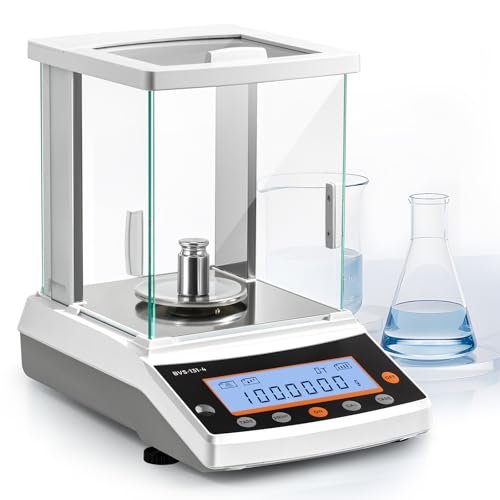
- 0.0001g readability for highly precise weighing
- Counting and percentage modes
- RS232 output and memory function
Best For: Very light samples, jewelry accessories, and ratio-based lab work
Best All-Around Lab Balance
500g x 0.001g Analytical Scale

- 500g capacity with 0.001g readability
- Glass windshield and leveling features
- Counting, percentage, tare, and RS232 functions
Best For: Jewelry, laboratory, pharmacy, and small-parts weighing
Best High-Capacity Option
UXILAII 5000g x 0.01g Lab Scale

- 5,000g capacity with 0.01g readability
- Parts counting and broad unit selection
- Calibration weights and RS232 output
Best For: Heavier batches, larger parts, and general laboratory weighing
Best Simple Windshield Design
500g x 0.001g Analytical Balance

- 500g capacity with 0.001g accuracy
- Windshield and adjustable leveling foot
- Counting, tare, and included calibration weight
Best For: Plug-in laboratory and jewelry weighing in controlled workspaces
Ultra-Fine Lab Precision

- 0.1 mg readability and 220 g capacity
- Glass draftshield for more controlled readings
- USB and RS232 data connectivity
Best For: Laboratory, pharmacy, chemical, and jewelry weighing
High-Capacity Precision

- 1000 g capacity with 0.01 g readability
- Tare and counting functions for batch work
- Level bubble and adjustable non-slip feet
Best For: Batch weighing, education, pharmacy, jewelry, and industrial use
Milligram Accuracy
U.S. Solid 200g Analytical Balance

- 1 mg resolution with 200 g capacity
- Manual calibration, tare, and part counting
- AC/DC power and backlit LCD
Best For: Laboratory, coin, jewelry, and compact small-part weighing
Portable Precision Workhorse
Bonvoisin 1000g x 0.01g Lab Scale

- 0.01g readability with 1000g capacity
- Rechargeable batteries plus charger
- Piece counting and six unit conversions
Best For: Jewelry, beads, screws, pills, and general small-part weighing
Ultra-Fine Analytical Choice

- 0.0001g readability with 120g capacity
- Windshield and calibration weight included
- RS-232 interface and counting function
Best For: High-resolution jewelry and laboratory measurements
High-Capacity Lab Precision
500g x 0.001g Analytical Scale

- 0.001g readability with 500g capacity
- Windshield and calibration weight included
- RS-232, quick stabilization, and 19 units
Best For: Higher-capacity laboratory, QC, jewelry, and industrial weighing
Best Micro-Precision Pick – Bonvoisin 220g x 0.0001g Analytical Balance
For precision balances for small parts that prioritize very fine readability, the Bonvoisin offers 0.0001g resolution across a 220g capacity. Its counting and percentage modes add practical flexibility for jewelry, pharmacy, and laboratory tasks.
Best For: Users weighing very light ingredients, jewelry accessories, or experimental ratios who need 0.1mg readability.
Pros:
- 0.0001g readability with stated 0.0004g tolerance
- Counting and percentage-weighing functions
- RS232 output, memory function, and four selectable units
Cons:
- 220g maximum capacity is lower than several larger balances
- Counting is recommended for unit weights over 50mg
This is the strongest choice when maximum readability matters more than capacity. The RS232 connection also makes it useful for recording or organizing repeated measurements.
Best All-Around Lab Balance – 500g x 0.001g Analytical Scale
Among precision balances for small parts, this 500g model balances useful capacity with 0.001g readability. Its glass windshield, leveling hardware, and practical weighing modes suit laboratories, jewelry work, and small-parts counting.
Best For: Jewelers, laboratories, pharmacies, and workshops needing a versatile 500g balance with airflow protection.
Pros:
- 500g capacity with 0.001g readability
- Glass windshield helps reduce airflow interference
- Includes tare, parts counting, percentage weighing, and multiple units
- RS232 interface supports PC or printer data records
Cons:
- RS232 cable is not included
- At 0.001g readability, it is less fine than a 0.0001g balance
This model is a well-rounded option when you need more capacity than a micro-balance while retaining fine resolution. The windshield and leveling features are particularly helpful in controlled weighing environments.
Best High-Capacity Option – UXILAII 5000g x 0.01g Lab Scale
If your precision balances for small parts also need to handle heavier batches, the UXILAII combines a 5,000g capacity with 0.01g readability. Its counting mode, broad unit selection, calibration support, and RS232 output make it suited to laboratories, schools, pharmacies, and jewelry work.
Best For: Users weighing larger quantities of parts, samples, or materials while retaining 0.01g resolution.
Pros:
- 5,000g maximum capacity with 0.01g readability
- Parts counting, tare, percentage, memory, and multiple units
- Adjustable feet, level bubble, overload alarm, and external calibration
- Calibration weights are included for the 100g–5000g range
Cons:
- 0.01g readability is coarser than the other balances in this roundup
- RS-232 connection wire is not included
This is the practical pick when capacity is the priority. It is better suited to batches and heavier small parts than ultra-fine micro-weighing, while still offering useful counting and calibration tools.
Best Simple Windshield Design – 500g x 0.001g Analytical Balance
For precision balances for small parts with a straightforward feature set, this plug-in analytical balance provides 500g capacity and 0.001g accuracy. Its windshield, adjustable leveling foot, tare function, and counting mode support more consistent small-part and jewelry measurements.
Best For: Laboratory and jewelry users who want 0.001g weighing with a lightweight, easy-to-assemble windshield.
Pros:
- 500g capacity with 0.001g accuracy and stated ±0.003g tolerance
- Windshield helps reduce airflow interference
- Tare, counting, unit conversion, and adjustable leveling foot
- Calibration weight is included
Cons:
- Must remain plugged in to operate
- Calibration is recommended before use
- Precise placement away from drafts, temperature changes, and magnetic interference is required
This balance offers a useful combination of fine resolution and basic stability features without the added complexity of a heavier enclosure. It is a sensible choice for controlled workspaces where AC power is available.
Ultra-Fine Lab Precision – 0.1mg Analytical Balance
For precision balances for small parts that require exceptionally fine readability, this Hanchen analytical balance offers 0.1 mg resolution across a 220 g capacity. Its draftshield, temperature-compensation technology, and compact bench footprint make it well suited to controlled weighing tasks.
Best For: Laboratories, pharmacies, chemical plants, and jewelry stores weighing small, lightweight samples or components.
Pros:
- 0.1 mg readability with a 220 g maximum capacity.
- Three-sided glass draftshield helps limit effects from airflow and small disturbances.
- USB and RS232 connectivity, plus matching PC software for data handling.
- Backlit LCD, eight unit conversions, and a space-saving 12-by-8-inch footprint.
Cons:
- The 220 g capacity may be limiting for larger batches or heavier parts.
- Its analytical-balance design is more specialized than a basic bench scale.
This is the strongest option here when the priority is maximum readability for very small samples. The draftshield and data connections add practical value for repeatable lab or jewelry work.
High-Capacity Precision – 1000g x 0.01g Lab Scale
This balance is a practical choice among precision balances for small parts when you need more capacity than a compact analytical model provides. It weighs up to 1000 g at 0.01 g readability and adds tare, counting, leveling, and common unit-conversion functions.
Best For: Educational labs, pharmacy weighing, jewelry work, and industrial fine measurement involving larger quantities or batches of small parts.
Pros:
- 1000 g maximum capacity with 0.01 g readout accuracy.
- Tare and counting functions support zeroing and batch counting.
- LED display, built-in level bubble, and four adjustable non-slip feet.
- Measures in grams, carats, ounces, and pounds.
Cons:
- Its 0.01 g readability is less fine than milligram or 0.1 mg analytical balances.
- The listed unit conversions are fewer than some specialized balances.
Choose this model when capacity and workflow features matter more than ultra-fine resolution. Counting and leveling support make it especially useful for repeated small-part weighing.
Milligram Accuracy – U.S. Solid 200g Analytical Balance
U.S. Solid 200x0.001g 1mg Digital Analytical Balance Precision Scale for Laboratories
Check Price On AmazonFor precision balances for small parts needing milligram-level resolution, the U.S. Solid analytical balance measures up to 200 g with 0.001 g readability. Its manual calibration, tare, counting, backlit LCD, and dual AC/DC power support make it adaptable for laboratory and jewelry tasks.
Best For: Laboratories, coin and jewelry weighing, and users who need 1 mg resolution in a compact balance.
Pros:
- 0.001 g (1 mg) resolution across a 200 g range.
- Manual calibration and tare functions support routine weighing adjustments.
- Part-counting function helps with batches of similar small components.
- Supports AC or DC power and displays readings on a backlit LCD.
Cons:
- The 200 g capacity is relatively limited for heavier items or larger batches.
- Manual calibration requires more hands-on setup than an automated calibration system.
- The supplied notes do not list USB or RS232 data connectivity.
This balance offers a useful middle ground for small-part work: finer than 0.01 g models while retaining counting and flexible power options. It is a sensible fit for controlled, lower-capacity weighing.
Portable Precision Workhorse – Bonvoisin 1000g x 0.01g Lab Scale
For general-purpose precision balances for small parts, the Bonvoisin combines 0.01g readability with a 1000g capacity. Its piece-counting mode, rechargeable batteries, and stainless steel pan make it practical for jewelry, beads, screws, pills, and other small-item weighing tasks.
Best For: Jewelry, small-part counting, laboratory tasks, kitchen use, and portable weighing.
Pros:
- Offers 0.01g readability with a 1000g maximum capacity.
- Includes two rechargeable lithium batteries and a charger for cordless or plug-in use.
- Supports piece counting, six measurement units, tare, and adjustable auto-off.
- Has a backlit LCD and rust-resistant stainless steel weighing pan.
Cons:
- Standard calibration weights are sold separately.
- Its 0.01g readability is less fine than analytical balances with 0.001g or 0.0001g resolution.
The Bonvoisin is a versatile choice when capacity and portability matter as much as resolution. It is especially useful for routine small-part counting and weighing rather than ultra-fine analytical measurements.
Ultra-Fine Analytical Choice – 120g 0.0001g Lab Balance
When your search for precision balances for small parts prioritizes the finest listed resolution, this analytical balance provides 0.0001g readability for loads up to 120g. Its electromagnetic sensor, windshield, counting function, and RS-232 interface suit controlled laboratory and jewelry work.
Best For: High-resolution jewelry weighing, laboratory measurements, counting, and computer or printer-connected workflows.
Pros:
- Provides 0.0001g readability, or 0.1mg accuracy, with a 120g capacity.
- Includes a windshield and calibration weight to support stable, repeatable use.
- Offers tare, overload protection, counting, fault alarms, and multiple unit conversions.
- RS-232 connectivity allows connection to external devices such as printers or computers.
Cons:
- Requires a two-hour preheating period before use.
- The RS-232 connection wire is not included.
- The 120g capacity is limited for larger batches or heavier small parts.
This is the strongest fit for users who need very fine resolution and can work within a 120g capacity. Plan for the preheating requirement when timing matters.
High-Capacity Lab Precision – 500g x 0.001g Analytical Scale
For precision balances for small parts that need more working capacity, this lab analytical balance pairs 0.001g readability with a 500g maximum load. The included windshield and calibration weight help support laboratory, quality-control, jewelry, food, and industrial weighing.
Best For: Higher-capacity lab work, quality control, jewelry, gemstones, food, and industrial weighing.
Pros:
- Combines 0.001g readability with a 500g capacity.
- Includes a windshield and 500g calibration weight.
- Provides an RS-232 interface, quick stabilization, and 19-unit versatility.
- Uses a plug-in design and stainless-steel construction for continuous, demanding use.
Cons:
- Plug-in operation does not offer the cordless portability of a battery-powered model.
- Its 0.001g readability is not as fine as the 0.0001g balance in this roundup.
- At 2kg, it is less lightweight for frequent relocation.
This model is a balanced option for users who need finer-than-centigram readings without sacrificing a 500g capacity. Its included calibration weight and windshield add useful readiness for lab and QC applications.
How We Picked the Best Precision Balances for Small Parts
We focused on the specifications that most affect real-world weighing: readability, maximum capacity, stated accuracy, calibration support, weighing-unit options, draft protection, and connectivity. The selection includes 0.1mg, 0.001g, and 0.01g models so buyers can compare true fine-measurement instruments with higher-capacity alternatives.
We also considered practical fit. A balance intended for laboratory or pharmaceutical work may prioritize a windshield, stable leveling, and RS232 output, while a jewelry or workshop user may value broader capacity, multiple units, and simpler operation. Product claims should still be verified against the manufacturer’s documentation, and every balance should be placed on a stable, vibration-resistant surface.
Quick Comparison
| Best suited for | Typical resolution | Capacity range in this roundup | Features to look for |
|---|---|---|---|
| Ultra-fine laboratory measurements | 0.0001g / 0.1mg | 120g–220g | Windshield, calibration, stable platform |
| General lab and jewelry work | 0.001g | 200g–500g | Draft protection, tare, repeatability |
| Higher-capacity precision weighing | 0.01g | 1,000g–5,000g | Unit conversion, larger pan, calibration |
Key Buying Factors for Precision Balances for Small Parts
Readability and Capacity
Readability is the smallest displayed increment, not necessarily the same as guaranteed accuracy. A 0.0001g balance can show finer changes than a 0.01g model, but it usually has a lower maximum capacity and requires more careful environmental control. Choose the finest resolution that matches your work without routinely approaching the scale’s limit.
Stability and Environmental Protection
Air movement, vibration, temperature changes, static, and an uneven surface can undermine small-part measurements. A draft shield or windshield is especially useful for 0.1mg and 0.001g balances. Allow the instrument to warm up, level it correctly, keep the pan clean, and avoid placing it near fans, doors, or heavy machinery.
Calibration and Workflow Features
Look for internal or supplied-weight calibration, a clear tare function, overload protection, and the units you actually use. RS232 or another data interface can simplify recordkeeping and reduce transcription errors in laboratory workflows. For occasional workshop use, straightforward controls may matter more than advanced output options.
Who Should Buy Which Precision Balances for Small Parts?
- Choose a 0.0001g model for very small samples, pharmaceutical-style measurements, jewelry components, or analytical work where environmental control is available.
- Choose a 0.001g model for the best balance of fine resolution and everyday capacity in laboratories, craft rooms, and precision workshops.
- Choose a 0.01g model when you need to weigh larger small parts, batches, or materials up to about 1,000g or more and do not require milligram-level resolution.
Before buying, confirm the supported calibration procedure, pan dimensions, power requirements, and return policy. For regulated or certified measurements, verify that the specific model meets your required compliance and calibration standards.