The right benchtop power supply gives you controlled voltage, dependable current limiting, and a safer way to test circuits than improvised adapters. This roundup compares 10 options spanning compact switching units, precision linear supplies, triple-output models, and high-current radio supplies.
Use the specifications and buying advice below to match output range, regulation, controls, connectivity, and protection features to your projects.
Best 10 Benchtop Power Supplies Picks for 2026
Compact High-Current Pick
Jesverty SPS-3010V 32V/10A Bench Supply

- 0–32V, 0–10A adjustable output
- Coarse/fine encoder controls and output switch
- USB-A and USB-C 20W charging ports
Best For: Space-conscious DIY electronics work and repairs
Multi-Output Lab Choice
Siglent SPD3303X-E Triple Output Supply
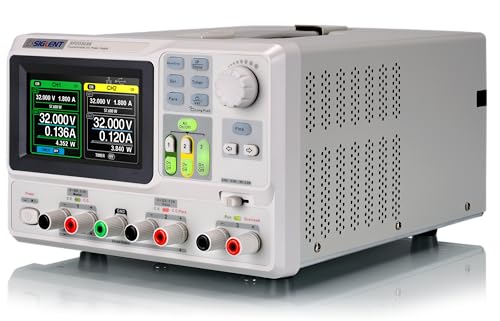
- Three controlled and isolated outputs
- Independent, series, and parallel modes
- 220W total output and three-year warranty
Best For: Multi-rail laboratory and engineering setups
Precision Linear Favorite

- 30V/5A linear regulated output
- Four-digit display with 0.001V/0.001A resolution
- Memory buttons and extensive protection features
Best For: Precision bench work and repeatable lab setups
Battery-Charging Pick
Jesverty SPS-3010C Intelligent Supply

- 0–32V and 0–10A adjustable DC output
- Automatic charging stop and reverse protection
- USB-A/USB-C 20W ports in a compact body
Best For: Bench work that includes battery charging
Compact Radio Power

- Fixed 13.8V DC output with 30A capacity
- Compact desktop form factor
- Cooling fan and multiple protection features
Best For: CB, HAM, and amateur-radio equipment
Precision Adjustment

- Encoder control for digit-by-digit adjustment
- 4-digit voltage and current display
- Output control, overcurrent protection, and USB charging
Best For: Repair benches and adjustable electronics projects
Most Versatile

- 0–30V, 0–10A, 300W adjustable output
- Coarse and fine encoder controls
- USB and USB-C 5V/3.6A charging
Best For: Repair benches, labs, and DIY users wanting charging ports
Best for Output Control
NICE-POWER 30V 10A Bench Supply

- Dedicated OUTPUT switch for safer setup
- Four-digit V/A/W display
- Compact design with 5V/2A USB port
Best For: Testing and repairs where controlled power application matters
Best Compact Pick

- Automatic CV/CC mode switching
- 0–30V, 0–10A adjustable output
- Lightweight body with V/A/W display
Best For: Space-limited hobby benches and electronics testing
Compact High-Current Pick – Jesverty SPS-3010V 32V/10A Bench Supply
For a compact option among benchtop power supplies, the Jesverty SPS-3010V combines 0–32V output with up to 10A, encoder-based coarse and fine adjustment, and a dedicated output switch. Its USB-A and USB-C ports also add convenient 20W charging for electronics projects.
Best For: DIY electronics, Arduino and Raspberry Pi projects, repairs, education, and workbenches where space is limited.
Pros:
- 0–32V and 0–10A adjustable output with 0.01V/0.001A setting resolution.
- Separate coarse and fine encoder knobs simplify precise adjustments.
- Compact 2.5-pound design with USB-A and USB-C 20W quick-charge ports.
- Output switch, over-current protection, and temperature-regulated cooling fan.
Cons:
- Included test leads are described as giveaways and may not suit sustained high-current use.
- Switchable 115V/230V input requires attention to the input setting.
The SPS-3010V is a practical space-saving choice when you need substantial current capacity and convenient controls without moving to a larger laboratory supply.
Multi-Output Lab Choice – Siglent SPD3303X-E Triple Output Supply
The Siglent SPD3303X-E is a substantial choice among benchtop power supplies, offering three independent, controlled, and isolated outputs. It supports independent, series, and parallel modes, making it suitable for more demanding multi-rail test setups.
Best For: Labs, engineering benches, and projects that need multiple isolated outputs or series and parallel configurations.
Pros:
- Three outputs: two rated 32V/3.2A and one selectable 2.5V/3.3V/5V at 3.2A.
- Independent, series, and parallel operating modes provide setup flexibility.
- 220W total output with a three-year warranty listed in the supplied details.
Cons:
- At 17.6 pounds and 16 x 14 x 11 inches, it is considerably less portable than compact supplies.
- The supplied specifications list a 3A current rating despite the individual 3.2A output ratings, so buyers should verify the intended limit.
Choose the SPD3303X-E when multiple isolated rails and configurable output modes matter more than bench space or portability.
Precision Linear Favorite – KORAD KA3005D 30V/5A Supply
The KORAD KA3005D is a 30V, 5A linear supply designed for controlled bench work. Its four-digit back-lit display, rapid adjustment knob, memory recall buttons, and constant-voltage or constant-current operation make it a focused option for precision-oriented benchtop power supplies.
Best For: Hobbyists, small labs, repair benches, and users who value readable displays and repeatable saved settings.
Pros:
- 30V/5A output with 0.001V and 0.001A display resolution.
- Four memory recall buttons can speed up recurring setups.
- Load on/off and lock buttons help with safer connections and accidental changes.
- Thermal, overload, short-circuit, and grounding protections are included.
Cons:
- Its 150W rating and 5A maximum provide less output capacity than 10A alternatives.
- The listed dimensions and 10-pound weight make it less compact than lightweight switching models.
The KA3005D stands out for straightforward precision control and repeatable workflows, especially when a linear design and memory presets fit your bench routine.
Battery-Charging Pick – Jesverty SPS-3010C Intelligent Supply
The Jesverty SPS-3010C adds intelligent battery charging to a 0–32V, 0–10A adjustable bench supply. A dedicated charging mode can display charging power, stop automatically when the battery is full, and provide reverse-connection protection.
Best For: Electronics makers and repair users who need adjustable DC output plus a more guided battery-charging workflow.
Pros:
- 0–32V and 0–10A adjustable output with 0.01V/0.001A setting resolution.
- Intelligent charging mode displays charging power and automatically stops at full charge.
- Built-in reverse-connection protection supports safer battery charging.
- Compact 2.5-pound body with output control and USB-A/USB-C 20W charging.
Cons:
- The supplied details list 20W output wattage for the USB charging function, so this should not be confused with the main 320W DC capability.
- Its included accessories are limited to basic test leads and a power cord.
The SPS-3010C is the more specialized Jesverty option for users who want high-current adjustable output and battery charging assistance in a small enclosure.
Compact Radio Power – 30A 13.8V Benchtop Supply
If you need straightforward power for radio equipment, this compact benchtop power supply converts AC input to a fixed 13.8V DC output. Its 30A rating, screw terminals, cooling fan, and built-in protection make it suited to compatible CB, HAM, amateur-radio, and other 13.8V setups.
Best For: CB/HAM radio stations and other equipment requiring a fixed 13.8V DC supply.
Pros:
- Provides up to 30A and 414W at a fixed 13.8V output.
- Compact desktop design measures approximately 7.48 × 5.9 × 2.36 inches.
- Includes screw-type terminals, a cooling fan, and over-voltage, over-current, and short-circuit protection.
Cons:
- Fixed 13.8V output is not adjustable for variable-voltage projects.
- Screw-terminal connections may be less convenient than plug-and-play connectors for some users.
This is a practical choice when your equipment already matches its fixed voltage. For electronics work requiring adjustable voltage and current, consider a variable supply instead.
Precision Adjustment – 30V 10A Variable Bench Supply
For projects that need adjustable output, this variable benchtop power supply offers up to 30V and 10A with a precise encoder control. Its 4-digit display, output enable button, constant-voltage/constant-current operation, and USB fast-charging port add useful control for bench testing and device work.
Best For: Electronics repair, personal-computer projects, and users who want precise voltage and current adjustment.
Pros:
- Encoder knob lets you select individual digits for more precise settings.
- 4-digit display shows voltage to 0.01V and current to 0.001A.
- Output enable/disable control and overcurrent protection help reduce accidental load damage.
- Includes an 18W USB fast-charging port.
Cons:
- The output range tops out at 30V and 10A.
- The supplied details list air cooling but do not specify a temperature-regulated fan.
The combination of fine adjustment and an output-control button makes this a flexible everyday bench unit. It is especially useful when repeatable settings and visible readings matter more than a higher voltage range.
Wide-Range Testing – 0-60V 5A Adjustable Supply
This adjustable benchtop power supply covers 0–60V and 0–5A, giving electronics hobbyists a broad output range for testing and development. The bright display reports voltage, current, and power, while automatic constant-voltage/constant-current operation helps maintain the selected limits as the load changes.
Best For: General electronics testing, projects needing up to 60V, and space-conscious workbenches.
Pros:
- Wide 0–60V adjustable output with up to 5A and 300W.
- 4-digit display shows real-time V/A/W readings with fine resolution.
- Automatically switches between constant-voltage and constant-current modes.
- Includes short-circuit and overload protection, a grounding terminal, and a temperature-regulated fan.
Cons:
- Maximum current is 5A, lower than some 10A or 30A supplies.
- Included test leads are described as a giveaway and may not suit long-term high-current use.
- The listed USB port provides 5V/2A rather than the faster charging output of some competing models.
With its higher 60V ceiling and live power calculation, this model is a strong fit for varied bench work. Plan to use appropriately rated test leads if your projects regularly approach its current limit.
Most Versatile – WANPTEK POWER DPS3010U
For shoppers comparing benchtop power supplies, the WANPTEK POWER DPS3010U stands out for its 0–30V, 0–10A adjustable output, coarse and fine encoder controls, and added charging ports. Its four-digit display and automatic 110V/220V ±10% input detection make it a flexible choice for repair benches, labs, and DIY electronics work.
Best For: Users who want precise adjustment controls plus USB and USB-C charging in one compact bench supply.
Pros:
- Coarse and fine knobs simplify voltage and current adjustments.
- Offers 0–30V and 0–10A output with a 300W rating.
- Includes 5V/3.6A USB and Type-C quick-charge ports.
- Provides short-circuit alerts and multiple protection features.
Cons:
- The supplied product details do not specify output-switch control.
- At 8.4 × 3.4 × 5.9 inches, it may require meaningful bench space.
Choose this model if charging convenience and fine control matter as much as adjustable output. Its temperature-controlled fan and broad protection features add practical reassurance for repeated electronics work.
Best for Output Control – NICE-POWER 30V 10A Bench Supply
The NICE-POWER is a practical option among benchtop power supplies for users who want to set voltage and current before energizing a load. Its dedicated OUTPUT switch, four-digit readout, and real-time voltage, current, and power display support safer, more controlled testing.
Best For: Experimenters and repair users who prioritize an output on/off control and clear measurements.
Pros:
- OUTPUT switch lets you adjust settings without applying power.
- Displays voltage, current, and power with stated 0.01V and 0.001A resolution.
- Includes 5V/2A USB charging and temperature-controlled cooling.
- Compact 8.4 × 3.3 × 5.5-inch design weighs about 2.6 pounds.
Cons:
- Accepts only 110V input; 220V input is not available.
- The supplied notes do not confirm coarse and fine adjustment controls.
This is a strong fit when output control and readable measurements are more important than dual-voltage input. Its compact enclosure also makes it easier to move between work areas.
Best Compact Pick – Jesverty SPS-3010
The Jesverty SPS-3010 is a space-conscious choice for shoppers comparing benchtop power supplies. It provides adjustable 0–30V and 0–10A output, automatic constant-voltage/constant-current operation, and a four-digit display that reports output voltage, current, and power.
Best For: Hobbyists and technicians who need a lightweight supply with automatic CV/CC switching.
Pros:
- Automatically switches between constant-voltage and constant-current modes.
- Four-digit display shows V/A/W with stated 0.01V, 0.001A, and 0.1W resolution.
- Compact 7.1 × 3.35 × 6.1-inch body weighs approximately 2.5 pounds.
- Includes short-circuit and overload protection plus a temperature-regulated fan.
Cons:
- Included test leads are described as a giveaway and may not suit sustained high-current use.
- The supplied details do not mention an output on/off switch.
Consider the SPS-3010 when bench space and automatic operating-mode changes are priorities. For demanding high-current projects, plan to use test leads with suitable current capacity rather than relying on the included set.
How We Picked These Benchtop Power Supplies
We focused on the specifications that matter most in a working electronics setup: adjustable voltage and current ranges, regulation, display readability, output control, adjustment resolution, protection features, and practical connectivity. The selection includes common 0–30V and 0–32V supplies, higher-voltage 0–60V models, 10A units, a 5A linear supply, a triple-output instrument, and a fixed 13.8V high-current supply for radio equipment.
Because product listings can vary by seller and revision, verify the latest manual, included leads, input requirements, and protection ratings before buying. A higher maximum output does not automatically mean a better supply for sensitive circuits.
Quick Comparison
| Best suited to | Look for | Why it matters |
|---|---|---|
| General electronics and repair | 0–30V or 0–32V, 5–10A | Covers common microcontroller, battery, motor, and board-testing tasks. |
| Higher-voltage experiments | 0–60V output | Provides additional headroom for specialized circuits and series-connected loads. |
| Low-noise bench work | Linear regulation | Can reduce switching-related noise for sensitive analog and measurement applications. |
| Multiple independent rails | Triple output | Lets you power several rails or circuits from one instrument. |
| CB, HAM, and amateur radio | 13.8V fixed output and high current | Matches the typical operating voltage of many radio systems. |
Key Buying Factors for Benchtop Power Supplies
Voltage and Current Range
Choose a maximum voltage above your normal requirement, but prioritize usable resolution at low settings. Current capacity should exceed the expected load, especially for motors, lamps, transmitters, and circuits with startup surges. Remember that maximum voltage and maximum current may not be available simultaneously because of the unit’s wattage limit.
Switching Versus Linear Design
Switching supplies are generally compact, efficient, and capable of high output power. Linear supplies are often heavier and less efficient but may be preferable when ripple and electrical noise are especially important. For routine digital projects, repair, and general prototyping, a well-equipped switching model is usually the more practical choice.
Controls, Displays, and Protection
Separate voltage and current controls, coarse and fine adjustment, an encoder, and an output-enable button make setup safer and faster. A clear four-digit display helps when readings must be monitored closely. Look for constant-voltage and constant-current operation, over-voltage and over-current protection, short-circuit protection, thermal protection, and sensible cooling.
Connections and Workspace Fit
USB or USB-C ports can be useful for charging or powering accessories, but they should not replace dedicated, properly rated output terminals. Check whether cables are included, whether terminals accept banana plugs, how much ventilation the supply needs, and whether its dimensions suit your bench.
Who Should Buy Which Benchtop Power Supplies?
Choose a 0–30V or 0–32V, 5–10A switching unit for the best all-around value in electronics repair, Arduino and microcontroller projects, and general prototyping. Pick a 0–60V model if your work regularly exceeds standard low-voltage ranges. A linear supply is the better fit for sensitive analog work where low noise takes priority over compact size and efficiency.
Buy the Siglent triple-output model when independently managed rails, more advanced bench control, or a more instrument-oriented setup matter most. Radio operators should favor the dedicated 13.8V, high-current supply. For occasional hobby use, prioritize clear controls, output enable, reliable protection, and included leads over headline amperage or extra charging ports.