The best microscopes for biology make it easier to examine prepared slides, plant cells, microorganisms, and other specimens with useful detail. This roundup includes approachable student models alongside more capable compound microscopes for advanced home study, classrooms, and laboratory-style work.
Magnification matters, but it is only one part of the buying decision. Optical quality, illumination, stage control, binocular comfort, included accessories, and overall ease of use can make a bigger difference in day-to-day biology work.
Best 10 Microscopes for Biology Picks for 2026
Research-Ready Choice
SWIFT SW350B Binocular Compound Microscope

- 40X-2500X range with six settings
- Binocular head and mechanical stage
- Adjustable LED and Abbe condenser
Best For: Advanced students, clinicians, and hobbyists
Everyday Learning Pick
AmScope M150C Cordless Compound Microscope

- 40X-1000X magnification range
- Runs on outlet power or three AA batteries
- All-metal body with optical glass
Best For: Homeschool and student science use
Digital Collaboration Option
PalliPartners Trinocular Biology Microscope

- 40X-2000X range with coarse and fine focus
- Trinocular design supports camera connection
- Dual LED illumination and stable stage
Best For: Shared viewing, teaching, and basic lab work
Wide-View Biology Explorer
High-Power Binocular Compound Microscope

- WF10x and WF25x eyepieces with wide-angle binocular viewing
- Top and bottom LED illumination
- Mechanical stage with coaxial coarse and fine focus
Best For: Adults, students, and hobbyists seeking comfortable binocular biology viewing
Complete STEM Lab Set
PalliPartners Binocular Microscope Kit

- 100x–2000x range with 2x Barlow lens
- 28 slides plus dissecting and collection tools
- Phone adapter, Bluetooth remote, and dual LED lighting
Best For: Students and families wanting an accessory-rich biology learning kit
Portable Student Lab
PALOBIL Microscope Kit for Biology Study

- Six listed settings from 100x to 2000x
- Metal frame with dual adjustable LED lighting
- Starter slides, tools, and phone adapter included
Best For: Kids, students, and homeschool beginners needing flexible power options
Best All-Around Starter
BEBANG 2000X Biology Microscope
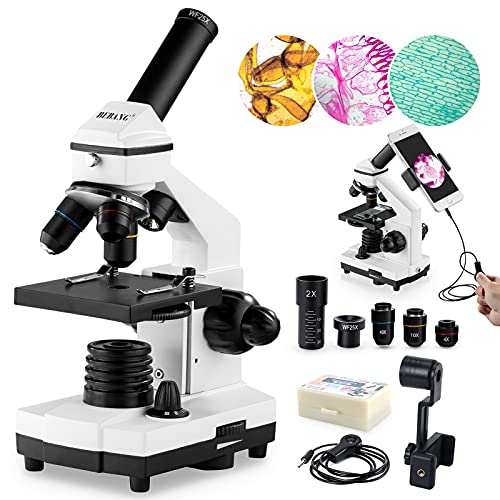
- Six magnification settings from 100X to 2000X
- Dual LED illumination with coarse and fine focus
- Includes slides, phone adapter, accessories, and carrying bag
Best For: Students, beginners, families, and hobbyists
Best Complete Slide Kit
PalliPartners 2000X Compound Microscope

- Includes 28 slides: 10 prepared and 18 blank
- Dual LED lighting for varied specimen types
- Phone adapter and Bluetooth shutter included
Best For: Students, homeschoolers, families, and hobbyists
Best Lightweight Option
HUTACT 2000X Beginner Microscope

- Lightweight 0.76 kg aluminum-alloy body
- 40X–2000X magnification range
- Includes prepared slides, storage bag, and LED light
Best For: Portable beginner use at home, school, or during science activities
Research-Ready Choice – SWIFT SW350B Binocular Compound Microscope
For shoppers seeking versatile microscopes for biology, the SWIFT SW350B combines high magnification, binocular viewing, and a mechanical stage. Its achromatic objectives and adjustable LED illumination make it suitable for detailed slide-based observation in educational, clinical, and hobby settings.
Best For: University students, clinicians, advanced hobbyists, and shared lab use.
Pros:
- Six magnification levels from 40X to 2500X
- Rotatable binocular head with interchangeable 10X and 25X eyepieces
- Mechanical stage, Abbe condenser, and adjustable LED brightness
- Carrying handle supports easier transport
Cons:
- Heavier and more substantial than beginner-oriented models
- AC-adapter powered rather than battery powered
The SW350B is a strong choice when precise slide positioning, comfortable binocular viewing, and a broad magnification range matter more than compactness.
Everyday Learning Pick – AmScope M150C Cordless Compound Microscope
The AmScope M150C is a practical option for families and students comparing microscopes for biology. It offers five common magnification settings, optical glass elements, and LED lighting that can run from an outlet or three AA batteries.
Best For: Homeschooling, elementary-to-high-school science, and portable learning.
Pros:
- 40X to 1000X magnification across five settings
- Cordless operation with three AA or rechargeable batteries
- All-metal framework with optical glass elements
- Rotatable monocular head and disc diaphragm
Cons:
- Monocular viewing is less suited to shared observation
- Offers a lower maximum magnification than the SW350B
With its sturdy construction and flexible power options, the M150C is a sensible, straightforward microscope for foundational biology lessons and home science work.
Digital Collaboration Option – PalliPartners Trinocular Biology Microscope
For biology learners and basic lab users who want to document observations, the PalliPartners trinocular microscope adds a camera connection point alongside its viewing eyepieces. Its dual LED illumination and double-layer stage support observations of transparent and non-transparent specimens.
Best For: Classroom sharing, basic laboratory work, adult hobbyists, and digital capture.
Pros:
- 40X to 2000X adjustable magnification range
- Trinocular head supports simultaneous viewing and camera connection
- Top and bottom LED illumination for varied specimens
- Separate coarse and fine focus controls
Cons:
- Camera functionality may require additional setup or compatible equipment
- One-year manufacturer warranty is shorter than some alternatives
The PalliPartners stands out among microscopes for biology when sharing or recording observations is important, while retaining approachable controls for educational and basic laboratory settings.
Young Scientist Starter – AmScope M30 STEM Microscope Kit
The AmScope M30-ABS-KT2-W is a beginner-friendly package for introducing children to microscopes for biology. Along with six magnification settings, it includes sample slides, tools, and a hard ABS carrying case for hands-on exploration.
Best For: Kids, beginner science learners, and portable STEM activities.
Pros:
- Complete 52-piece kit for hands-on learning
- 120X to 1200X magnification across six settings
- LED lighting and rotating color filter wheel
- Includes sample slides, accessories, and carrying case
Cons:
- Designed for beginners rather than advanced laboratory work
- Includes plastic slides, which may feel less substantial than glass slides
The M30 kit prioritizes accessibility and convenience, making it a useful starting point for young learners who need equipment and specimens in one portable package.
Wide-View Biology Explorer – High-Power Binocular Compound Microscope
For shoppers comparing microscopes for biology, this binocular compound model offers a broad magnification range, dual illumination, and a mechanical stage for more controlled specimen work. Its WF10x and WF25x eyepieces, 4x/10x/40x objectives, and coaxial focusing controls suit beginners and hobbyists who want a more capable setup than a basic student microscope.
Best For: Adults, students, beginners, and hobbyists exploring prepared slides, plant material, and other biological specimens at home or in educational settings.
Pros:
- Binocular, wide-angle viewing is designed for a comfortable, expansive field of view.
- Top and bottom LED lighting support both incident and transmitted illumination.
- Coaxial coarse and fine focus controls help make adjustments more precise.
- Large mechanical stage includes a spiral moving scale for specimen positioning.
Cons:
- The product listing gives conflicting magnification information, so buyers should verify the exact usable range.
- It is corded electric and may be less convenient for portable use.
- The listed kit details do not specify prepared slides or dissecting accessories.
Choose this model when comfortable binocular viewing and stage control matter most. Its dual-light design expands its usefulness beyond translucent slides, while the broad eyepiece and focus setup make it a practical option for extended introductory biology work.
Complete STEM Lab Set – PalliPartners Binocular Microscope Kit
This PalliPartners model is a strong all-in-one choice among microscopes for biology, combining 100x–2000x magnification with a WF25x eyepiece, 2x Barlow lens, slides, and dissecting tools. Its binocular design, coaxial focusing, phone adapter, and dual LED lighting make it suitable for structured home study or classroom-style exploration.
Best For: Students, homeschoolers, families, and beginners who want a biology microscope kit with specimens, accessories, and phone-friendly documentation.
Pros:
- Includes 4x, 10x, and 40x objectives, a WF25x eyepiece, and 2x Barlow lens for multiple magnification settings.
- Comes with 10 prepared slides, 18 blank slides, collection containers, and dissecting tools.
- Adjustable top and bottom LEDs can illuminate opaque and translucent objects.
- Phone clip adapter and Bluetooth remote support specimen photography.
Cons:
- The plastic enclosure may be less substantial than a fully metal professional instrument.
- Some included accessories are geared toward beginners rather than advanced laboratory work.
- High magnification requires careful focusing and suitable specimen preparation.
For buyers prioritizing value and convenience, this is the most complete package of the three. The included slides and tools reduce the need for extra purchases, while the phone accessories add a useful way to record observations.
Portable Student Lab – PALOBIL Microscope Kit for Biology Study
PALOBIL’s compound microscope is a practical pick for microscopes for biology when portability and beginner-friendly accessories are priorities. It provides six listed magnification settings from 100x to 2000x, 4x/10x/40x objectives, dual LED lighting, a metal frame, and a starter experiment kit for home or school use.
Best For: Kids, students, homeschool projects, and beginners who need a compact microscope with prepared slides, phone compatibility, and battery or AC operation.
Pros:
- Six listed magnification settings cover 100x, 200x, 250x, 500x, 1000x, and 2000x.
- Metal enclosure provides a sturdy construction for student use.
- Adjustable top incident and bottom transmitted LED lighting handle opaque and translucent objects.
- Includes prepared and blank slides, droppers, tweezers, a phone adapter, and instructions.
Cons:
- Requires three AA batteries, which are not included, for battery-powered operation.
- The compact design and 1.65 kg weight may limit stability compared with larger laboratory microscopes.
- The listing describes it for children and beginners, so advanced users may want more specialized controls.
This model balances a sturdy metal body with a relatively portable format and a useful starter kit. Its battery option is convenient for demonstrations and travel, while the included slides and dual lighting make it ready for introductory biology activities.
Best All-Around Starter – BEBANG 2000X Biology Microscope
If you want versatile microscopes for biology at home, school, or in a beginner lab setup, this BEBANG model combines six magnification settings with coarse and fine focus controls. Its dual LED illumination and included slide kit make it ready for hands-on specimen exploration.
Best For: Students, families, beginners, and hobbyists who want a complete biology microscope kit with phone documentation.
Pros:
- Offers six magnification settings from 100X to 2000X using multiple eyepiece, objective, and 2X lens combinations.
- Coarse and fine focusing knobs support more precise image adjustment.
- Top-and-bottom LED illumination, a condenser, and disc diaphragm help accommodate different specimens.
- Includes a phone adapter, remote shutter, accessories, slides, and carrying bag.
Cons:
- Its monocular design may be less comfortable for extended viewing than a binocular microscope.
- The supplied 15-piece slide set may be limiting for users who want a larger range of prepared or blank specimens.
With a metal frame, achromatic objectives, and a one-year warranty, this is a practical entry-level choice for structured biology activities rather than advanced professional research.
Best Complete Slide Kit – PalliPartners 2000X Compound Microscope
For shoppers comparing microscopes for biology that are ready for experiments out of the box, the PalliPartners compound microscope stands out for its included 28-slide collection. Its 100X–2000X range, dual LEDs, and phone accessories support both observation and simple documentation.
Best For: Middle- and high-school students, homeschoolers, families, and adult hobbyists who want prepared and blank slides for immediate practice.
Pros:
- Combines 4X, 10X, and 40X objectives with a WF25X eyepiece and 2X lens for 100X–2000X magnification.
- Includes 10 prepared slides and 18 blank slides for ready-made and DIY samples.
- Top and bottom LED lighting supports opaque objects and translucent biological specimens.
- Comes with a phone clip adapter, Bluetooth remote shutter, and power adapter.
Cons:
- Its PC and PE enclosure is not described as a metal construction.
- The listed 30-degree viewing angle may feel less upright than some users expect.
- At 1.65 kg, it is less lightweight than the compact HUTACT option.
The large slide assortment gives this model strong educational value, while the coaxial coarse and fine focus controls provide useful adjustment for basic to intermediate biology work.
Best Lightweight Option – HUTACT 2000X Beginner Microscope
If portability matters when choosing microscopes for biology, this HUTACT model pairs a lightweight 0.76 kg build with an aluminum-alloy body and storage bag. It offers several eyepiece combinations, achromatic glass lenses, and a small prepared slide set for straightforward beginner use.
Best For: Kids, adults, students, and beginners who need a portable microscope for homeschooling, classroom activities, or science exploration.
Pros:
- Supports magnification from 40X to 1000X, with a 2X lens extending the maximum to 2000X.
- Lightweight aluminum-alloy construction is easier to carry and store.
- Achromatic glass lenses are designed to produce clear, bright images.
- Includes five prepared slides, a storage bag, LED lighting, and a user manual.
Cons:
- The included five-piece slide set is smaller than the slide collections supplied with the other options.
- The notes do not mention a phone adapter or digital photography accessories.
- It does not list dual illumination, so it may be less flexible for opaque objects.
This is a sensible pick for first-time users who value easy transport and simple setup. Its compact kit is more focused on introductory exploration than on a broad, fully equipped laboratory workflow.
How We Picked These Microscopes for Biology
We selected models across several common use cases, including beginner education, family STEM activities, student coursework, and more demanding biological observation. Our comparison focused on stated magnification ranges, compound optical designs, binocular or trinocular viewing, mechanical-stage controls, LED illumination, included eyepieces or slides, construction, and ease of setup.
Specifications can vary by seller and package, so verify the current listing before buying—especially the included objectives, accessories, power arrangement, and warranty.
Quick Comparison
| Best For | Look For | Why It Matters |
|---|---|---|
| Young beginners | Simple controls and included slides | Reduces setup time and makes early lessons more engaging |
| Students | Mechanical stage and multiple objectives | Allows more precise specimen positioning and useful magnification changes |
| Advanced home users | Binocular viewing and better optical components | Improves comfort and supports longer observation sessions |
| Documentation | Trinocular head or camera compatibility | Makes it easier to capture and share observations |
Key Buying Factors for Microscopes for Biology
Magnification and Useful Resolution
Do not choose by the largest number alone. A 2000x or 2500x rating is useful only when the optics, condenser, lighting, and specimen preparation can support it. For many biology lessons, a clear low- and medium-power image is more valuable than extreme magnification.
Optical Design and Viewing Comfort
Binocular heads reduce the need to observe through one eyepiece and can be more comfortable for extended sessions. Trinocular models may suit users who want to attach a camera. Look for glass optics, wide-field eyepieces, and smooth focusing when image clarity and comfort are priorities.
Stage, Illumination, and Controls
A two-layer mechanical stage helps you move a slide precisely instead of nudging it by hand. Adjustable LED lighting is practical for home and classroom use, while a condenser and iris help manage contrast. Coarse and fine focus controls should move smoothly without excessive looseness.
Accessories and Maintenance
Prepared slides, blank slides, cover slips, and basic tools can make a beginner kit more useful immediately. Keep lenses covered, use lens paper rather than household tissues, and avoid forcing objectives or focus knobs.
Who Should Buy Which Microscopes for Biology?
For Children and First-Time Users
Choose a beginner-focused kit with straightforward controls, durable construction, and prepared specimens. A moderate magnification range is usually easier to use than a complicated high-power setup.
For Students and Home Biology Learners
A compound binocular microscope with a mechanical stage, multiple objectives, and dependable LED illumination offers the best balance of capability and value for regular coursework and independent projects.
For Serious Hobbyists and Advanced Users
Prioritize better optical quality, ergonomic binocular viewing, precise focusing, and upgrade options. A trinocular head is especially worthwhile if photographing or recording specimens is part of the plan.
For Classrooms or Shared Use
Favor robust all-metal construction, simple controls, replaceable accessories, and a design that different users can adjust quickly. A reliable, easy-to-maintain microscope is often more useful than one with the highest advertised magnification.