Choosing among stereo microscopes for biology can be difficult because magnification, working distance, lighting, and imaging features vary widely. The right model depends on whether you need hands-on specimen work, routine observation, teaching, or documentation.
This roundup compares 10 selected microscopes, including binocular and trinocular designs, zoom systems, compound configurations, LED illumination, and accessories that can improve biological viewing.
Best 10 Stereo Microscopes for Biology Picks for 2026
Versatile Stereo Viewing
AmScope SE306R-PZ Binocular Microscope

- 20x, 40x, and 80x stereo magnification
- Dual top and bottom halogen illumination
- Metal pillar stand with binocular viewing
Best For: Larger specimens, dissection, and hands-on biology observation
High-Magnification Biology Study
PalliPartners Trinocular Microscope

- 40x-to-2000x adjustable magnification
- Dual LED lighting and stable slide stage
- Trinocular design for camera connection
Best For: Slide-based biology learning, teaching, and basic lab use
Cool LED Stereo Illumination
AmScope SE306R-PZ-LED Microscope

- 20x, 40x, and 80x stereo settings
- Top and bottom LED illumination
- Forward binocular head with metal stand
Best For: Hands-on specimen viewing where LED lighting is preferred
Flexible Trinocular Inspection
SENZHIYI Trinocular Stereo Zoom Microscope

- 3.5x-to-90x continuous magnification
- Adjustable boom arm and heavy steel base
- Camera-ready trinocular head with ring light
Best For: Dissection, teaching, and larger-sample biological inspection
Best Cordless Starter
AmScope SE306R-P-LED Stereo Microscope

- 20x/40x stereo magnification
- Top and bottom LED illumination
- Cordless, battery-powered design
Best For: Basic biology observation and student use
Best Flexible Imaging Setup
ZTEEERS Trinocular Stereo Zoom Microscope

- 3.5x-90x expanded magnification
- Trinocular viewing with camera adapters
- Dimmable 56S LED ring light
Best For: Specimen inspection with digital imaging
Best Wide-Range Zoom
AmScope SM-4TZZ-B Trinocular Microscope

- 3.5x-180x stereo zoom range
- Super-widefield stereo optics
- Trinocular photo/video port
Best For: Flexible inspection and future imaging upgrades
Professional Lab Choice
SWIFT Trinocular Stereo Zoom Microscope
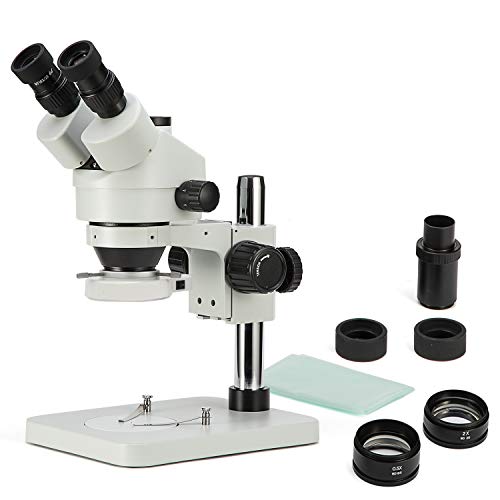
- 3.5X–90X magnification flexibility
- Cool 56-bulb ring illumination
- Trinocular port for camera documentation
Best For: Advanced biological lab observation and specimen imaging
Ergonomic Laboratory Pick
Euromex StereoBlue Trinocular Microscope

- 7X–45X zoom magnification
- Incident and transmitted LED lighting
- Ergonomic head with adjustable eyepieces
Best For: Routine biology labs and higher-education instruction
Stable Workstation Value
Parco Scientific Trinocular Zoom Microscope

- 3.5X–45X parfocal magnification
- 144-LED adjustable ring light
- Stable pillar stand with camera-ready port
Best For: Bench-top specimen inspection and controlled biology work
Versatile Stereo Viewing – AmScope SE306R-PZ Binocular Microscope
For shoppers comparing stereo microscopes for biology, the AmScope SE306R-PZ offers practical low-to-moderate magnification for viewing larger specimens and samples. Its binocular head, glass optics, metal pillar stand, and dual illumination support comfortable observation from above or below.
Best For: Biology hobbyists and students who need 20x, 40x, and 80x stereo magnification for dissecting or examining larger, three-dimensional specimens.
Pros:
- Three stereo magnification settings: 20x, 40x, and 80x
- Widefield optical glass lenses and a forward binocular head
- Built-in incident and transmitted halogen lighting
- Sturdy all-metal pillar stand with a five-year manufacturer warranty
Cons:
- Maximum magnification is lower than that of a compound microscope
- Halogen lighting may produce more heat than LED illumination
- Requires corded 120-volt power
This is a solid choice when depth perception and working access matter more than viewing very small cells or prepared slides. Consider a compound microscope instead for high-magnification biological inspection.
High-Magnification Biology Study – PalliPartners Trinocular Microscope
Among stereo microscopes for biology and related lab work, this PalliPartners model is a compound trinocular microscope designed for slide-based observation. Its 40x-to-2000x range, dual LED lighting, and camera-ready third viewing port make it suited to foundational biological inspection and documentation.
Best For: Home science learning, classroom instruction, and basic laboratory work involving transparent or non-transparent specimens on slides.
Pros:
- Adjustable magnification from 40x to 2000x
- Top and bottom LED illumination for varied specimens
- Double-layer stage helps hold slides securely
- Trinocular head supports simultaneous viewing and camera connection
Cons:
- Compound microscope design is less suited to large three-dimensional specimens
- Supplied notes do not specify a camera beyond the listed 5MP camera highlight
- One-year manufacturer warranty is shorter than some competing options
The broad magnification range gives this model greater reach for biological slides than a typical stereo microscope. Its trinocular configuration is especially useful when observations need to be shared or recorded.
Cool LED Stereo Illumination – AmScope SE306R-PZ-LED Microscope
The AmScope SE306R-PZ-LED is a practical option for shoppers seeking stereo microscopes for biology with lower-maintenance LED lighting. It provides 20x, 40x, and 80x stereo magnification, a forward binocular head, and illumination from both the top and bottom.
Best For: Students and hobbyists who want accessible stereo viewing of larger biological samples with adjustable LED illumination.
Pros:
- 20x, 40x, and 80x stereo magnification settings
- LED incident and transmitted lighting for different sample types
- Forward-mounted widefield binocular head
- Sturdy metal pillar stand and five-year manufacturer warranty
Cons:
- 80x maximum magnification is not intended for detailed cellular viewing
- Supplied specifications list 220-volt voltage and battery-powered operation, so buyers should verify compatibility
- Does not offer the high magnification range of a compound microscope
Compared with the halogen SE306R-PZ variant, this version emphasizes LED illumination while retaining the same useful stereo magnification range. Verify the power specifications before ordering for your setup.
Flexible Trinocular Inspection – SENZHIYI Trinocular Stereo Zoom Microscope
This trinocular stereo zoom microscope suits buyers looking beyond basic stereo microscopes for biology and needing a larger working area. Continuous 3.5x-to-90x magnification, a long-reach boom arm, camera support, and adjustable ring lighting make it adaptable for dissection, teaching, and specimen inspection.
Best For: Biological dissection, academic teaching, and detailed observation of larger samples where working distance, stable positioning, and image capture are important.
Pros:
- Continuous 3.5x-to-90x magnification with 0.7x-to-4.5x zoom objective
- Trinocular design supports simultaneous viewing and camera connection
- Adjustable boom arm offers broad positioning and operating space
- 18-pound steel base and 56-LED adjustable ring light are included
Cons:
- Lower minimum magnification than compound microscopes makes it unsuitable for cellular slide work
- Large boom-arm and heavy-base design may require substantial bench space
- Supplied notes do not specify a camera included in the package
This model is strongest when access around the specimen and smooth positioning are priorities. Its auxiliary lenses and trinocular port add flexibility, while the substantial base helps keep observations steady.
Best Cordless Starter – AmScope SE306R-P-LED Stereo Microscope
For straightforward stereo microscopes for biology work, the AmScope SE306R-P-LED offers two practical magnification settings and dual LED illumination. Its cordless, battery-powered design can be useful when bench space or outlet access is limited.
Best For: Students, hobbyists, and basic specimen observation where 20x or 40x magnification is sufficient.
Pros:
- 20x and 40x stereo magnification settings
- Top incident and bottom transmitted LED lighting
- Binocular head with widefield optical glass lenses
- Sturdy all-metal pillar stand
Cons:
- Maximum magnification is 40x
- Battery-powered operation may require monitoring battery availability
This is a compact, uncomplicated option for biology users who value flexible lighting and cordless operation over high magnification or camera connectivity. The included five-year warranty is an additional practical consideration.
Best Flexible Imaging Setup – ZTEEERS Trinocular Stereo Zoom Microscope
Among stereo microscopes for biology, this ZTEEERS model stands out for its broad, continuously adjustable 3.5x-90x range and trinocular design. The included adapters and auxiliary lenses make it suitable for users who want visual observation alongside digital imaging.
Best For: Detailed specimen inspection, larger samples, and biology work that benefits from camera or electronic-eyepiece connectivity.
Pros:
- Continuous 3.5x-90x magnification range with included auxiliary lenses
- Trinocular port with two adapter configurations
- Long working distance and stable heavy-duty steel base
- Dimmable 56S LED ring light with focused, shadow-free illumination
Cons:
- Large 19.5-inch dimensions and 18-pound base may require substantial bench space
- One-year warranty is shorter than some alternatives
Its double-arm boom stand, rotating head, and adjustable ring light make this a versatile setup for extended observation and documentation. It is more equipment-heavy than a basic binocular microscope, but the expanded range and imaging options add flexibility.
Best Wide-Range Zoom – AmScope SM-4TZZ-B Trinocular Microscope
For biology users seeking stereo microscopes for biology with a wide zoom range, the AmScope SM-4TZZ-B provides 3.5x-180x magnification and super-widefield optics. Its trinocular port also leaves room for adding photo or video equipment.
Best For: Users who need broad magnification flexibility, a wide viewing area, and optional computer-based documentation.
Pros:
- 3.5x-180x stereo zoom magnification range
- Super-widefield optics for crystal stereo erect images
- 2.5-inch field of view and 8-inch working distance
- Trinocular port supports photo and video expansion
Cons:
- Corded electric operation limits placement flexibility
- Camera and video accessories are not listed as included
This model is a strong fit when one microscope needs to cover both lower-power scanning and higher-power stereo viewing. The long working distance and trinocular port further support hands-on inspection and future imaging upgrades.
Professional Lab Choice – SWIFT Trinocular Stereo Zoom Microscope
For biology labs seeking stereo microscopes for biology with flexible magnification, the SWIFT trinocular model combines a 3.5X–90X range, a long working distance, and cool LED illumination. Its trinocular port also supports camera attachment for documenting specimens.
Best For: Biological laboratory work, specimen documentation, and users who need broad magnification flexibility.
Pros:
- Wide 3.5X–90X range with included 0.5X and 2.0X objectives.
- 56-bulb LED ring light provides cool, shadow-free illumination.
- 45° rotating trinocular head helps reduce viewing strain and supports camera use.
- Sturdy metal base and 100 mm working distance suit hands-on specimen work.
Cons:
- Its broad professional feature set may be more than casual users need.
- Camera and computer are not included.
- The corded unit is specified for 230 volts.
This is the most versatile option of the three for users who want high-end magnification expansion and image-capture capability in one biology-oriented workstation.
Ergonomic Laboratory Pick – Euromex StereoBlue Trinocular Microscope
The Euromex StereoBlue is a practical choice among stereo microscopes for biology, offering 7X–45X zoom, crisp achromatic optics, and both incident and transmitted LED lighting. Its ergonomic adjustments and rack-and-pinion stand are suited to repeated laboratory or teaching use.
Best For: Biology labs, higher-education teaching, and users examining specimens with either surface or transmitted illumination.
Pros:
- 7X–45X zoom range covers common low-power biological observation.
- Incident and transmitted 3W LED illumination can operate simultaneously.
- 45° trinocular head includes interpupillary and diopter adjustments.
- Includes multiple stage plates and a 10-year warranty description.
Cons:
- Maximum 45X magnification is lower than some alternatives in this roundup.
- Camera is not listed as included.
- The corded model is specified for 220 volts.
Choose the StereoBlue when ergonomic operation and flexible top-and-bottom lighting matter more than very high magnification, especially in shared lab or classroom environments.
Stable Workstation Value – Parco Scientific Trinocular Zoom Microscope
The Parco Scientific PA-1FX-IFR09W is a solid option for stereo microscopes for biology when stable positioning and comfortable specimen handling are priorities. It pairs 3.5X–45X magnification with a flexible pillar stand, reversible stage plate, and intensity-controlled 144-LED ring light.
Best For: Biology workbenches, dissecting and specimen inspection, and users who want a stable stand with adjustable lighting.
Pros:
- Parfocal optics help keep images sharp across the 3.5X–45X range.
- 144-LED ring light offers cool white illumination with intensity control.
- Pillar stand provides flexible working distance and 360° body rotation.
- Trinocular port supports a digital camera or HD touch screen.
Cons:
- Maximum magnification is limited to 45X.
- The included 0.5X Barlow lens expands working distance but does not provide the higher range of the SWIFT model.
- The corded unit is specified for 240 volts.
Its stable pillar stand, adjustable ring light, and camera-ready head make this a strong fit for users who value controlled bench work and consistent focus over extreme magnification.
How We Picked These Stereo Microscopes for Biology
We focused on specifications that matter during real biological observation: usable magnification ranges, optical configuration, viewing comfort, illumination, working distance, and upgrade potential. The selection includes binocular models for straightforward observation and trinocular microscopes for camera-based documentation or shared viewing. We also considered whether each design appears better suited to dissecting, sorting, classroom demonstrations, specimen preparation, or close inspection of larger samples.
Magnification claims should be read alongside the optical system. A very high stated maximum does not automatically produce more useful detail, particularly when a microscope relies on digital enlargement or a compound design that is less suitable for opaque specimens.
Quick Comparison
| Feature | What to look for | Best suited to |
|---|---|---|
| Binocular viewing | Two-eyepiece observation without camera output | Routine inspection and teaching |
| Trinocular viewing | Dedicated camera port alongside eyepieces | Documentation, presentations, and collaboration |
| Zoom range | Continuous adjustment across low and high powers | Specimen scanning and detailed inspection |
| LED illumination | Incident, transmitted, or ring-light coverage | Consistent viewing of varied samples |
| Auxiliary lenses | Optional changes to magnification and working distance | More specialized or flexible setups |
Key Buying Factors for Stereo Microscopes for Biology
Magnification and Optical Design
For dissecting, sorting, plant work, insects, and larger opaque specimens, a stereo zoom system typically offers a more useful three-dimensional view and greater working distance. Compound microscopes can be preferable for thin, prepared slides and much higher magnification. Choose the design that matches the specimen rather than selecting the largest number on the specification sheet.
Working Distance and Ergonomics
A generous working distance makes it easier to manipulate samples, use tools, and position dishes or small equipment beneath the objective. Adjustable eyepieces, a stable stand, and an ergonomic viewing angle also matter during long sessions. If multiple users share the microscope, check interpupillary and diopter adjustment ranges.
Lighting and Specimen Contrast
Incident lighting is important for opaque specimens, while transmitted illumination helps with translucent samples. Ring lights provide even surface coverage, but adjustable intensity and directional lighting can be more useful when texture, edges, or shadows need emphasis. Confirm whether the selected model includes the illumination you need.
Camera Connectivity and Expandability
A trinocular port is worthwhile if you plan to capture images, record demonstrations, or display specimens on a monitor. Before buying, verify camera compatibility, adapter requirements, and whether the optical path supports simultaneous eyepiece and camera viewing. Auxiliary objectives can add flexibility but may increase cost and reduce the available working distance.
Who Should Buy Which Stereo Microscopes for Biology?
Choose a binocular stereo microscope for direct observation, classroom use, basic dissection, and routine specimen handling. Pick a trinocular zoom model if image capture, remote instruction, or collaborative analysis is part of your workflow. A cordless LED model can suit mobile workstations or locations where cable management is inconvenient. For prepared slides and very small transparent structures, consider a compound microscope rather than a stereo instrument. Buyers who need one adaptable system should prioritize a broad zoom range, comfortable stand, reliable LED illumination, and a supported camera path over headline magnification alone.