Accurate powder measurements depend on more than a readable display. Capacity, resolution, calibration, draft protection, and repeatability all affect whether a balance delivers dependable results.
We’ve selected 10 precision balances for powder weighing across laboratory, workshop, jewelry, kitchen, and general-purpose use. The guide below explains which specifications matter most and how to match a balance to your workflow.
Best 10 Precision Balances for Powder Weighing Picks for 2026
Best Laboratory Pick
Hanchen 0.1mg Analytical Balance

- 0.1mg readability and 220g capacity
- Glass draftshield helps limit airflow effects
- USB and RS232 data connectivity
Best For: Laboratory, pharmacy, and chemical bench work
Best Complete Kit

- 0.001g readability with 50g capacity
- Includes calibration weight and powder tools
- Battery or USB operation with windproof cover
Best For: Portable small-quantity powder weighing
Best High-Capacity Option
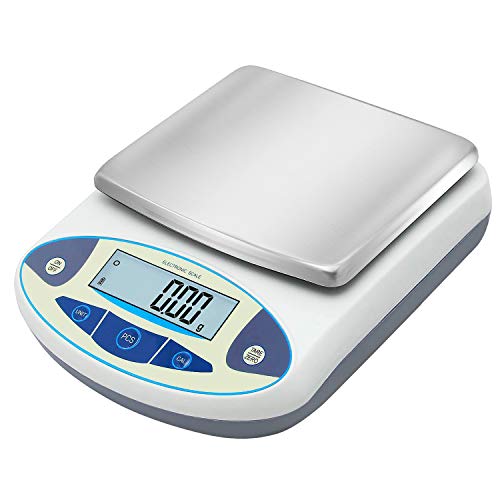
- 5000g capacity with 0.01g readability
- Large stainless steel weighing pan
- Multiple functions and 13 unit conversions
Best For: Higher-volume laboratory and business weighing
Best Portable Design
THINKSCALE 0.001g Milligram Scale

- 0.001g readability and 50g capacity
- Protective cover doubles as a wind shield
- Includes calibration weight, tray, scoop, and batteries
Best For: Portable powder and small-item weighing
High-Capacity Lab Pick
Bonvoisin 600g x 0.01g Lab Scale

- 600g capacity with 0.01g readability
- Tare, counting, and six-unit conversion functions
- AC or AA battery operation; calibration weights not included
Best For: Higher-volume powder and small-item weighing
Portable Everyday Pick
MAXUS 500g x 0.01g Pocket Scale

- 500g capacity with 0.01g readability
- Cover doubles as a clear weighing tray
- Pocket-sized design with tare and overload protection
Best For: Portable everyday powder and small-item weighing
Milligram Precision Pick
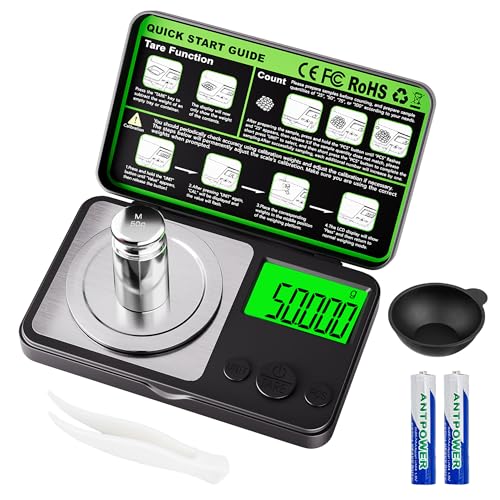
- 0.001g readability with a 50g maximum capacity
- Includes calibration weight and weighing accessories
- Backlit display, tare function, and seven units
Best For: Small-quantity powders requiring milligram-level readability
High-Capacity Powder Workhorse

- 30kg capacity with 0.1g readability
- Anti-drift sensor and leveling features
- Backlit display with AC or battery operation
Best For: Larger powder batches and general lab or workshop weighing
Compact Precision Pick
KitchenTour 500g x 0.01g Scale

- 0.01g readability up to 500g
- Tare and piece-counting functions
- Compact design with two trays
Best For: Small-batch powders, ingredients, jewelry, and beads
Portable Fine-Readout Option

- 0.01g readability in a pocket-size design
- Includes a 100g calibration weight
- Tare, six units, and backlit LCD
Best For: Portable weighing of small powder samples and lightweight items
Best Laboratory Pick – Hanchen 0.1mg Analytical Balance
For precision balances for powder weighing in laboratory, pharmacy, or chemical settings, the Hanchen combines 0.1mg readability with a 220g capacity. Its three-sided glass draftshield, temperature compensation, and stable base are designed to help reduce airflow, vibration, and temperature-related variation.
Best For: Lab and pharmacy users who need very fine readability, a draftshield, and computer connectivity.
Pros:
- 0.1mg readability with a 220g maximum capacity.
- Three-sided glass draftshield and electromagnetic load cell support repeatable readings.
- USB and RS232 connectivity, plus PC software for data handling.
- Eight weighing units and a compact 12-by-8-inch footprint.
Cons:
- Its 220g capacity is lower than that of high-capacity laboratory balances.
- The analytical design is less portable than a pocket scale.
This is the strongest fit when repeatability and documentation matter more than portability. The backlit display, spacious chamber, and one-year guarantee add practical value for routine bench work.
Best Complete Kit – UNIWEIGH 0.001g Powder Scale
The UNIWEIGH is a practical choice for precision balances for powder weighing when portability and included accessories are priorities. It reads to 0.001g across a 50g capacity and includes a tare function, calibration weight, windproof cover, and tools for handling small quantities.
Best For: Portable powder, medicine, jewelry, and small-item weighing with a ready-to-use accessory kit.
Pros:
- 0.001g increments with a 50g maximum capacity.
- Includes a 50g calibration weight, two powder pans, scoop, tweezers, brush, batteries, and USB cable.
- Windproof cover, tare function, and adjustable feet support more consistent measurements.
- Runs from two AAA batteries or USB power and offers six units.
Cons:
- Its 50g capacity limits larger weighing jobs.
- USB power is available, but the batteries are non-rechargeable.
With calibration equipment and powder-handling accessories included, this UNIWEIGH minimizes setup costs. It is best suited to small quantities and mobile use rather than high-volume laboratory work.
Best High-Capacity Option – Bonvoisin 5000g Lab Balance
For buyers who need precision balances for powder weighing across larger batches, the Bonvoisin offers a 5000g maximum capacity with 0.01g readability. Its stainless steel pan, adjustable feet, level bubble, overload alarm, and external calibration features are suited to laboratory, school, business, and jewelry applications.
Best For: Larger powder or component loads where capacity matters as much as 0.01g resolution.
Pros:
- Handles up to 5000g while reading in 0.01g increments.
- Large 180-by-140mm stainless steel weighing pan accommodates multiple items.
- Includes tare, counting, memory, fault visualization, and 13 unit conversions.
- Level bubble, adjustable feet, overload alarm, and external calibration aid setup.
Cons:
- The 5000g version does not include calibration weights.
- At approximately 2kg, it is less convenient to move than compact scales.
This model stands out when a 50g pocket scale is too limited. Confirm the calibration-weight situation before purchase, especially if you select the 5000g version, and allow sufficient bench space for its larger pan.
Best Portable Design – THINKSCALE 0.001g Milligram Scale
The THINKSCALE offers a compact approach to precision balances for powder weighing, with 0.001g readability and a 50g capacity. Its flip cover protects the pan during storage and can serve as a wind shield, while the included calibration weight and batteries make it ready to use.
Best For: Portable weighing of powders, supplements, medicine, jewelry, and other small items.
Pros:
- 0.001g readability with a 50g maximum capacity.
- Includes a 50g calibration weight, weighing tray, powder scoop, and AAA batteries.
- Flip cover protects the scale and can help shield the weighing area from drafts.
- Backlit LCD, tare function, six units, and 180-second auto-off.
Cons:
- The 50g capacity is unsuitable for larger batches.
- Its plastic construction is less bench-oriented than stainless steel laboratory balances.
This is a convenient choice for users who value compact storage and straightforward operation. The included calibration weight supports periodic checking, while the small capacity keeps it focused on light-duty, small-quantity work.
High-Capacity Lab Pick – Bonvoisin 600g x 0.01g Lab Scale
For buyers comparing precision balances for powder weighing, the Bonvoisin offers a useful combination of 600g capacity and 0.01g readability. Its tare function, multiple units, and large LCD make it practical for weighing powders and other small items, while AC or battery operation adds flexibility.
Best For: Users who need higher capacity for powders, jewelry, parts, or other small items and prefer a lab-style tabletop scale.
Pros:
- 600g capacity with 0.01g readability and fast-response strain-gauge sensing
- Tare and counting functions support container weighing and repeated small-item measurements
- Supports six units, including grams, ounces, carats, pennyweight, tola, and grains
- Can run from an AC adapter or two AA batteries
Cons:
- Calibration weights are not included
- AA batteries must be purchased separately
- Auto-off activates after 270 seconds of inactivity
This is a versatile option when capacity matters more than milligram-level resolution. Buyers should plan to source calibration weights separately if they need to verify accuracy before use.
Portable Everyday Pick – MAXUS 500g x 0.01g Pocket Scale
The MAXUS is a compact choice for precision balances for powder weighing when portability is important. It measures up to 500g in 0.01g increments, includes a clear cover that doubles as a tray, and offers tare weighing for powders and other small items.
Best For: Portable weighing of powders, tea, jewelry, coins, and other small items at home or on the go.
Pros:
- 500g capacity with 0.01g readability
- Clear protective cover doubles as a weighing tray
- Supports six units, including grams, ounces, troy ounces, pennyweight, carats, and grains
- Compact pocket-sized design includes auto-off, overload protection, and tare functionality
Cons:
- AAA batteries are required for operation
- Its 0.01g readability is less granular than a milligram scale
- Calibration requires a separate 100g calibration weight
Choose this model for convenient, general-purpose measurements rather than ultra-fine laboratory resolution. Its tray and compact body make handling loose powders and transporting the scale especially straightforward.
Milligram Precision Pick – Wigearss 50g x 0.001g Scale
For especially small powder quantities, the Wigearss provides 0.001g readability across a 50g maximum capacity. It combines a backlit display, tare function, included calibration weight, and stainless steel pan in a compact kit designed for fine powders, jewelry, herbs, and precious metals.
Best For: Users who prioritize milligram-level readability for small batches of powder, herbs, gold, gemstones, or other lightweight items.
Pros:
- 0.001g readability for fine measurements up to 50g
- Includes a 50g calibration weight, tweezers, measuring cup, and two AAA batteries
- Backlit LCD, tare function, and seven weighing units improve usability
- Stainless steel pan is durable and easy to clean
Cons:
- 50g maximum capacity limits the size of samples or containers
- Drafts, vibrations, and unstable surfaces can affect measurements
- Requires careful calibration and handling for the stated precision
This is the strongest fit of the three when resolution is the priority. Its low capacity means it is better suited to small, carefully controlled measurements than bulk powder weighing.
High-Capacity Powder Workhorse – 30kg x 0.1g Lab Scale
For precision balances for powder weighing where capacity matters, this digital lab scale combines a 30kg maximum load with 0.1g readability. Its leveling feet, bubble level, anti-drift sensor, and stainless steel pan are practical features for steadier measurements in a lab, workshop, or production setting.
Best For: High-volume powder weighing, laboratory testing, industrial inspection, jewelry work, and other applications needing a broad capacity range.
Pros:
- 30kg capacity with 0.1g readout accuracy.
- Anti-drift sensor, leveling feet, and level bubble support stable readings.
- Tare, piece counting, overload protection, fault reminders, and 13 unit options add versatility.
- Large backlit display and dual AC/battery power support flexible use.
Cons:
- 9V batteries are not included.
- The 1.8kg body and larger platform are less portable than pocket scales.
- A 0.1g resolution may be insufficient for very small powder quantities.
This is the most capable option here for larger batches and heavier containers. Choose it when capacity and stability are more important than pocket-sized portability or hundredth-gram resolution.
Compact Precision Pick – KitchenTour 500g x 0.01g Scale
For precision balances for powder weighing in small quantities, the KitchenTour EG5001 offers 0.01g readability across a 0.05g to 500g range. Its stainless steel platform, tare function, multiple units, and included trays make it useful for measured ingredients, powders, beads, and other small items.
Best For: Small-batch powder weighing, cooking ingredients, medicines, jewelry, beads, and counting identical small items.
Pros:
- 0.01g readout accuracy with a 500g maximum capacity.
- Tare and PCS functions support container compensation and piece counting.
- Seven weighing units, including grams, ounces, carats, and grains.
- Compact 4.96-by-3.94-inch design includes two protective or weighing trays.
Cons:
- The 500g capacity limits use with larger containers or batches.
- Auto-off activates after 120 seconds, which may interrupt longer weighing tasks.
- Its small platform may be less convenient for bulky powder containers.
This is a balanced choice for everyday, small-quantity measurements where fine readability and compact storage matter. It offers more capacity than a typical pocket scale while retaining 0.01g precision.
Portable Fine-Readout Option – 200g x 0.01g Pocket Scale
When portability is the priority, this pocket model is one of the more convenient precision balances for powder weighing at up to 200g. It provides 0.01g readability, a stainless steel platform, tare functionality, and a supplied 100g calibration weight for maintaining measurement accuracy.
Best For: Portable weighing of small powder samples, coins, jewelry, gemstones, beads, and other lightweight items.
Pros:
- 0.01g readout accuracy in a compact pocket format.
- Includes a 100g calibration weight and supports user calibration.
- Six unit modes, tare, blue backlit LCD, and large digits improve usability.
- Protective flip cover and 60-second auto shutoff support travel and battery conservation.
Cons:
- 200g maximum capacity is the lowest among these options.
- The instructions recommend calibrating before each weighing session.
- It is not suitable for items weighing over 200g.
This scale makes sense for users who need hundredth-gram readability in a lightweight format. Its limited capacity and calibration routine make it better for careful small samples than continuous or high-volume powder work.
How We Picked the Best Precision Balances for Powder Weighing
We compared the listed balances by resolution, maximum capacity, stated accuracy, calibration support, tare functionality, display readability, portability, and intended use. A balance showing 0.001g is not automatically more accurate than one showing 0.01g, so we also considered whether its capacity and features suit practical powder-measuring tasks.
Because these products range from compact pocket scales to larger laboratory-style units, the best choice depends on the size of each sample and how consistently you need to reproduce measurements.
Quick Comparison
- Highest resolution: 0.001g milligram scales are suited to very small samples and fine adjustments.
- Laboratory-style precision: 0.0001g analytical balances offer the finest displayed increments among the listed options.
- General-purpose accuracy: 0.01g scales balance useful precision with greater capacity and simpler operation.
- Large-capacity weighing: 0.1g models supporting several kilograms or more are better for bulk powders.
- Portable use: Pocket models are convenient, but their small platforms and sensitivity require careful setup.
Key Buying Factors for Precision Balances for Powder Weighing
Resolution, Accuracy, and Capacity
Resolution is the smallest increment shown on the display; accuracy describes how close the reading is to the true mass. Choose a capacity comfortably above your container and sample weight. Overloading a small milligram scale can damage it or produce unreliable readings.
Calibration and Repeatability
Look for included calibration weights or a calibration procedure. Calibration should be performed on a stable, level surface and repeated when the balance is moved, exposed to temperature changes, or begins producing inconsistent readings. Repeatability matters when you need the same result across multiple measurements.
Drafts, Vibration, and Weighing Technique
Fine-resolution balances are sensitive to air movement, vibration, static, temperature, and contact with the weighing pan. Use a stable bench, allow the unit to warm up when recommended, close any draft shield, and let the reading settle before recording it. Tare functionality makes container weighing faster and reduces calculation errors.
Display, Platform, and Power
A backlit LCD helps in dim work areas, while a larger platform is useful for bowls or containers. Pocket scales are easier to transport, but laboratory models are generally more comfortable for repeated measurements. Check whether the balance uses batteries, an adapter, or both.
Who Should Buy Which Precision Balances for Powder Weighing?
Choose a 0.001g milligram scale for tiny samples, careful hobby work, or applications where small changes matter. These models are compact and affordable, but usually have limited capacity.
Choose a 0.0001g analytical balance when maximum displayed precision is the priority and you can provide a stable, controlled workspace.
Choose a 0.01g balance for jewelry, coffee, kitchen ingredients, educational experiments, and everyday powder measurements where extreme milligram resolution is unnecessary.
Choose a high-capacity 0.1g model for larger containers, bulk ingredients, or workshop tasks. It offers less fine resolution but avoids the capacity limits of pocket scales.
For any regulated, medical, or safety-critical application, verify the balance’s certification, calibration documentation, and suitability for that specific task rather than relying on display resolution alone.