Finding capable test equipment on a modest budget is easier when you know which specifications matter. The best signal generators under $200 can cover audio troubleshooting, circuit development, classroom experiments, and general bench testing without the cost of advanced lab instruments.
This roundup includes DDS and function generators with different frequency ranges, waveform options, channel counts, interfaces, and power requirements. Use the guide below to match those differences to your projects.
Best 10 Signal Generators Under 200 Picks for 2026
High-Frequency Pick
FY6900 60MHz DDS Function Generator

- 60MHz frequency and 250MSa/s sampling
- Dual-channel DDS with arbitrary waveform support
- Includes several useful BNC and USB cables
Best For: Bench users needing broad waveform coverage and a higher frequency range
Audio Testing Value
ECUTEE TAG-101 Low-Frequency Generator

- 10Hz-to-1MHz operating range
- Sine and square wave outputs
- Adjustable level with six-step attenuation
Best For: Audio and amplifier testing with simple panel controls
Feature-Rich Bench Option
Koolertron 15MHz DDS Generator

- Dual-channel output with independent settings
- Includes sweeps, measurements, and white noise
- Stores instrument states and custom waveforms
Best For: Learning, lab, and project work needing advanced digital features
Versatile Modulation Pick
UNI-T UTG932E Function Generator

- Dual-channel output with six modulation types
- 1Hz-to-30MHz range and 200MSa/s sampling
- Includes frequency counter and waveform storage
Best For: Hobbyists, students, and small labs needing modulation flexibility
Best Low-Frequency Value
Adjustable 10Hz–1MHz Signal Generator
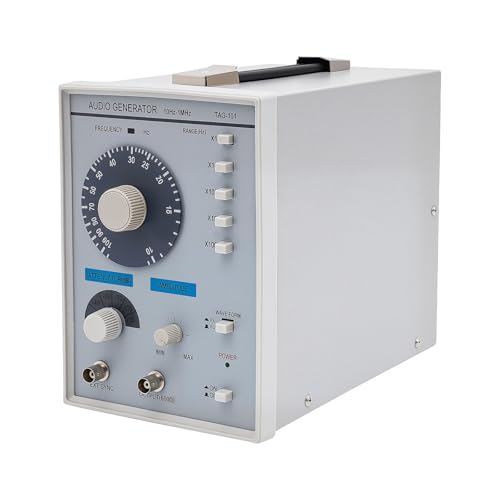
- 10 Hz–1 MHz range with five measurement ranges
- Sine and square waveform output
- 0 dB to -50 dB six-stage attenuation
Best For: Low-frequency bench testing with adjustable sine or square signals
Best Portable DDS Option
1Hz–500kHz Mini Signal Generator

- Five waveform types, including arbitrary waveforms
- 1 Hz–500 kHz frequency range
- Lightweight 7.4-ounce portable design
Best For: Portable testing and development requiring varied waveforms
Best Industrial Control Pick
4–20mA and PWM Signal Generator

- 0–24 mA current output with 4–20 mA default
- ±12 V voltage output with calibration accuracy
- 1–150 kHz PWM and 0–100% duty cycle
Best For: Testing current-loop, voltage, and PWM control signals
Compact DDS Pick
FG-200 Function Signal Generator

- Sine output from 0.01Hz to 500kHz
- Sine, square, and sawtooth waveforms
- Adjustable amplitude, DC offset, and filters
Best For: Portable circuit testing and oscilloscope calibration
Wide-Range DIY Kit
XR2206 Adjustable Signal Generator

- Adjustable from 1Hz to 1MHz
- Outputs sine, triangle, and square waves
- Includes coarse and fine frequency tuning
Best For: Hands-on electronics assembly and experimentation
Precision Assembly Kit

- 1Hz–1MHz adjustable frequency range
- Sine, square, and triangle outputs
- Specified distortion and flatness performance
Best For: Soldering projects needing documented output specifications
High-Frequency Pick – FY6900 60MHz DDS Function Generator
For shoppers comparing signal generators under 200, the FY6900 stands out for its 60MHz frequency specification, dual-channel DDS design, and broad waveform support. It also includes a frequency-meter function and a 250MSa/s sampling rate, making it a versatile option for general electronics work.
Best For: Users who want a dual-channel generator with a relatively high frequency range and multiple waveform options.
Pros:
- 60MHz frequency specification with 250MSa/s sampling
- Dual-channel DDS function and arbitrary waveform capability
- Supports sine, square, triangle, pulse, sawtooth, and staircase waves
- Includes USB, power, BNC-BNC, and BNC-clip cables
Cons:
- Uses AC power rather than a portable battery supply
- Supplied notes do not specify modulation or memory features
The FY6900 is a strong all-purpose choice when frequency range and waveform variety matter most. Its included cables add convenience for getting started, while the AC-powered design makes it better suited to a bench setup.
Audio Testing Value – ECUTEE TAG-101 Low-Frequency Generator
If your search for signal generators under 200 centers on audio and amplifier work, the ECUTEE TAG-101 offers a focused design. Its 10Hz-to-1MHz range, sine and square outputs, and adjustable output level suit tasks such as amplifier-gain measurement and basic signal injection.
Best For: Audio troubleshooting, amplifier testing, and users who prefer a straightforward panel-operated oscillator.
Pros:
- Frequency range spans 10Hz to 1MHz across five ranges
- Provides sine and square waveforms
- Six-step attenuator uses 10dB steps, alongside a level regulator
- Specified sine output exceeds 5Vrms unloaded and 2.8Vrms at 600Ω
Cons:
- Limited to sine and square waveforms according to the supplied notes
- 110V model may require attention to local power compatibility
- Does not list dual-channel or arbitrary-waveform functions
The TAG-101 prioritizes accessible controls and audio-oriented output over advanced digital features. Choose it when simple, adjustable sine-wave testing is more important than high-frequency or multi-function operation.
Feature-Rich Bench Option – Koolertron 15MHz DDS Generator
The Koolertron 15MHz DDS generator is a compelling option among signal generators under 200 for users who want dual-channel control and measurement features. It combines multiple standard waveforms with white noise, user-defined waveforms, sweep functions, and built-in frequency and pulse measurements.
Best For: Electronics learners, laboratory work, and projects requiring saved settings, waveform customization, or signal measurements.
Pros:
- Dual-channel output with independently settable parameters
- Supports sine, square, triangle, sawtooth, pulse, white noise, and user-defined waves
- Includes linear and logarithmic frequency sweep functions
- Stores up to 99 instrument-state parameter groups and 60 user-defined waveforms
Cons:
- Sine-wave output is specified up to 15MHz, below some higher-frequency alternatives
- The supplied notes do not identify a power-source type
With measurement, storage, sweep, and custom-waveform functions, the Koolertron offers unusually broad capability for a compact bench instrument. Its 15MHz ceiling is the main trade-off, so verify that it covers your intended test frequencies.
Versatile Modulation Pick – UNI-T UTG932E Function Generator
For buyers evaluating signal generators under 200, the UNI-T UTG932E offers a practical balance of dual-channel output, modulation, and arbitrary-waveform functions. Its 1Hz-to-30MHz output range, 200MSa/s sampling rate, and built-in frequency counter support a wide range of basic electronics and audio tests.
Best For: Hobbyists, students, small labs, ham-radio alignment, and pro-audio or circuit troubleshooting.
Pros:
- Dual channels can be combined and produce standard, DC, noise, and arbitrary waveforms
- Supports AM, FM, PM, FSK, line, and logarithmic modulation
- Offers 200MSa/s sampling, 14-bit vertical resolution, and 1Hz full-band resolution
- Includes a six-digit frequency counter and 24 groups of non-volatile arbitrary-waveform storage
Cons:
- 30MHz output range is lower than the 60MHz option in this roundup
- Supplied notes do not specify the maximum arbitrary-waveform length
The UTG932E is a well-rounded choice when modulation and application flexibility matter as much as basic waveform generation. Its included cables and stated customer-support access add practical value for newer users and small workspaces.
Best Low-Frequency Value – Adjustable 10Hz–1MHz Signal Generator
For shoppers comparing signal generators under 200, this adjustable low-frequency model covers 10 Hz to 1 MHz across five ranges. Its sine and square outputs, frequency attenuator, and metal-and-plastic construction make it a practical choice for basic signal testing.
Best For: Low-frequency testing that requires adjustable sine or square wave output.
Pros:
- 10 Hz–1 MHz range divided into five measurement ranges
- Produces sine and square waveforms
- Six-stage attenuation from 0 dB to -50 dB in 10 dB increments
- Metal-and-plastic housing is designed for durability and easy cleaning
Cons:
- Limited to sine and square output waveforms
- At 6.8 pounds, it is less portable than mini signal generators
- Frequency accuracy is specified as ±5% of full scale
This is a straightforward option when your work centers on low-frequency sine and square signals. The broad attenuation range adds useful control, while the larger housing favors bench use over portability.
Best Portable DDS Option – 1Hz–500kHz Mini Signal Generator
Among signal generators under 200, this compact DDS mini kit stands out for waveform variety and portability. It supports sine, square, triangle, pulse, and arbitrary waveforms, along with modulation capabilities and precise frequency control.
Best For: Portable electronics testing, development work, and users who need multiple waveform types.
Pros:
- Generates sine, square, triangle, pulse, and arbitrary waveforms
- Offers a 1 Hz–500 kHz frequency range
- Supports modulation for communication-system testing
- Compact 7.4-ounce design with intuitive controls
Cons:
- Its maximum frequency is lower than the 1 MHz model in this roundup
- Supplied notes do not specify the included power adapter or battery runtime
- Mini format may provide less physical control space than a full-size bench unit
This DDS generator is the flexible pick for users who value portability and waveform selection. It is especially useful when testing requires more than basic sine and square outputs, though its 500 kHz ceiling should be checked against your projects.
Best Industrial Control Pick – 4–20mA and PWM Signal Generator
For signal generators under 200 aimed at control and instrumentation tasks, this rechargeable unit focuses on voltage, current, and PWM outputs. It can generate adjustable 0–24 mA current, ±12 V voltage, and 1–150 kHz PWM signals, with built-in protection features.
Best For: Calibrating or testing voltage, current-loop, and PWM control signals.
Pros:
- Adjustable 0–24 mA current output with a default 4–20 mA range
- Voltage output can be set to ±12 V, with 0–10 V as the factory default
- PWM frequency adjusts from 1–150 kHz with 0–100% duty cycle
- Includes short-circuit, reverse-connection, and charging protection
Cons:
- PWM high level is fixed at 5 V and is not suitable for 12 V or 24 V systems
- Battery runtime varies from 1 to 5 hours depending on output load
- Charging generally takes more than six hours
This is the most specialized option here, built around industrial-style current loops and control outputs rather than general waveform generation. Confirm the fixed 5 V PWM level and output requirements before buying.
Compact DDS Pick – FG-200 Function Signal Generator
If you need signal generators under 200 for bench testing, the FG-200 is a compact DDS option with sine, square, and sawtooth outputs. It covers sine frequencies from 0.01Hz to 500kHz, includes adjustable amplitude and DC offset, and can save settings for repeat measurements.
Best For: Circuit testing, oscilloscope calibration, and audio amplifier frequency-response checks.
Pros:
- Offers sine, square, and sawtooth waveform modes.
- DDS design provides frequency accuracy and stability.
- Includes filter control, DC bias up to ±10V, and shutdown functionality.
- Works with a 3.7V lithium battery or a recommended 4–9V adapter supply.
Cons:
- Other waveform modes are specified at 0.01Hz–100kHz.
- Sine-wave output amplitude decreases as frequency rises.
- Requires an external power source and test equipment for complete bench use.
The FG-200 is a practical choice when portability, saved settings, and stable low-frequency output matter more than a fully enclosed laboratory instrument.
Wide-Range DIY Kit – XR2206 Adjustable Signal Generator
Among signal generators under 200, this XR2206 DIY kit stands out for its broad 1Hz–1MHz adjustment range and three waveform choices. It uses direct-insertion components, with coarse and fine frequency tuning plus adjustable amplitude for hands-on assembly and experimentation.
Best For: DIY electronics builders who want a customizable function-generator module.
Pros:
- Generates sine, triangular, and square waves.
- Provides a 1Hz–1MHz frequency range.
- Offers five-bit frequency resolution with coarse and fine adjustment.
- Supports 9–12V external power or a 9V battery.
Cons:
- As a DIY kit, it requires installation and debugging.
- The notes do not specify an included enclosure or finished instrument housing.
- It requires a suitable 9–12V supply or 9V battery.
This kit is best suited to users comfortable with electronic assembly who value a wide frequency range and adjustable controls over plug-and-play operation.
Precision Assembly Kit – Weewooday XR2206 Module
This Weewooday XR2206 module is one of the more detailed signal generators under 200 for builders who want documented output specifications. It produces sine, square, and triangle waves from 1Hz to 1MHz, but soldering tools are required before it can be used.
Best For: DIY users seeking a solder-together module with stated distortion, flatness, and rise-time specifications.
Pros:
- Provides sine, square, and triangle outputs.
- Covers a 1Hz–1MHz frequency range.
- Lists less than 1% sine-wave distortion at 1kHz.
- Includes a transparent case box shell for assembly.
Cons:
- Requires soldering tools and installation.
- Needs a 9–12V DC input.
- Amplitude is specified as 0–3V for sine and triangle output at 9V DC.
Choose this module if you prefer a documented DIY build and want useful electrical specifications, including sine-wave flatness and square-wave rise and fall times.
How We Picked the Best Signal Generators Under 200
We focused on generators that offer useful waveform output and practical controls at an affordable price. The selection spans full-size dual-channel DDS instruments, compact signal sources, low-frequency audio units, current or voltage-focused modules, and DIY kits. We considered frequency range, waveform support, frequency stability, output flexibility, display and controls, power requirements, and likely use cases.
Because specifications and included accessories can vary by seller, verify the listing before purchase. Pay particular attention to whether a product is a complete, powered instrument or an unfinished module requiring assembly and an external supply.
Quick Comparison
| Type | Best suited to | What to prioritize |
|---|---|---|
| Dual-channel DDS generator | General bench testing | Independent outputs, frequency range, modulation, display |
| Audio signal generator | Amplifiers and audio circuits | Low-frequency accuracy, clean output, level adjustment |
| Compact DDS module | Portable or embedded projects | Power input, controls, output amplitude, enclosure |
| DIY XR2206 kit | Learning and experimentation | Assembly requirements, component quality, calibration |
| 4–20 mA or 0–12 V source | Control and automation testing | Output range, resolution, isolation, terminal layout |
Key Buying Factors for Signal Generators Under $200
Frequency Range and Resolution
Choose a range that comfortably exceeds your target signal. Audio work may need only a few hertz to tens of kilohertz, while digital and switching experiments benefit from higher maximum frequencies. A broad range is useful, but frequency resolution and stability often matter more than the headline maximum.
Waveforms and Channel Count
Sine, square, and triangle outputs cover many basic tests. Arbitrary waveform capability is valuable when reproducing custom signals, while two channels help with synchronized tests, phase comparisons, and reference signals. Confirm whether both channels provide the same features and output limits.
Amplitude, Offset, and Output Compatibility
Check the available voltage range, DC offset, impedance, and connector type. A generator should match the input limits of the circuit under test. Specialized current or voltage sources are useful for automation equipment but are not substitutes for a general-purpose waveform generator.
Controls, Accuracy, and Power
A clear display and direct controls make frequent adjustments easier. Look for stated accuracy, frequency counter functions, sweep or modulation features, and memory options when relevant. Also confirm whether the unit uses mains power, USB, batteries, or a separate 9–12 V supply.
Who Should Buy Which Signal Generators Under 200?
Choose a dual-channel DDS model such as the FY6900 or Koolertron when you want a flexible bench instrument for varied electronics work. A UNI-T unit is a sensible option for buyers who prefer an established test-equipment brand and a more conventional function-generator format.
For amplifier, speaker, and audio-circuit troubleshooting, a low-frequency generator such as the ECUTEE or another 10 Hz–1 MHz model may provide the most relevant range. Compact DDS and FG-200-style modules suit experienced users who value small size and broad frequency coverage.
Choose the 4–20 mA or 0–12 V generator for control-system testing rather than general waveform experimentation. XR2206 kits are best for students, hobbyists, and DIY builders who want to learn how signal generation works and are comfortable soldering, calibrating, and supplying the module themselves.