USB duplicators can help small businesses prepare training materials, software installers, promotional media, and backup drives without copying each device manually. The right choice depends on throughput, target capacity, verification features, and whether you need a standalone unit or a computer-connected setup.
This roundup compares 10 options ranging from compact 1:2 duplicators to higher-volume multi-port systems, plus USB hubs that may suit lighter-duty workflows. Use the guide below to match port count, speed, and management features to your daily workload.
Best 10 USB Duplicators for Small Businesses Picks for 2026
Compact IT Workhorse

- Copies to two USB drives standalone
- Supports file and sector-by-sector modes
- Includes multiple erase and verification options
Best For: Small IT teams and technicians with moderate duplication needs
Batch Production Choice

- Copies one source to seven drives
- Standalone operation needs no computer
- Supports synchronous and asynchronous copying
Best For: Small businesses producing larger USB batches
Budget Expansion Tool

- Adds four USB 3.0 Type-A ports
- Supports up to 5Gbps data transfer
- Compact design suits laptop-based workflows
Best For: Computer-based copying setups that need more USB ports
Secure Professional Option
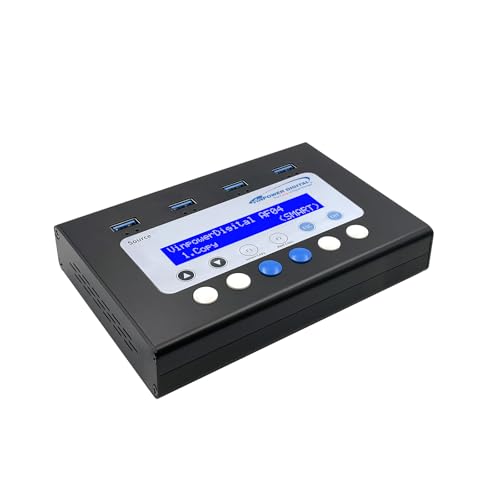
- Duplicates three drives standalone
- Offers Smart Copy and Raw Copy modes
- Includes DoD erase and Read Error Skip
Best For: Secure, recurring USB distribution and drive-reuse workflows
Best USB Port Expander

- Adds four USB ports from one connection
- Supports data speeds up to 5Gbps
- Works with major desktop operating systems
Best For: Small offices connecting several USB drives and peripherals
Best Standalone Duplicator

- Copies or erases five USB drives at once
- Works without a computer
- Includes verification and overwrite modes
Best For: IT teams producing, checking, or sanitizing USB media
Best High-Capacity Workflow

- Duplicates up to 10 drives simultaneously
- Copies from images, drives, or selected files
- Supports Windows and Mac workflows
Best For: Small businesses producing larger batches of USB drives
Best Compact 1-to-2 Choice
BestDuplicator UB300 USB Duplicator

- Duplicates one USB drive to two targets
- Supports data-only and bit-for-bit copying
- Includes testing and erase functions
Best For: Small teams with modest duplication volumes
Best Portable 1-to-4 Value
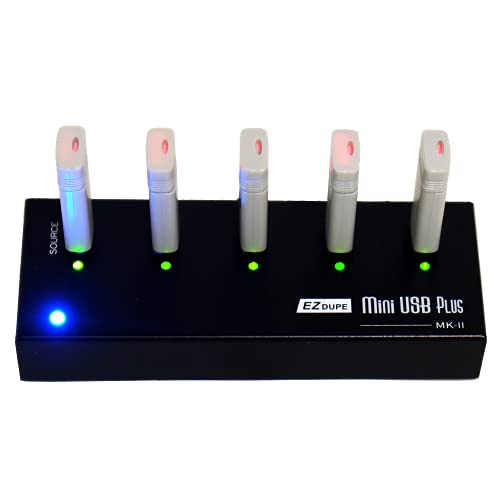
- Duplicates up to four USB drives
- Supports asynchronous copying
- USB 1.0/2.0/3.0 compatibility
Best For: Portable four-drive duplication workflows
Best Higher-Volume Pick

- Duplicates up to seven USB drives
- Supports asynchronous replacement of finished drives
- Compatible with USB 1.0, 2.0, and 3.0 media
Best For: Frequent batches requiring higher simultaneous output
Compact IT Workhorse – StarTech 1:2 USB Duplicator
For small businesses seeking USB duplicators, the StarTech USBDUP12 is a compact standalone option for copying or erasing two USB drives at a time. It supports file-based and sector-by-sector duplication, plus multiple erase modes, without requiring a computer.
Best For: Technicians and small IT teams managing boot drives, data distribution, or USB sanitization in modest batches.
Pros:
- Copies to two target drives without a computer.
- Supports file-based and whole-drive sector-by-sector copying.
- Offers quick erase, single-pass, and three-pass overwrite modes.
- LCD menu, error scanning, and Copy & Compare help monitor results.
Cons:
- Its two-target capacity is limited for larger production runs.
- Asynchronous copying is limited to source content under 64 MB.
- Some external USB devices may require their own power source.
The StarTech is a practical choice when flexibility and data-wipe options matter more than maximum throughput. Its compact design and verification features suit routine office and technician workflows.
Batch Production Choice – Systor 1:7 USB Duplicator
The Systor SYS-USBD-7 is built for small businesses that need USB duplicators with more target capacity. Its standalone design copies one source to up to seven USB drives at speeds up to 2GB per minute, with synchronous and asynchronous modes.
Best For: Offices, service providers, and teams distributing the same USB content in larger batches.
Pros:
- Duplicates one source to up to seven USB drives.
- Requires no computer or software.
- Supports bit-by-bit copying for direct duplication.
- Copy speed remains consistent as the number of loaded drives increases.
Cons:
- The desktop unit weighs about 10 pounds, making it less portable.
- Its listed USB interface is USB 1.1.
- It offers fewer explicitly described erase controls than some competing models.
Choose the Systor when batch size is the priority. Seven target ports can reduce repeated copy cycles, making it a better fit than compact two- or three-port units for routine distribution work.
Budget Expansion Tool – BENFEI 4-Port USB 3.0 Hub
The BENFEI hub is not a standalone duplicator, but it can help small businesses using USB duplicators or computers that lack available ports. It adds four USB 3.0 Type-A connections for flash drives and peripherals in a compact, portable design.
Best For: Laptop-based workflows that need extra USB ports for drives, keyboards, printers, or other peripherals.
Pros:
- Adds four USB 3.0 ports to a compatible laptop or desktop.
- Supports data transfer rates up to 5Gbps.
- Works with USB 2.0 and USB 1.1 devices.
- Compact aluminum housing and braided cable suit mobile use.
Cons:
- It is a port expander, not a standalone USB duplicator or cloner.
- It requires a computer-based workflow.
- It does not provide dedicated duplication, verification, or erase modes.
This is best treated as an accessory rather than a replacement for purpose-built USB duplicators. It makes sense when your existing computer setup needs more ports and you are comfortable managing copies through software.
Secure Professional Option – Vinpower 1:3 USB Duplicator
The Vinpower 1:3 USB duplicator is a standalone solution for small businesses that need both reliable copying and secure drive reuse. It offers Smart Copy for accessible files, Raw Copy for bit-by-bit duplication, DoD 5220.22-M erasing, and Read Error Skip for damaged media.
Best For: Businesses distributing bootable drives, software, training materials, or sensitive data in recurring small batches.
Pros:
- Copies to three USB drives without a PC.
- Smart Copy and Raw Copy support different duplication needs.
- DoD 5220.22-M erase mode helps prepare drives for reuse or disposal.
- Read Error Skip can bypass damaged sectors during duplication.
Cons:
- Its three-target capacity is smaller than seven-port batch units.
- The supplied notes do not specify a transfer speed.
- It is designed for USB duplication rather than general-purpose computer connectivity.
Vinpower stands out when secure erasure and difficult source media are part of the workflow. Its three-port capacity is suitable for recurring departmental or client jobs without requiring a dedicated computer.
Best USB Port Expander – 4-Port USB 3.0 Hub
For small businesses looking at USB duplicators for small businesses, this compact hub is better viewed as a connectivity aid than a true duplicator. It expands one computer USB port into four, making it useful for connecting several flash drives and peripherals at once, with data-transfer speeds up to 5Gbps over USB 3.0.
Best For: Small offices that need extra USB ports for flash drives, printers, keyboards, card readers, or other peripherals.
Pros:
- Expands one USB port to four ports.
- Supports USB 3.0 transfer speeds up to 5Gbps.
- Plug-and-play compatibility with Windows, Mac, Linux, and Chrome OS.
Cons:
- It is not a standalone duplicator and requires a computer.
- Maximum output current is 900mA, so it is not recommended for charging and may not power some higher-current hard drives.
This is a practical, low-cost way to connect multiple USB drives during occasional file transfers, but businesses needing simultaneous drive cloning should choose a dedicated duplicator instead.
Best Standalone Duplicator – StarTech 1:5 USB Duplicator
For businesses that regularly prepare or sanitize flash drives, the StarTech 1:5 is a dedicated option among USB duplicators for small businesses. It can copy or erase up to five USB drives without a computer and includes verification, error scanning, and multiple erase modes for more controlled workflows.
Best For: IT technicians and small-business teams creating boot drives, distributing data, or erasing USB media in batches.
Pros:
- Duplicates or erases up to five USB drives without a computer.
- Supports system/file copying, sector-by-sector copying, quick erase, and single- or three-pass overwrite modes.
- Copy-and-compare verification, LCD controls, and error or bad-sector scanning support quality checks.
Cons:
- External USB storage devices may require their own power source.
- Asynchronous copying is limited to source content under 64MB.
Its standalone operation and broad duplication and erasure modes make it the strongest fit here for repeatable media-management tasks, especially where verification and sanitization matter.
Best High-Capacity Workflow – DupliM 1:10 USB Duplicator
For teams that need higher-volume production, the DupliM 1:10 is a computer-connected choice among USB duplicators for small businesses. Its DupliM software can duplicate up to 10 USB 3.0 or 2.0 drives simultaneously from image files, flash drives, or selected files and folders.
Best For: Small businesses that need to create larger batches of USB flash drives from a computer running Windows or Mac OS.
Pros:
- Duplicates up to 10 USB drives simultaneously.
- Can copy from image files, flash drives, or selected hard-drive files and folders.
- Includes software, power adapter, USB 3.0 cable, and U.S.-based technical support.
Cons:
- Requires a connected Windows or Mac computer and the DupliM software suite.
- Compatibility depends on the listed system requirements, including a 1.8GHz dual-core processor and 2GB RAM.
This model offers the highest stated simultaneous drive capacity in the group, making it attractive for batch preparation, though its computer-dependent workflow may be less convenient than a standalone unit.
Best Compact 1-to-2 Choice – BestDuplicator UB300 USB Duplicator
For small businesses that need a straightforward way to prepare two USB drives at once, the BestDuplicator UB300 is a practical pick among USB duplicators for small businesses. Its standalone design performs either data-only copying or bit-for-bit whole-media cloning without requiring a computer.
Best For: Small IT teams, schools, technicians, and field deployments that usually need up to two duplicate USB drives at a time.
Pros:
- Copies one source drive to two target drives simultaneously without a computer.
- Offers Quick Copy and Whole Media Copy modes for flexible duplication.
- Includes capacity, device-information, read/write-speed, and erase functions.
- Compact LCD-and-button interface is easy to use in portable work areas.
Cons:
- Limited to two target drives per duplication cycle.
- Designed primarily for USB 1.1 and USB 2.0 media.
- Memory-card duplication requires a compatible USB card reader sold separately.
The UB300 is a sensible choice when portability, simple controls, and media-checking tools matter more than high-volume output. Its two-port capacity keeps it best suited to modest, recurring duplication tasks.
Best Portable 1-to-4 Value – EZ Dupe Mini USB Plus MK II
The EZ Dupe Mini USB Plus MK II is a useful middle ground for small businesses comparing USB duplicators for small businesses. It works without a computer, supports up to four target USB devices, and provides asynchronous copying so completed drives do not have to wait for an entire batch.
Best For: Small offices, trainers, software distributors, and technicians that need portable four-drive duplication with USB 1.0, 2.0, or 3.0 media.
Pros:
- Copies to up to four USB flash drives simultaneously.
- Supports asynchronous copying for more flexible workflows.
- Rated for copy speeds up to 2.5GB per minute or 45MB per second, depending on media.
- Can use a power bank or USB power source for added portability.
Cons:
- External USB storage devices require their own power source.
- Actual speed depends on the connected drives’ read/write performance.
- It offers less output capacity than seven-target models.
With four target ports and asynchronous operation, the MK II balances portability and throughput well. It is a strong fit for businesses that have regular batches but do not need the capacity of a larger duplicator.
Best Higher-Volume Pick – EZ Dupe Mini USB Plus MK III
Businesses that distribute software, training materials, or prepared media in larger batches may prefer the EZ Dupe Mini USB Plus MK III. Among USB duplicators for small businesses, its seven target ports provide the highest simultaneous output in this group, while standalone operation keeps the process independent of a computer.
Best For: Small businesses with frequent multi-drive batches, including IT departments, distributors, and technicians.
Pros:
- Duplicates up to seven USB flash drives simultaneously.
- Supports asynchronous copying so finished drives can be replaced during operation.
- Works with USB 1.0, 2.0, and 3.0 flash media and compatible external USB storage.
- Offers listed speeds up to 2.5GB per minute or 45MB per second, depending on the media.
Cons:
- External USB hard drives require their own power source.
- Actual duplication speed depends on the connected drives.
- Seven-port capacity may be more than needed for occasional two- or four-drive jobs.
The MK III is the most efficient choice here for recurring, higher-volume USB preparation. Its seven-port layout can reduce batch cycles, making it worthwhile when a small business regularly duplicates several drives at once.
How We Picked These USB Duplicators for Small Businesses
We focused on the features that matter most in small-business workflows: the number of target drives supported at once, stated copy speed, standalone operation, drive-erasing or sanitizing functions, portability, and compatibility with common USB flash media. The selection includes dedicated duplicators from StarTech, Systor, Vinpower, DupliM, BestDuplicator, and EZ Dupe, along with compact USB hubs that may work for occasional, computer-managed copying.
Port counts are based on the product descriptions provided and should be confirmed against the manufacturer’s current specifications. Actual performance can vary with source media, target-drive speed, file size, and data volume.
Quick Comparison
- For occasional copying: A 1:2 standalone duplicator or a compact computer-connected unit keeps cost and footprint low.
- For regular production: Five- to seven-target systems reduce labor when preparing multiple drives simultaneously.
- For higher-volume batches: A 1:10 model can be more efficient if your business routinely produces large quantities of identical media.
- For basic expansion only: A four-port USB hub adds connections but is not automatically a true asynchronous duplicator or data-verification system.
Key Buying Factors for USB Duplicators for Small Businesses
Target Count and Throughput
Choose the number of target ports according to your normal batch size, not your occasional peak. A higher port count can reduce hands-on time, but only if your source and target drives can sustain the workload. Advertised speeds such as 1.5GB/min or 2GB/min are useful benchmarks, not guarantees for every file set.
Standalone Operation
Standalone duplicators can copy media without tying up a workstation, which is valuable for offices, retailers, event teams, and field operations. Computer-connected models may be preferable when you need to manage files directly, use existing software, or keep initial costs low.
Verification, Erasing, and Compatibility
Look for copy verification if failed drives would create rework or customer-service problems. Sanitizing and erase modes are important when reusing returned or test media. Also check supported USB versions, maximum drive capacities, file-system compatibility, and whether the unit requires identical target drives.
Size, Controls, and Support
LCD controls and straightforward status indicators can reduce training time. Compact models suit limited workspaces, while larger systems may be easier to operate in a fixed production area. Before buying, confirm warranty coverage, replacement support, and the availability of compatible power supplies or cables.
Who Should Buy Which USB Duplicators for Small Businesses?
Choose a compact 1:2 or 1:3 duplicator if you prepare small batches, need occasional backups, or value portability. Choose a 1:5 or 1:7 system for recurring office, education, retail, or deployment work where several drives must be ready at once. Choose a 1:10 model when media production is frequent enough to justify maximum batch efficiency.
If you only need extra USB ports and will manage copying from a computer, a powered or compact USB hub may be adequate. For repeatable, unattended, or customer-facing production, a dedicated standalone duplicator is generally the safer choice because it is designed specifically for cloning, erasing, and batch handling.